

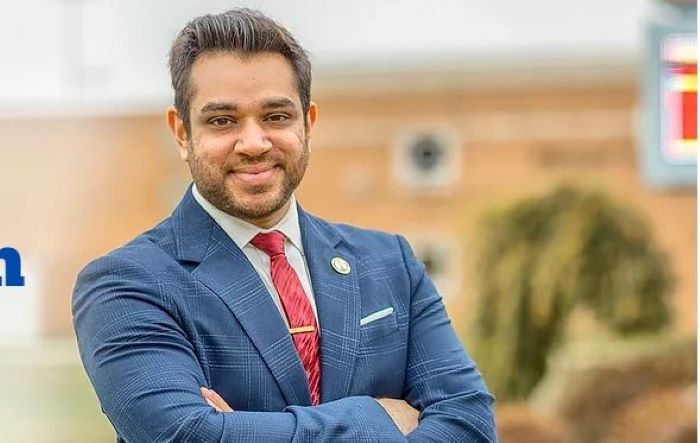
In 2025, Sam Joshi consolidated his place as one of the most successful Indian American mayors in the United States, blending grassroots governance with global ambition and emerging as a model of civic leadership for the community.
When Edison, New Jersey went to the polls on November 4, 2025, the result was decisive. Sam Joshi did not merely win re-election—he dominated it. Securing roughly 71.5 percent of the vote against independent challenger Dave Tingle, Joshi earned a second four-year term as mayor with a mandate that reflected both popularity and performance. In a township often described as the epicenter of Indian American life in the U.S., the victory carried symbolic weight far beyond municipal boundaries.
Joshi’s triumph was not an isolated personal success. His entire Democratic slate—Kelli Dima, Robert Kentos, and Biral Patel—won their council races, delivering a clean sweep that ensured policy continuity and administrative stability. Earlier in June, Joshi had already demonstrated his political strength by winning the Democratic primary with 68 percent of the vote, comfortably defeating two challengers. Together, these results confirmed his control over Edison’s political landscape and underscored the trust he had built with a diverse electorate.
At the heart of Joshi’s appeal in 2025 was governance that delivered visible results. Infrastructure emerged as the signature achievement of his first term and a key argument for his second. Under his administration, Edison completed the repaving of more than 50 miles of roads—the highest total in any three-year period in the township’s history. For residents, this was not abstract policy but tangible improvement, reinforcing Joshi’s reputation as a mayor focused on basics that matter.
Public spaces also saw a transformation. By the end of 2025, all 32 municipal parks had been upgraded, the town’s first-ever Splash Park had opened, and two new community gardens were added. These projects reflected Joshi’s emphasis on quality of life and community cohesion in one of New Jersey’s fastest-growing suburbs.
His attention to seniors proved equally consequential. The expansion of Edison’s “Mr. Fix-It” program resulted in more than 3,000 free home repairs for elderly residents, while free transportation services helped seniors remain mobile and independent. In a township with a rapidly aging population, these initiatives strengthened Joshi’s image as a mayor attentive to vulnerable communities.
Public safety formed another pillar of his leadership. In 2025, the Edison Police Department reached 199 officers—its largest force in 18 years. Two new police substations, at Oak Tree Road and Menlo Mall, extended law enforcement presence across key commercial and residential zones. The moves were framed not as punitive policing but as proactive community protection in a growing township.
Joshi also demonstrated an ability to tackle long-standing structural issues. By facilitating the entry of Comcast/Xfinity, his administration broke a decades-old internet monopoly, introducing competition and choice for residents and businesses alike. The move signaled a willingness to confront entrenched interests in favor of consumer benefit.
Beyond Edison’s borders, 2025 saw Joshi expand his profile as an economic diplomat. In September, he joined New Jersey Governor Phil Murphy on an official economic mission to India. During the trip, Joshi engaged with more than 250 executives from multi-billion-dollar companies across AI, biopharma, and deep tech sectors, pitching Edison as a destination for investment and job creation. The effort reflected his belief that local governance in a globalized economy must think internationally while delivering locally.
That blend of local credibility and global outlook has made Joshi a role model within the Indian American community. Unlike national figures whose power flows from Washington, Joshi’s influence is rooted in municipal governance—proof that real authority and impact can be built city by city. In Edison, where Indian Americans form a significant political and cultural force, his leadership represents a maturation of diaspora politics from symbolic representation to administrative competence.
In December 2025, the Township Council approved a 32 percent raise in the mayor’s salary, increasing it to $198,000 effective January 2026. While the move sparked debate, it also reflected the expanded scope and intensity of the office under Joshi’s tenure. Looking ahead, he outlined ambitious second-term priorities, including a new high school on Kilmer Road to address overcrowding and a redevelopment of Edison’s riverfront featuring a marina.
In 2025, Sam Joshi’s story became about more than re-election. It was about how Indian American leadership at the local level can combine electoral strength, administrative delivery, and international engagement. In doing so, he has helped redefine what political success looks like for a community increasingly confident of its place in American public life.