

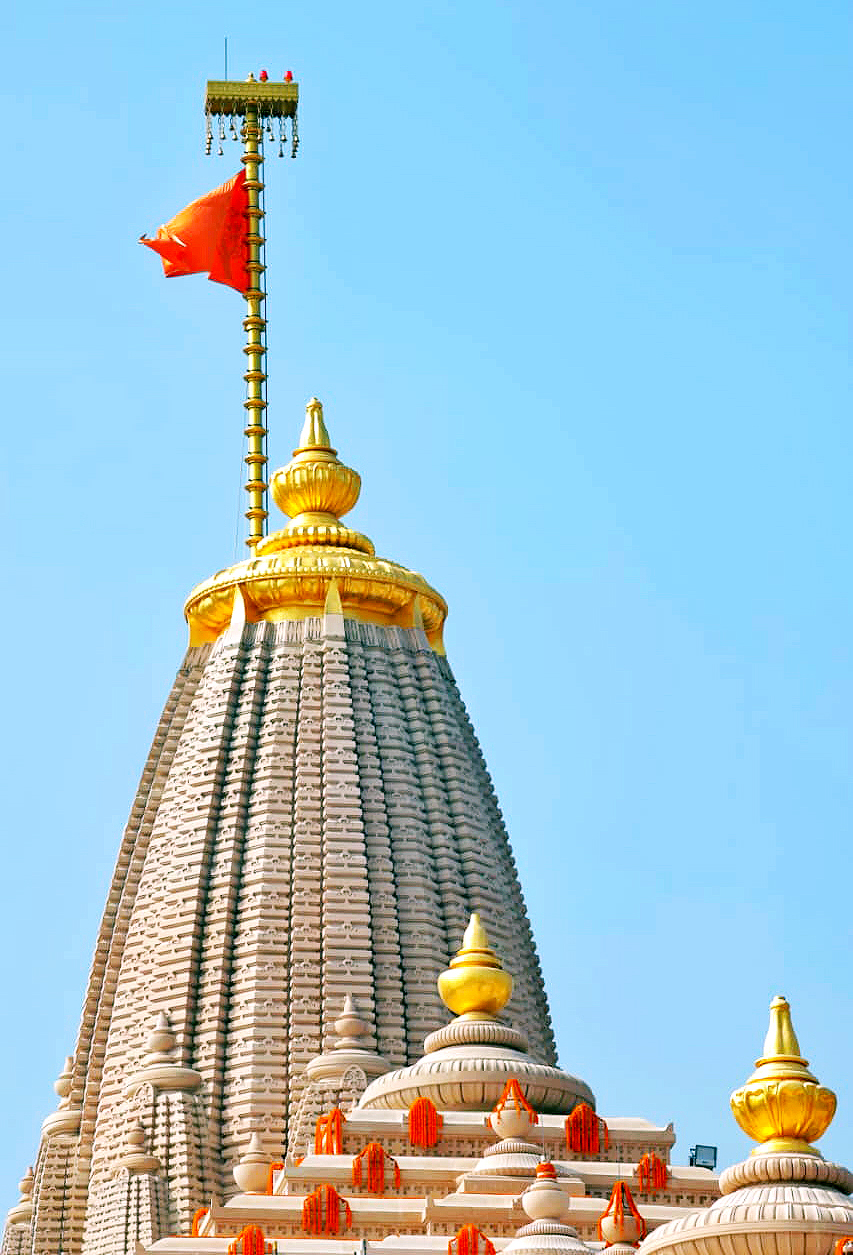
When the saffron flag rose above the shikhar of the Ram Janmabhoomi Temple in Ayodhya, it was framed as a religious ritual. In reality, it was also a political milestone and a civilizational statement
Our Bureau
Ayodhya / New Delhi / Lucknow
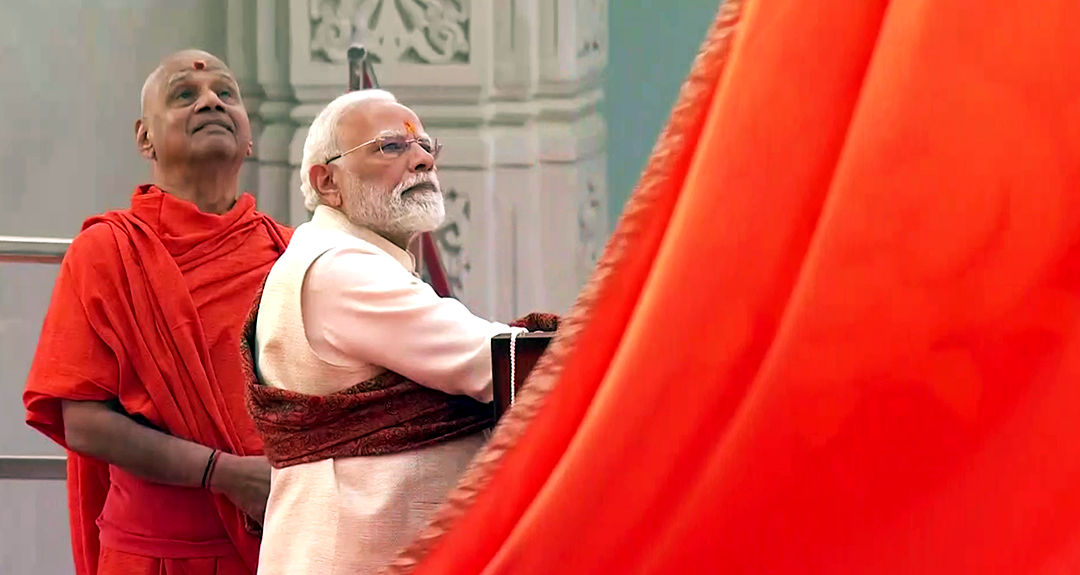
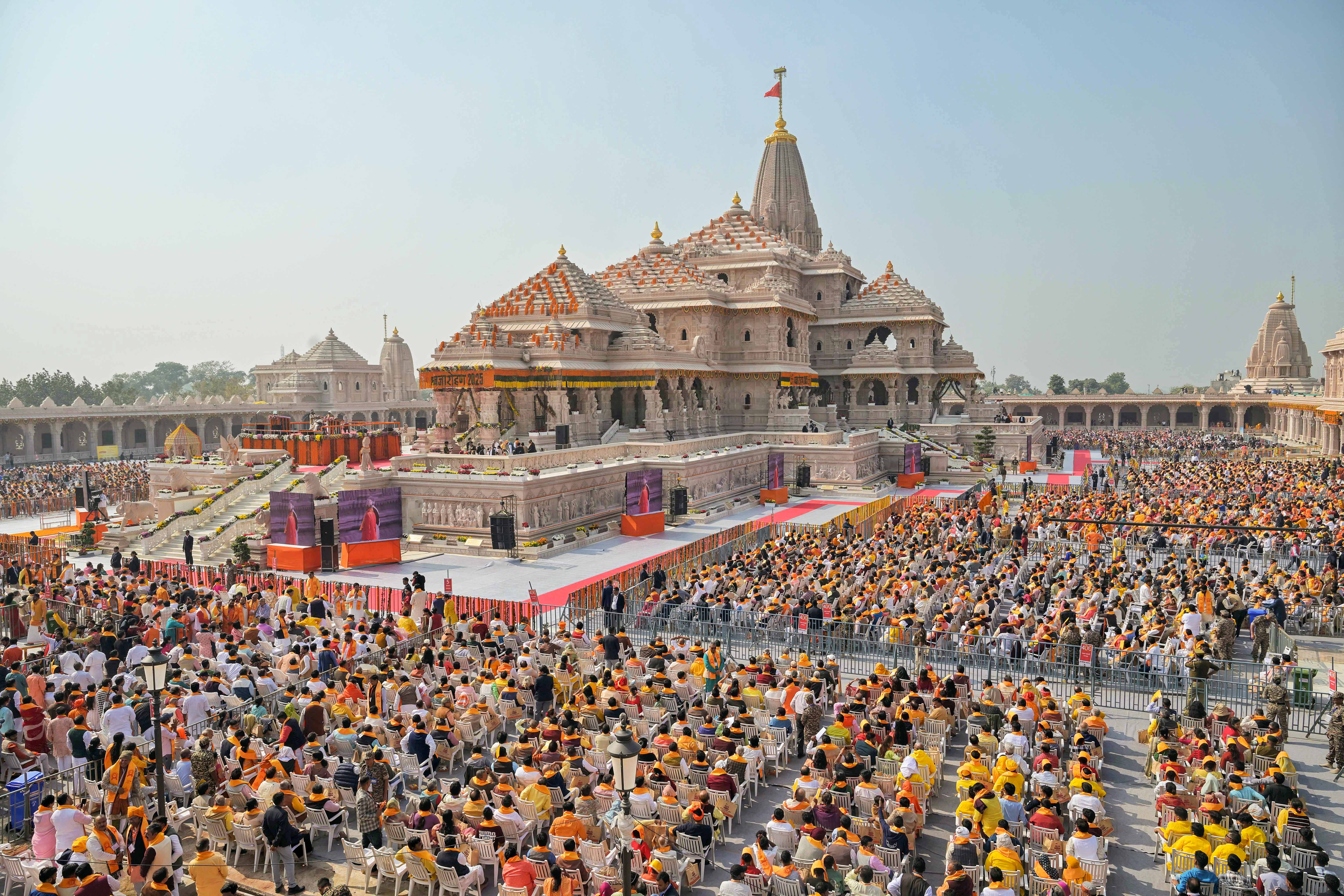
On Wednesday, a clear November day in Ayodhya, Prime Minister Narendra Modi stood before the towering 191-foot shikhar of the newly built Ram Janmabhoomi Temple and pulled at the rope that would unfurl the saffron Dharma Dhwaj. As the triangular flag—with Om, the Sun of the Suryavansh lineage, and the sacred Kovidar tree—caught the wind, a cheer rose from the courtyard below. For the government, this was not just a ceremonial end to construction. It was the visual full stop to a half-millennium saga.
Modi later called the moment “extremely moving,” saying it marked “a new chapter in our cultural pride and national unity.” In his telling, this was the culmination of a yajna whose fire had burned for 500 years, never flickering, never losing faith. The flag, he said, was not merely cloth on a pole, but “the flag of the renaissance of Indian civilization,” a living emblem of struggle, sacrifice and eventual victory.
Around him stood Uttar Pradesh Governor Anandiben Patel, Chief Minister Yogi Adityanath, RSS chief Mohan Bhagwat, and a cross-section of the Sangh Parivar that had carried the Ram Janmabhoomi agitation through agitations, courtrooms and campaigns. For them, Ayodhya was no longer just a disputed site. It was now a completed project: a temple consecrated, a narrative settled, and a flag raised where, for decades, there had only been slogans and promises.
As Modi spoke, his language moved quickly from the intimate to the epic. He spoke of his own “overwhelming emotion” on having darshan of the Ram family—Lord Ram, Mata Janaki, Lakshman—and then widened the frame to say that this was the fruition of “the penance of countless Ram devotees.” He described the Dharma Dhwaj as resolve, as success, as “the saga of creation through struggle,” and promised that for “centuries and millennia to come,” it would proclaim Ram’s ideals to the world.
Ayodhya, he reminded the crowd, had always been more than a dot on the map. It was the land where “ideals transform into conduct,” where Ram left as Yuvaraj and returned as Maryada Purushottam. In that journey—from sheltered prince to exiled wanderer to dharmic king—Modi located a template for the country he wants to build: one formed not just by economic ambition, but by a consciously embraced civilizational ethic.
Rediscovering a Civilizational Self
The speech that followed the flag-hoisting was not a typical event address. It was closer to an ideological charter.
Modi presented Ram not as a deity confined to temple premises, but as the distilled value system of a nation—“not merely a person but a value, a discipline, and a direction.” Ram, he said, was the confluence of truth and valor, the embodiment of dharma, a ruler who put the happiness of his people above his own, a symbol of patience, forgiveness, knowledge and humility. If India was to become a developed country by 2047, he argued, then “Ram must be awakened within each of us.”
The Prime Minister stitched together mythology, governance and development into a single narrative. Ram Rajya, in his framing, was not a nostalgic fantasy. It was a workable model where good governance, justice, social equality and moral discipline could underpin economic growth. A developed India—or Viksit Bharat—would not be built on GDP figures alone, but on a deep cultural self-confidence that drew power from its roots instead of borrowing its legitimacy from foreign models.
That argument led him directly to the question of “mental slavery.” He went back to 1835, to Thomas Macaulay and the colonial-era education system that, he said, sowed the seeds of uprooting India from its cultural foundations.
Ayodhya, for him, was now the antidote to that mindset. The Kovidar tree engraved on the Dharma Dhwaj—a hybrid of Mandar and Parijat created by Rishi Kashyap—became a metaphor. When a civilization is cut off from its roots, its glory is buried in the pages of history; when those roots are restored, identity is reborn. The next ten years, he urged, must be dedicated to freeing India from the mentality of slavery, so that by 2035—two centuries after Macaulay’s project—India would stand culturally decolonized.
To give that vision political and social flesh, Modi pointed back to his government’s record. In the last 11 years, he said, every marginalized section—women, Dalits, backward classes, tribals, the deprived, farmers, workers, youth—had been placed at the center of development.
Critics & Counter-Narratives
The symbolism of the Dharma Dhwaj did not remain confined to Ayodhya. It quickly travelled across borders and into domestic political trenches.
In Islamabad, Pakistan’s Ministry of Foreign Affairs condemned the flag-hoisting, accusing India of discriminatory practices against minorities and alleging that historic mosques were under threat of desecration and demolition. It urged New Delhi to “uphold its responsibilities” towards Muslims and to protect their places of worship under international human rights norms.
The reaction in New Delhi was swift and scathing. Ministry of External Affairs spokesperson Randhir Jaiswal dismissed the comments “with the contempt they deserve,” calling Pakistan a country with a “deeply stained record of bigotry, repression and systemic mistreatment of its minorities.” A state, he said, with such an “abysmal human rights record” had “no moral standing to lecture others” and should “turn its gaze inwards” instead of delivering “hypocritical homilies.”
At home, the political debate around Ayodhya continued in familiar, if sharper, tones. In West Bengal, TMC MLA Humayun Kabir triggered controversy by announcing that he would lay the foundation stone of a “Babri Masjid” in Beldanga on December 6. The BJP national spokesperson Shehzad Poonawalla framed Kabir’s remarks as “appeasement politics” aimed at a vote bank, while Congress leader Udit Raj tried to shift the argument to religious freedom, saying that if the foundation of a temple could be laid, there should be no objection to laying the foundation of a mosque.
Yet the political center of gravity had visibly shifted. Few mainstream parties, even those critical of the BJP, were willing to directly attack the flag-hoisting itself.
The Road to 2047
As the flag over Ayodhya flapped against the November sky, Modi was already looking beyond the immediate spectacle. The Dharma Dhwaj, he said, would forever proclaim that “truth is Dharma,” that there should be “no discrimination or pain,” and that a truly dharmic society would be one where “there is no poverty, and no one is helpless.” The vision, at least in words, linked cultural pride with social justice and spiritual symbolism with material change.
In his speech, he invoked the image of Ram’s chariot in the war against Ravan: its wheels as valor and patience, its flag as truth and good conduct, its horses as strength, wisdom, discipline and benevolence, and its reins as forgiveness, compassion and equality. That chariot, he suggested, was the metaphor for India’s journey to becoming a developed nation. The challenge was not just to build highways and ports, but to ensure that power did not turn arrogant, that success did not corrode humility, and that growth did not deepen divisions.
For Modi and the BJP, the message is clear: the road to 2047 runs not only through industrial corridors and digital highways, but through temple courtyards, Ramayana parks and spiritual congregations. The hoisting of the Dharma Dhwaj in Ayodhya is a landmark in that project—a visual anchor for a larger ideological shift in which India is invited to see itself not merely as a post-colonial state, but as an ancient civilization resuming its interrupted story.
But for now, in the narrative being written from Ayodhya’s newly paved streets and gleaming temple stones, the saffron standard atop the shikhar is being projected as a symbol of confidence, not confrontation; of wounds healed, not reopened; of a civilizational memory returned to the center of national life.