A new push on technology, manufacturing, and investment is redefining India–Israel economic ties as the two nations begin formal negotiations for a long-pending Free Trade Agreement
Our Bureau
Tel Aviv
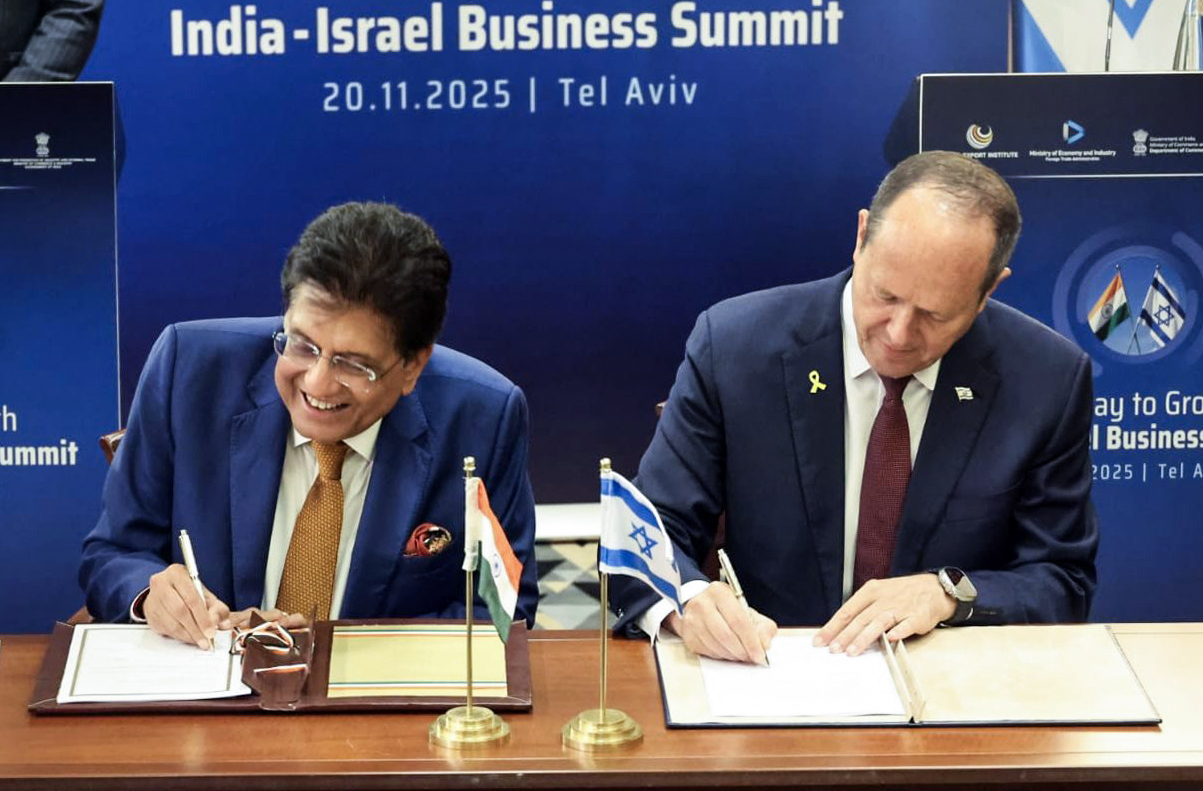
India and Israel have opened a fresh chapter in their economic relationship, coupling Israel’s innovation ecosystem with India’s expanding manufacturing and industrial base in a way that leaders on both sides describe as mutually transformative. The renewed momentum came as Union Commerce and Industry Minister Piyush Goyal and Israel’s Minister of Economy and Industry Nir Barkat met in Tel Aviv on Thursday, signing the Terms of Reference for negotiations on a long-delayed India–Israel Free Trade Agreement (FTA).
Calling the partnership a “win-win” for both nations, Barkat was emphatic about the strategic complementarity driving this engagement. “Israel’s innovation and India’s scale make for a great combination. India is scaling so rapidly, we are amazed. ‘Make in India’ is one of the smartest concepts and is relevant for many Israeli companies,” he said. His comments reflect growing confidence within Israel’s industry that India’s manufacturing push and market potential can anchor a deeper long-term partnership.
For India, the FTA negotiation comes at a time when New Delhi is fast-tracking multiple trade pacts to integrate more deeply into global supply chains. With Israel, the focus is squarely on high-value sectors: advanced manufacturing, homeland security, defense technologies, water management, precision agriculture, and frontier technologies like AI, semiconductors and cyber-security — areas where Israel is a global leader.
Goyal, speaking at the India–Israel Business Summit in Tel Aviv, stressed these complementarities and pointed to India’s new economic trajectory. “India and Israel share similar thinking. We are grateful for this friendship. India continues to rise amidst challenges,” he said, presenting what he called the “10 Ds” that define India’s growth story — from Demography and Demand to Digitalization and Decisiveness. According to Goyal, these fundamentals make India “a compelling investment destination” and create “huge opportunities on both sides.”
The Business Summit — themed Gateway to Growth — drew a sizeable Indian business delegation, a turnout that Goyal said illustrated the scale of opportunity. Inviting Israeli start-ups and tech companies to deepen their presence in India, he emphasized the government’s push for co-creation models: “I spoke about the complementarities between India’s industrial ecosystem and Israel’s innovation ecosystem and invited Israeli companies and start-ups to co-develop, co-design, and co-produce in India.”
A potential FTA, officials say, aims to reduce tariff barriers, improve market access, simplify regulatory processes and encourage technology transfer. While earlier rounds of negotiations had stalled, the new Terms of Reference suggest both sides are now treating the agreement as a strategic priority rather than a routine trade negotiation.
Economic engagement between the two countries has steadily expanded in recent years, though it remains below potential. Bilateral trade stands at roughly USD 10 billion, dominated by diamonds, pharmaceuticals, chemicals, defense components and emerging tech. A trade pact could diversify this portfolio significantly, especially in electronics manufacturing, food processing, medical devices, renewable energy and agricultural technologies — all critical to India’s next phase of industrial development.
Beyond trade, geopolitical alignment is also shaping the economic agenda. Both governments see value in diversifying supply chains, reducing dependency on single-source suppliers, and building trusted technology partnerships. As the global economy becomes more fragmented, mid-sized powers like India and Israel are increasingly looking to each other to hedge risk and expand their reach.
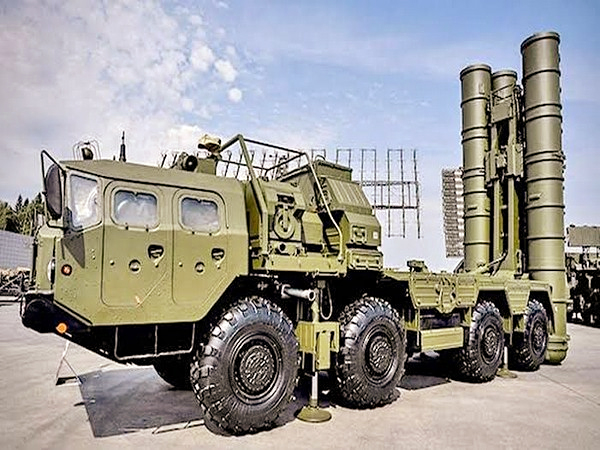
Israel’s leadership has repeatedly underlined the importance of engaging India on everything from water desalination to digital governance. India, in turn, sees Israeli technologies as crucial to meeting its climate, agricultural and security challenges. The defense relationship — once the centerpiece of bilateral ties — is now evolving into a broader industrial partnership, with growing interest in co-production and joint R&D.
If the FTA progresses as planned, it could become one of India’s most innovation-focused trade agreements. For now, Israel’s enthusiasm for India’s scale and India’s appetite for Israeli technology signal a renewed economic partnership — one driven not by sentiment but by strategy, competitiveness, and the logic of a rapidly changing global economy.