Our Bureau
New York, NY
Gracie Mansion shimmered with lamps, colors, and community spirit on October 17 as New York City Mayor Eric Adams hosted a grand Diwali celebration, honoring the Indian and South Asian communities whose cultural and economic contributions continue to enrich the city’s dynamic fabric.
Welcoming diplomats, community leaders, and artists, Adams called Diwali “a festival that reminds us there’s far too much darkness in the world and not enough light.” The event, organized by the Mayor’s Office of International Affairs and led by Deputy Commissioner Dilip Chauhan, transformed the historic mayoral residence into a vibrant space of faith, fellowship, and gratitude.
“Diwali is a time for reflection, renewal and unity — a triumph of light over darkness, good over evil, and knowledge over ignorance,” said Chauhan, who opened the evening by describing Gracie Mansion as “the people’s house, the mayor’s house.” He hailed the collective effort that led to the recognition of Diwali as an official New York City public school holiday, calling it “a historic first made possible by years of advocacy.”

Representing India, Deputy Consul General Vishal Jayeshbhai Harsh conveyed festive greetings and highlighted the festival’s timeless message of hope and harmony. “Even a single lamp can dispel great darkness,” he said. “The declaration of Diwali as a school holiday reflects inclusion, respect, and the recognition of our shared values.”
Taking the stage to loud applause, Mayor Adams—introduced warmly as the “Hindu mayor of New York”—spoke with emotion about Diwali’s universal symbolism.
“The symbolism of turning Diwali into a school holiday is so significant,” he said. “It acknowledges the festival of light and reminds us that there is far too much darkness in our city, our country, and our world. Diwali gives us an opportunity to ask: how do we celebrate each other? How do we lift each other up—in the spirit of Gandhi?”

He recalled his visit to India and the moving experience of standing at Mahatma Gandhi’s final steps. “I remember looking at the pavement and seeing his last footprints before the assassin took his life,” Adams said. “We may have lost Gandhi physically, but the emotional and spiritual journey he inspired must continue—not only in India but here in America, and especially in New York City.”
Adams praised the Indian community’s contributions across fields—from medicine and technology to civic service—and pointed to milestones under his administration, including the appointment of the city’s first Indian-American Deputy Mayor and Dr. Ashwin Vasan as Health Commissioner.
“From our hospitals to our classrooms to our startups, you are shaping the city’s future,” he said. “As long as we work together, we will lift this beautiful city to the level it deserves.”
The evening also featured messages from diplomats representing multicultural traditions of the festival.
Niel Parsan, Ambassador of Trinidad and Tobago, described Diwali as “the flame of faith, family, and nationhood — the undeniable triumph of good over evil, unity over division, and courage over fear.” In his country, he noted, Diwali is “a national expression of harmony” where “each one of us can light a lamp in another’s life through our kindness and service.”

Malaysia’s Consul General Norala Jal spoke of Deepavali as a celebration embraced by all Malaysians. “Our streets are lit, our homes are open, and our hearts are full of unity,” she said. “Diversity is woven into the very fabric of our identity.”
From Guyana, Vice Consul Jeff Magantian reflected on Diwali’s deep roots in the Indo-Caribbean community. “In Guyana, Diwali is a national holiday, a demonstration of our religious freedom and tolerance,” he said. “The lights we hang are symbols of hope, peace, and belonging.”
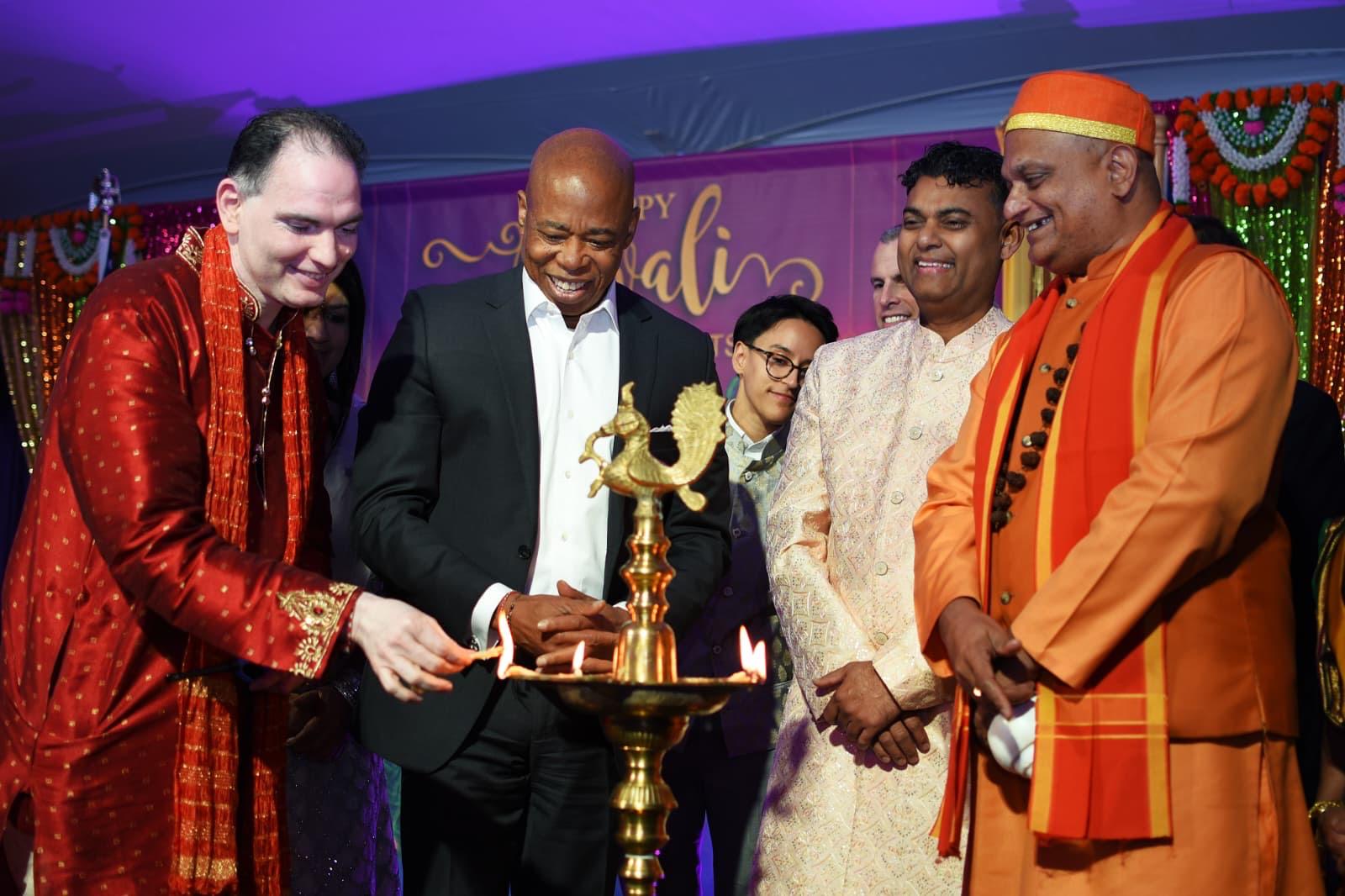
Following the lighting of the ceremonial diya, Mayor Adams and Deputy Commissioner Chauhan honored several community figures whose work reflects Diwali’s spirit of service and creativity.
- Manju Masson, New York-based entrepreneur and philanthropist, thanked the city for “bringing this beautiful Diwali celebration to life.”
- Hammond Kumar Sumay, musician and Surinamese community leader, acknowledged the mayor for supporting Indo-Caribbean heritage and “making the first Surinamese flag-raising in New York City possible.”
- Chef Vikas Khanna, eight-time Michelin-starred chef and author of 40 books, called New York “the city of rebirth.” “Our food became our soft power,” he said. “I’m proud to represent Indian culture every single day.”
- Representatives from BAPS Swaminarayan Sanstha, marking 50 years of service in the U.S., accepted an award for spiritual and humanitarian contributions. “We humbly accept this honor on behalf of our volunteers and gurus,” said Hina and Deepak Patel.
As the evening drew to a close, hundreds of guests joined in lighting lamps across Gracie Mansion’s terrace, their glow reflected on the East River. “When New York City does something, the world listens,” Chauhan said, thanking his wife Ruchika Chauhan, daughter Ridhi, and his organizing team.
“Our children can now celebrate Diwali without missing a school day,” he added. “That’s the light of inclusion we wanted to bring.”
Mayor Adams, standing before a sea of diyas, ended with a message that resonated beyond the night: “Diwali is not just about lighting lamps—it’s about lighting lives. As we celebrate love, unity, and understanding, let us carry this light into every home, every heart, and every corner of our city.”