As India aims for a $2 trillion export economy by 2030, its future growth story is being rewritten around high-value manufacturing and semiconductor design — a transformation from a services powerhouse to a global technology hub
Our Bureau
Mumbai / New Delhi
India’s growth trajectory is entering a decisive and transformative phase. With exports projected to cross USD 2 trillion by 2030, policymakers and industry leaders are converging on a single insight: the country’s economic future depends on how fast it can pivot toward technology-intensive, high-value manufacturing and digital innovation.
A recent report by Forvis Mazars India underscores this shift, warning that reliance on low-value exports and global demand cycles could expose India’s economy to external shocks. “Export growth cannot rely on GDP expansion alone,” said Rohit Chaturvedi, Partner for Transport and Logistics at Forvis Mazars. He emphasized the need for targeted incentives to strengthen India’s position in advanced global value chains (GVCs), adding that capital formation and logistics infrastructure will be crucial in achieving sustained progress.
Over the past two decades, India’s export profile has undergone a structural evolution. Sectors such as engineering goods, electronics, pharmaceuticals, gems and jeweler, and chemicals now account for nearly 70% of total merchandise exports. Electronics, in particular, have emerged as a breakout performer, growing fivefold to USD 38.5 billion between FY18 and FY25. Traditional sectors like textiles have ceded ground to knowledge- and technology-driven industries, signaling India’s gradual ascent up the manufacturing value chain.
But technology transformation is not confined to exports alone — it’s reshaping India’s entire industrial ecosystem. Semiconductor design and innovation, once peripheral to India’s tech narrative, are now central pillars of its manufacturing ambitions.
At the forefront of this shift is MediaTek, the Taiwan-based semiconductor giant with a strong base in India. The company’s India operations already command a 47% market share in smartphones, along with leadership in smart TVs, routers, and Chromebooks. Anku Jain, Managing Director of MediaTek India, said the country’s semiconductor ecosystem is rapidly maturing, driven by the government’s Production Linked Incentive (PLI) schemes and a surge in private investment.
“In the last two to three years, the momentum has really picked up. We’re now looking at a 10–20-year roadmap for India’s semiconductor future,” Jain said. He pointed out that ten new semiconductor products have already been announced under the PLI initiative — a signal that India’s design and fabrication capabilities are beginning to find commercial expression.
Jain acknowledged, however, that challenges remain. “Skilled manpower continues to be a constraint,” he noted, calling for greater collaboration between academia, industry, and government to develop next-generation technical expertise. MediaTek’s ongoing work in satellite communication chipsets — particularly for IoT-NTN and NR-NTN — reflects the expanding scope of innovation in India’s tech landscape.
“Although MediaTek is a fabless company, it’s encouraging to see the manufacturing ecosystem developing in India,” Jain added, emphasizing the company’s bullish outlook on the Indian market as a global growth engine.
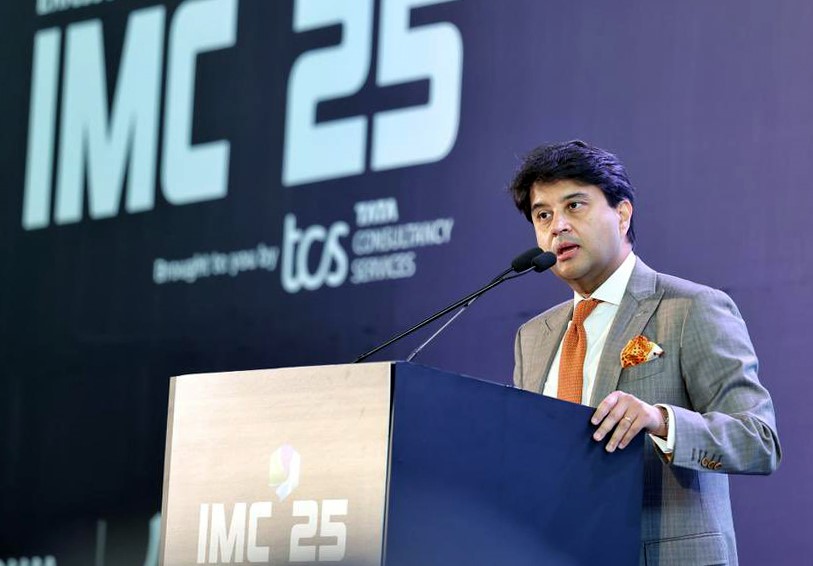
Meanwhile, India is preparing for the next wave of connectivity — the transition from 5G to 6G — that could define the next decade of digital and industrial transformation. On the sidelines of the India Mobile Congress 2025, experts described India’s 6G ambitions as both bold and strategic.
Ashutosh Dutta, Chief 5G Strategist at Johns Hopkins University Applied Physics Laboratory, highlighted ubiquitous connectivity as the core of 6G innovation. “When cell towers or Wi-Fi are unavailable, satellite integration will fill the gap,” he said, stressing the importance of combining non-terrestrial and terrestrial networks. Dutta called for the creation of prototypes, testbeds, and simulations through partnerships among telecom operators, academia, and startups — all aimed at building secure, AI-enabled communication systems.
Professor Harald Haas, known as the “Father of Li-Fi,” said light-based wireless communication could help India extend broadband access to rural regions where fiber is too costly. “Li-Fi can complement 5G and 6G networks and even use solar panels as receivers — harnessing both sunlight and data together,” he explained.
Japan’s National Institute of Information and Communication Technology (NICT) also sees India as a rising technology partner. Executive Iwao Hosako said Japan is eager to deepen collaboration with India across industries and governments. “India is a big power in communications and software development. Many talented Indian engineers already work with us, and we see tremendous potential to take this cooperation further.”
Together, these developments — from export diversification and semiconductor design to 6G and Li-Fi — reveal a clear trajectory: India is moving beyond its traditional image as a back-office economy toward becoming a frontline innovator in global technology and manufacturing.
As the Forvis Mazars report suggests, India’s ambition to reach a USD 1 trillion merchandise export target by 2030 will not hinge solely on volume, but on value — powered by innovation, integration, and industrial depth. The next decade, it seems, will not just be about India’s rise — it will be about how India builds the future.