

As British Prime Minister Keir Starmer’s visit to India concludes, New Delhi and London have not only reaffirmed their historic ties but also elevated their cooperation to a new strategic level — spanning defence, education, innovation, and global governance
Our Bureau
Mumbai / New Delhi
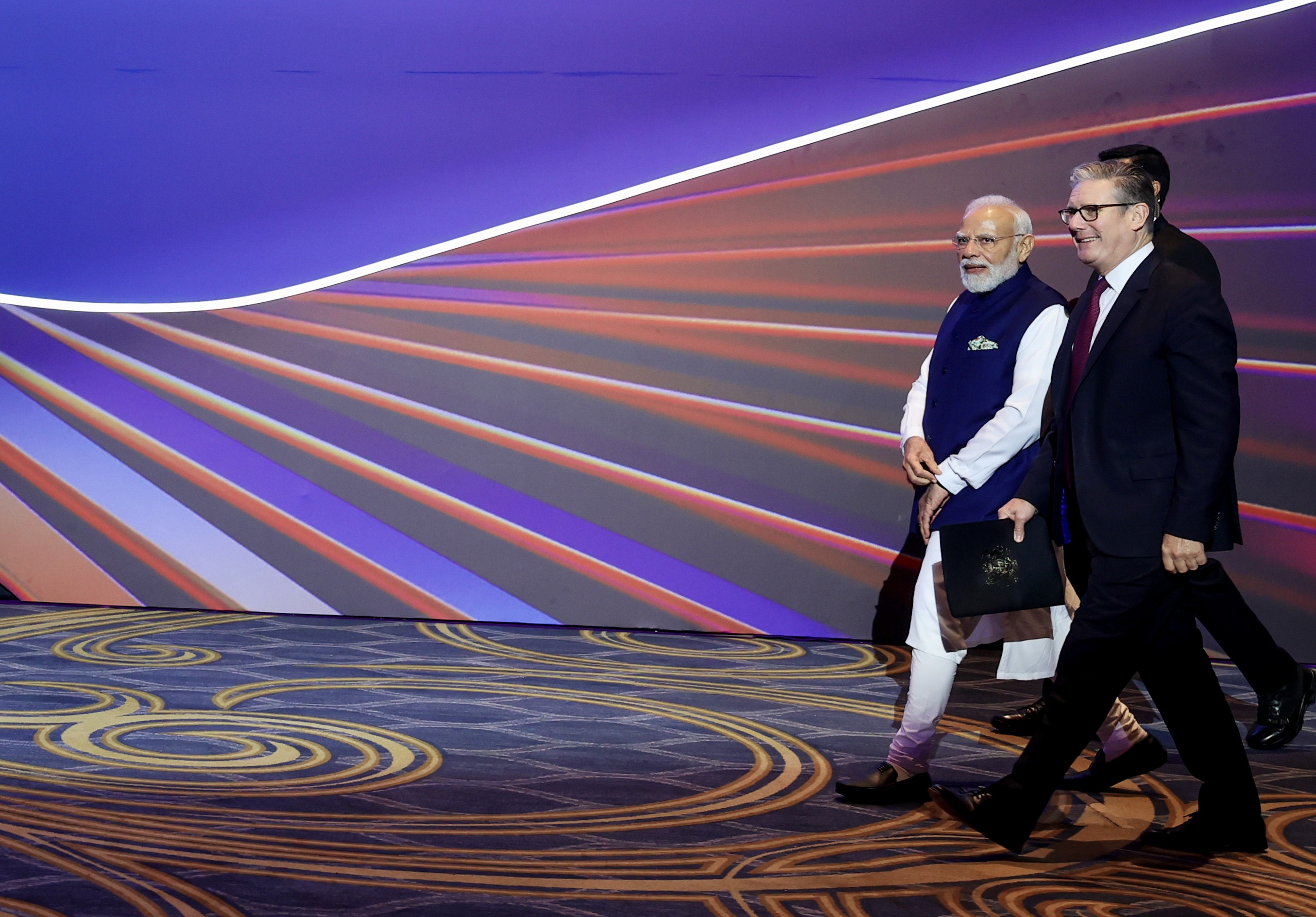
India and the United Kingdom are charting a new course in their bilateral relationship — one that blends strategic pragmatism with shared democratic values. Prime Minister Narendra Modi and his British counterpart Keir Starmer, meeting in Mumbai and New Delhi this week, unveiled a sweeping agenda that positions both nations as key partners in trade, technology, defence, and global diplomacy.
At the heart of this renewed engagement lies a shared understanding: in an increasingly fractured world order, like-minded democracies must collaborate more closely to ensure economic stability, technological resilience, and global security.
A major highlight of Starmer’s visit was the £350 million defence deal between India and the UK, a landmark agreement that will supply India’s armed forces with UK-manufactured Lightweight Multirole Missiles (LMMs) built in Belfast. The deal secures over 700 jobs in Northern Ireland and signals a deepening of defence industrial ties, with both countries now exploring a broader “complex weapons partnership.”
UK Defence Secretary John Healey described the pact as “a blueprint for a deeper relationship between our defence industries.” Alongside the missile agreement, both nations also inked a £250 million collaboration on electric-powered naval engines, marking a shift towards sustainable maritime technology.
Together, these steps signify a maturing partnership — one that extends beyond transactional defence trade to long-term co-development and innovation.
The long-awaited India-UK Free Trade Agreement (FTA), signed in July, now moves toward ratification in both countries. Both leaders reaffirmed their commitment to maximizing the benefits of tariff reductions and enhancing investment flows.
Foreign Secretary Vikram Misri noted that the FTA is more than a trade deal — it’s an economic bridge. “The visit has provided both sides an opportunity to deepen strategic economic engagement and derive full benefits from tariff reduction under the FTA,” he said.
The reconstituted India-UK CEOs Forum met in Mumbai, where business leaders mapped future cooperation in fintech, green energy, and digital innovation. The presence of a 125-member British business delegation — the largest ever to India — underscored the commercial confidence in this partnership.
In what Misri called a “silent revolution,” nine leading British universities have received approvals to open campuses in India under the National Education Policy (NEP). These include Southampton University in Gurgaon and multiple universities in Gujarat’s GIFT City, Mumbai, and Bengaluru.
This unprecedented educational expansion is set to generate a £50 million boost to the UK economy while offering Indian students access to British degrees at home. UK Prime Minister Keir Starmer hailed it as “a transformative step” that strengthens academic collaboration and cultural connection.
“Our great British universities are admired all over the world for their excellence and innovation,” Starmer said. “More Indian students will now benefit from that world-class education without having to leave home.”
This initiative also positions the UK as the country with the largest higher education footprint in India, aligning with India’s ambitious goal of accommodating 70 million university students by 2035.
Technology emerged as the second major pillar of the visit. Both nations launched the India-UK Connectivity and Innovation Centre and the India-UK Joint Centre for Artificial Intelligence, alongside a Critical Minerals Industry Guild to strengthen supply chain resilience in green technologies.
These initiatives fall under the Technology Security Initiative (TSI) — an umbrella framework for cooperation on AI, cybersecurity, and emerging technologies, ensuring that innovation aligns with democratic values and strategic autonomy.
In a clear diplomatic breakthrough, Prime Minister Keir Starmer voiced strong support for India’s permanent membership in a reformed United Nations Security Council (UNSC). “We want to see India taking its rightful place in the UN Security Council,” Starmer said, adding that both nations will work together for “reformed multilateralism and a rules-based international order.”
The joint statement reaffirmed commitments to counter terrorism and violent extremism, with Modi raising concerns over Khalistani radicalism and stressing that democratic freedoms should not be abused by extremist elements. The leaders also condemned recent terror attacks in Manchester and Pahalgam, pledging “zero tolerance for terrorism in all forms.”
This alignment on global issues — from counter-terrorism to multilateral reform — reflects a deeper synergy in worldviews between New Delhi and London.
From defence manufacturing to dual-degree campuses, from clean tech to UNSC reform, the Modi-Starmer engagement marks one of the most comprehensive expansions of India-UK ties in decades. In essence, the India-UK relationship has evolved from historical familiarity to strategic necessity — a 21st-century partnership grounded in innovation, resilience, and shared global responsibility.