

Our Bureau
Fayetteville, AR
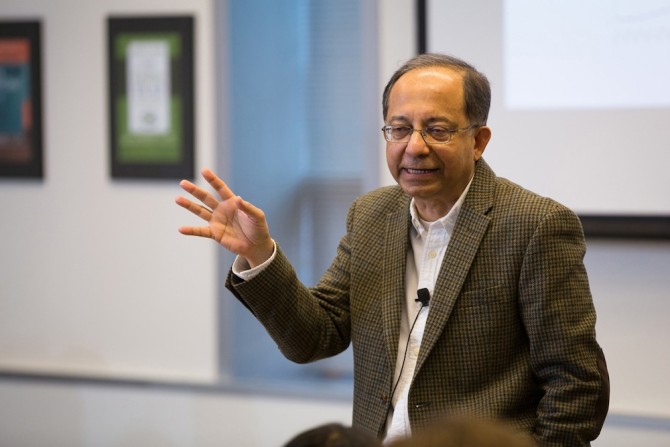
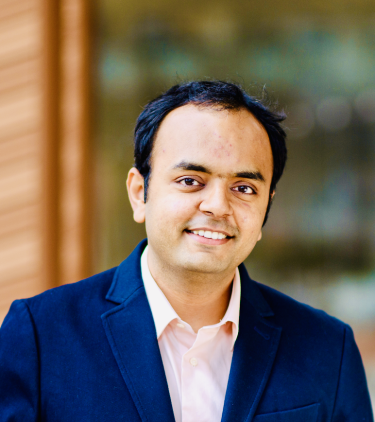
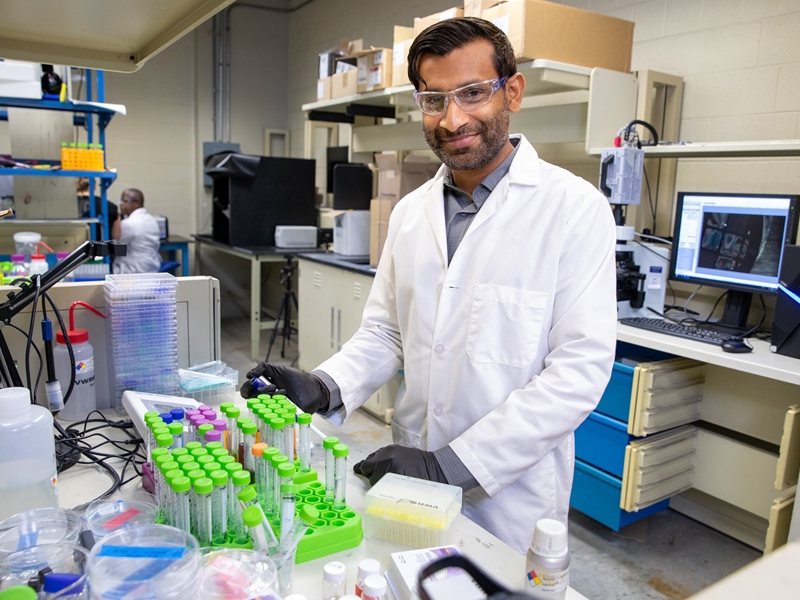
Karthik Nayani, an assistant professor of chemical engineering at University of Arkansas, received a five-year, $500,000 National Science Foundation CAREER award to unravel how rod-shaped strands of DNA move particles within cells to create these compartments.
“The CAREER award gives me an amazing opportunity to do some fundamental science that will unravel the mysteries behind liquid-liquid phase separation caused by rod-shaped particles. I am extremely excited about this project and am happy that the scientific community finds this important problem highly relevant,” Nayani said.
Nayani’s research to understand how DNA works within a cell could lead to faster and more sensitive tests for infectious diseases or abnormal genes.
The prestigious CAREER grants support early-career faculty with the “potential to serve as academic role models in research and education,” according to the National Science Foundation (NSF).
“I am thrilled that Karthik has received an NSF CAREER award,” said Keisha Walters, chair of the Ralph E. Martin Department of Chemical Engineering. “Not only does this award support the research success of talented junior faculty, like Karthik, it also advances cutting-edge science and engineering efforts in our state and helps prepare our students for career success.”
Current PCR tests to detect DNA, like those that are widely used to confirm COVID-19 infections, often take days to deliver results. This new process proposed by Nayani would be almost instantaneous and could identify small amounts of a particular strand of DNA. The presence of DNA could even be monitored live, which could be used to detect harmful biofilms as they form.
Nayani’s research covers a wide range of subjects. He studies the fundamental structures of cells and the role of DNA. He created a new way to detect COVID-19 and other infectious diseases using liquid crystals. He is developing a technology, funded by an Arkansas Research Alliance grant, to make lithium extraction in southern Arkansas more efficient.
The research interests all fall within the field of “soft matter physics.”
“It all comes down to understanding the underlying physics of how things work that are soft and squishy, and not metals,” he said.
Soft matter, neither a solid nor a liquid, can be deformed and reshaped by heat and force.
As part of his CAREER award, Nayani will create programs for K-12 students to show them how soft matter and chemical engineering can help them understand the world around them.