

India’s Vice-Presidential election on September 9 is shaping into a contest not just between two men—CP Radhakrishnan and Justice B Sudershan Reddy—but between two competing visions of Parliament’s future.
Our Bureau
New Delhi
The Vice President’s office, often overshadowed by the executive-heavy nature of Indian politics, has rarely been so politically charged. With the Vice President doubling up as the ex-officio Chairman of the Rajya Sabha, the role carries deep institutional weight. In an era of heightened parliamentary polarization, the upcoming election offers more than a ceremonial choice—it represents two distinct political statements.
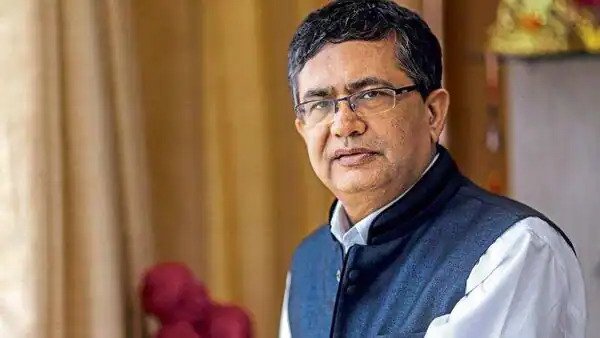
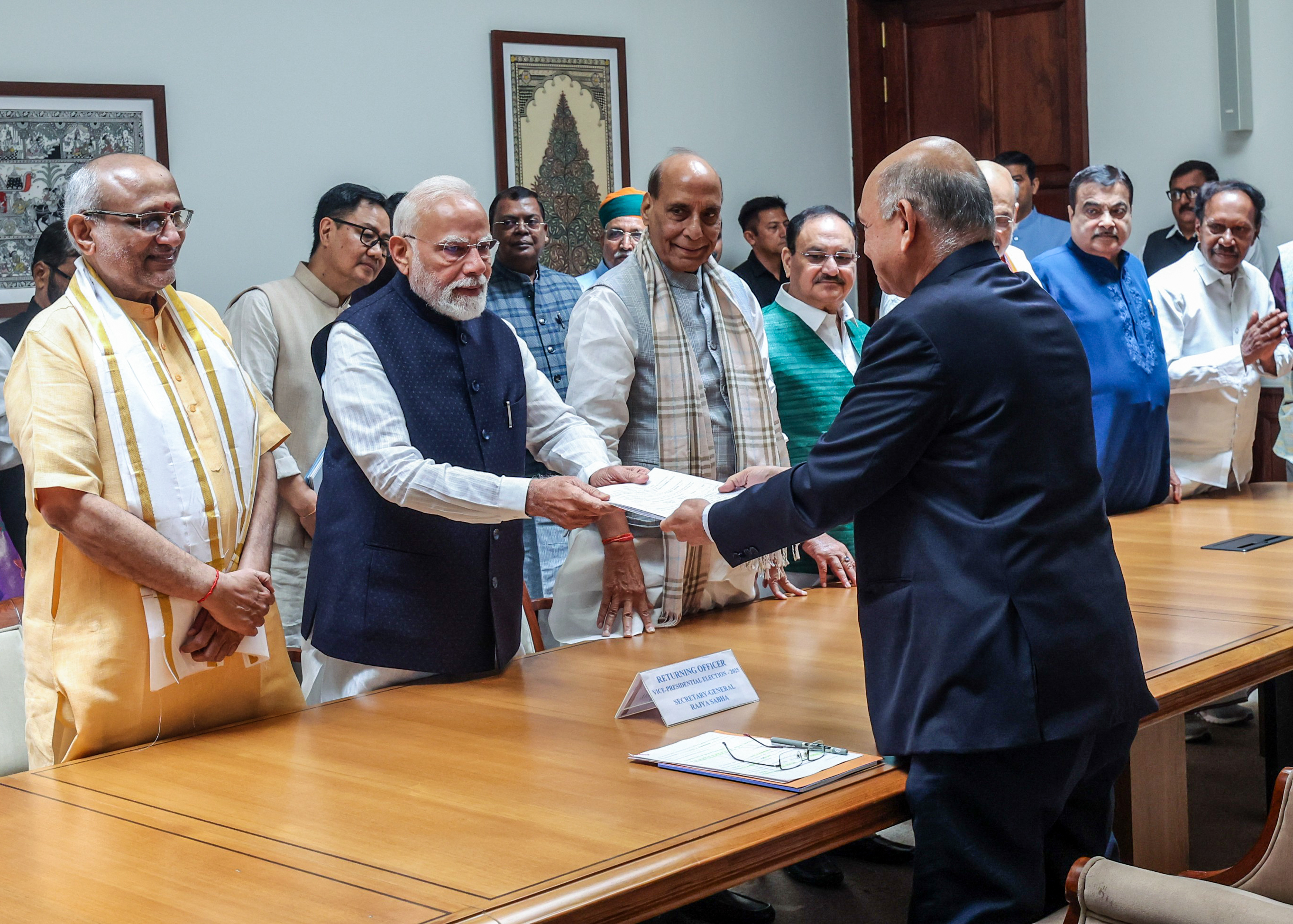
The ruling National Democratic Alliance (NDA) has fielded CP Radhakrishnan, a veteran Bharatiya Janata Party (BJP) leader from Tamil Nadu, known for his long association with the Rashtriya Swayamsevak Sangh (RSS) and his administrative stints as Governor of Jharkhand, Telangana, and Maharashtra. His candidacy, endorsed enthusiastically by Prime Minister Narendra Modi, signals continuity and consolidation of the NDA’s grip on Parliament’s functioning.
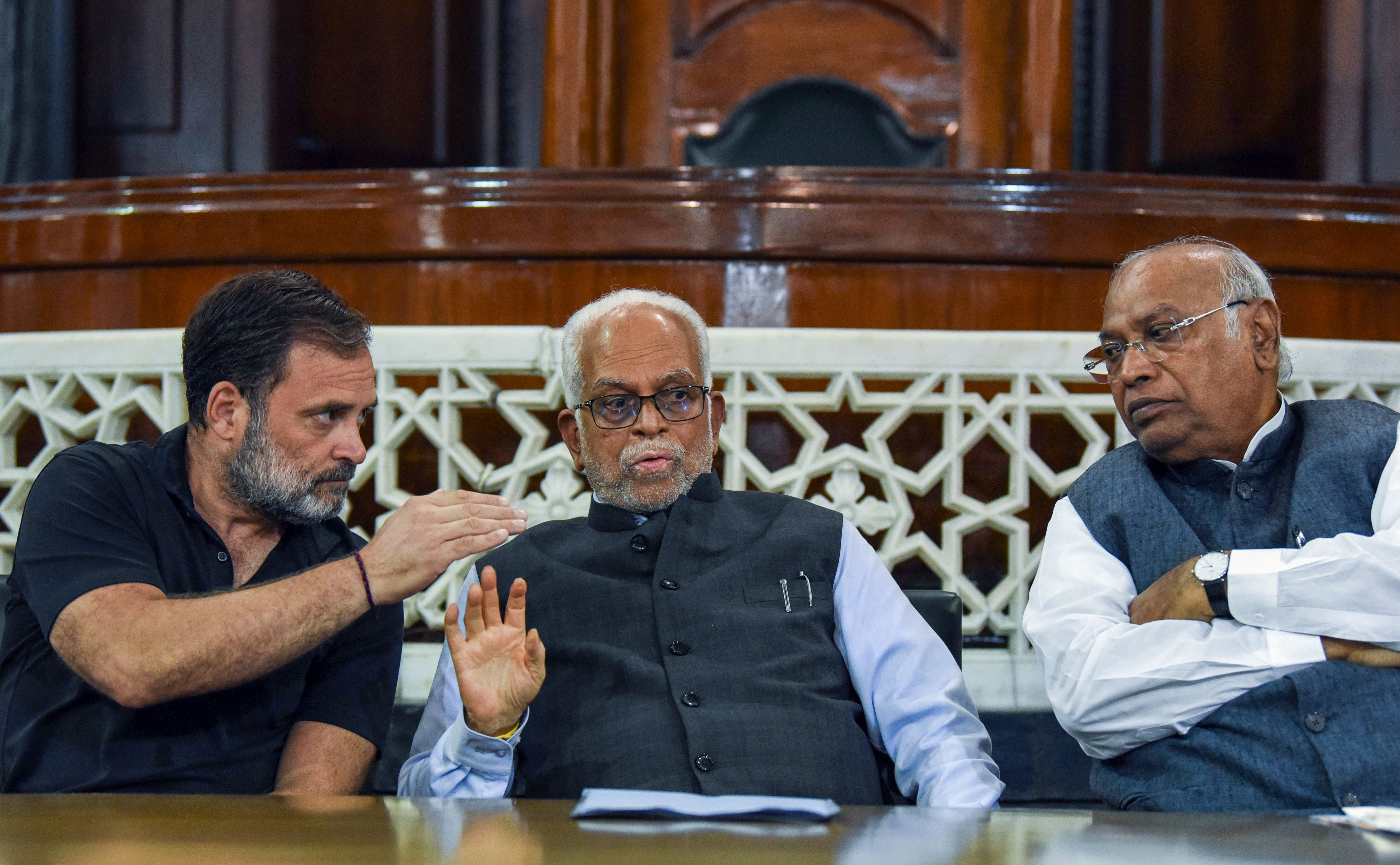
On the other side, the opposition INDIA bloc has rallied behind Justice B Sudershan Reddy, a retired Supreme Court judge known for his jurisprudence, progressive rulings, and recent interventions in issues of democracy and social justice. Congress President Mallikarjun Kharge called his nomination an “ideological battle,” framing it as a stand for fairness, impartiality, and the dignity of the Rajya Sabha.
Radhakrishnan’s selection reflects the BJP’s strategy of blending experience, loyalty, and regional representation. Hailing from Tamil Nadu, a state where the party has struggled to build an independent base, his elevation is also a symbolic gesture to southern India. Modi described him as a man of “dedication, humility, and intellect,” with a career that began in the Jana Sangh era and matured through parliamentary and gubernatorial assignments.
As a two-time MP from Coimbatore in the late 1990s, Radhakrishnan earned a reputation as a steady parliamentarian. He chaired the Parliamentary Standing Committee and played a role in scrutinizing financial scandals, such as the Stock Exchange scam. His tenure as governor was marked by quiet administrative diligence rather than flamboyance, reinforcing the image of a grounded, disciplined party loyalist.
By nominating him, the NDA appears keen to avoid controversy and project stability. In a period when opposition leaders complain of curtailed debate and shrinking space in Parliament, Radhakrishnan’s presence is expected to ensure that the ruling party retains a firm but controlled hand over Rajya Sabha proceedings. For the BJP, which prizes order and predictability, his candidacy represents continuity.
If Radhakrishnan is the face of establishment continuity, Justice Reddy represents disruption—albeit through constitutionalism. A former Chief Justice of the Guwahati High Court and Supreme Court judge until 2011, Reddy is remembered for judgments rooted in rights-based interpretations of law. His recent interventions on issues like electoral rolls in Bihar and the caste census in Telangana reflect a jurist unafraid of confronting political power.
In his first remarks after nomination, Reddy rejected the notion of a “Radhakrishnan versus Reddy” contest, stressing that the Vice Presidency is not a political office. Yet, his statements—warning that “universal adult suffrage is under serious challenge” and praising Rahul Gandhi for not letting the “streets be silent”—place him firmly in the opposition’s ideological frame.
For the INDIA bloc, Reddy’s candidacy is both symbolic and tactical. By nominating a jurist with no formal party background, they seek to counter the NDA’s narrative of partisanship. Kharge’s insistence that Reddy embodies “fairness and impartiality” positions him as a corrective to what the opposition calls “misuse of parliamentary majority” under the BJP. The challenge, however, lies in numbers: with the NDA commanding a majority in Parliament, Reddy’s campaign is more about political messaging than arithmetic victory.
At its core, this election is about the Rajya Sabha’s character. Opposition leaders argue that the Upper House, envisioned as a chamber of reflection and federal balance, has increasingly been reduced to a rubber stamp. Bills of sweeping consequence are often rushed without scrutiny, they contend. In this context, Kharge frames Reddy’s candidacy as resistance: “To decisively act against these transgressions in Parliament, the nation needs an impartial justice.”
The NDA, meanwhile, frames the election in terms of governance efficiency. Modi and his ministers project Radhakrishnan as a seasoned administrator who will “enrich our journey towards national progress.” For them, the office of Vice President is not about obstructing the majority’s legislative will but about ensuring procedural order.
Numerically, the NDA holds the upper hand. With its parliamentary majority, Radhakrishnan’s election looks almost certain. Yet, as in the presidential race of 2022, the opposition views the contest less as a fight for victory and more as an opportunity to underline ideological differences before the 2026 general elections.