Our Bureau
Houston, TX
After spending almost 18 days aboard the International Space Station as part of the Axiom-4 mission (Ax-4), Group Captain Shubhanshu Shukla, the first Indian astronaut to visit the ISS, along with this crew for the mission, is set to return from the space station.
The Axiom-4 has successfully undocked and is making its way back to Earth, as observed by Axiom Space and NASA on Monday.
In an informative blog about the mission updates, NASA informed that the SpaceX Dragon spacecraft undocked at 7:15 a.m. EDT from the space-facing port of the International Space Station’s Harmony module, completing the fourth private astronaut mission to the orbiting laboratory, Axiom Mission 4.
It further noted that the Dragon is slowly manoeuvring away from the station into an orbital track that will return the crew and its cargo safely to Earth, targeting a splashdown off the coast of California on Tuesday, July 15.
As per Axiom Space, the crew’s return journey will take approximately 22.5 hours back to Earth, marking the conclusion of their nearly mission aboard the orbiting laboratory.
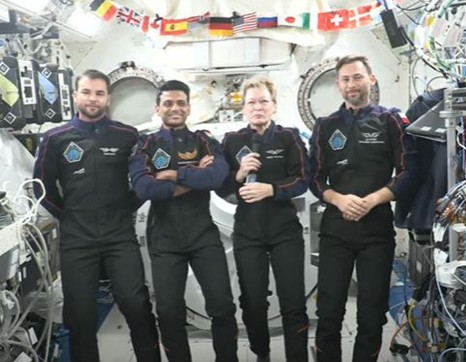
Group Captain Shubhanshu Shukla, the first Indian to visit the ISS and pilot for the mission, is part of the four-member crew that will conclude their mission aboard the SpaceX Dragon spacecraft, which will undock from the space-facing port of the station’s Harmony module.
The crew also includes veteran NASA astronaut Commander Peggy Whitson, European Space Agency (ESA) project astronaut Slawosz Uznanski-Wisniewski of Poland, and Hungarian to Orbit (HUNOR) astronaut Tibor Kapu.
The coverage will continue by Axiom Space and SpaceX via axiom.space/live and SpaceX’s website, which will show the Dragon spacecraft re-entry into the Earth’s atmosphere and subsequent splashdown off the coast of California.
The Dragon spacecraft will return with more than 580 pounds of cargo, including NASA hardware and data from over 60 experiments conducted during the mission.
Over the past 17 days, the Ax-4 crew have been intensely focused on research aboard the ISS as they start to wrap up ahead of their departure.
On flight day 17, Group Captain Shukla performed centrifugation and freezing of microalgae samples to study their potential in supporting life on long-duration missions.
The crew continued the Voyager Displays study, investigating eye movement and coordination in microgravity, and gathered data for the Voice in Space project, analysing vocal performance changes.
Additionally, they took part in a cognitive study called the Acquired Equivalence Test, which examined how astronauts learn and adjust to life in microgravity.
The group concluded the day by collecting samples for more human health research, such as Human Gut Microbiota, Immune Multiomics, Muscular Stimulation, and Microbiome Profiling.
To ensure astronaut health on upcoming long-duration missions, these studies seek to expand our knowledge of how the human body reacts to living in space.
Axiom Mission 4 was launched on June 25 aboard a SpaceX Falcon 9 rocket from Launch Complex 39A at NASA’s Kennedy Space Centre in Florida. The Dragon spacecraft successfully docked with the ISS on June 26 at 4:05 pm IST, ahead of schedule, connecting to the space-facing port of the station’s Harmony module.