








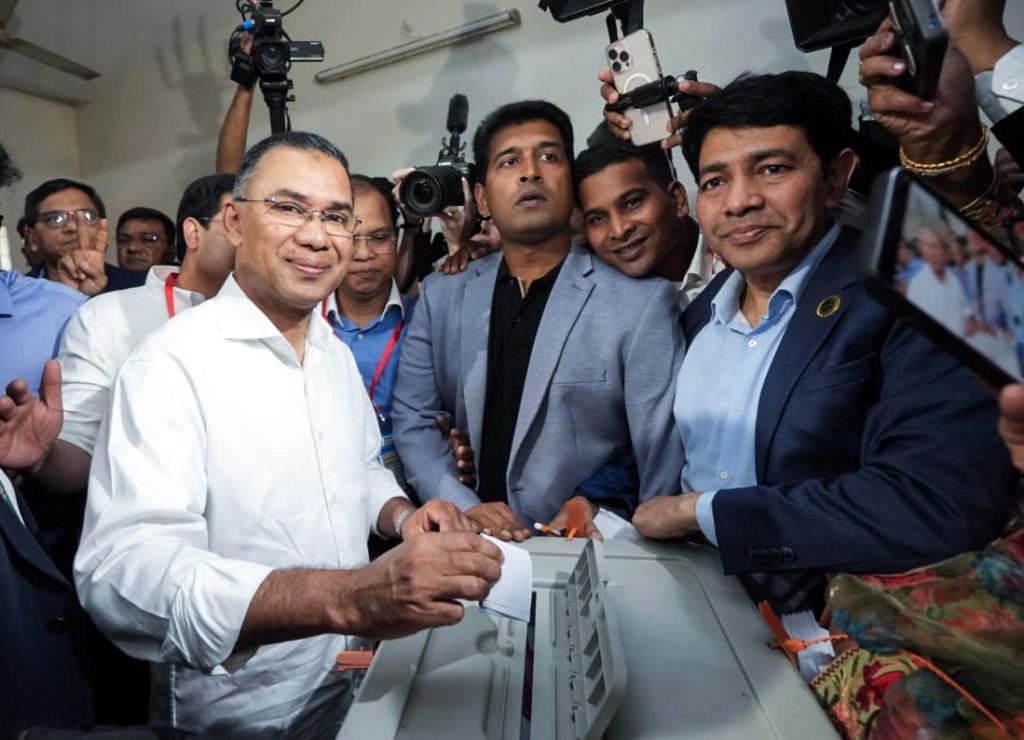
With the BNP’s sweeping victory marking a dramatic political shift, Bangladesh now faces the twin tests of democratic restoration and economic recovery
Our Bureau
Dhaka
Bangladesh has entered a new political chapter following the Bangladesh Nationalist Party’s (BNP) decisive victory in the February 12 parliamentary elections — the first national vote since the violent 2024 uprising that led to the removal of former prime minister Sheikh Hasina.
The BNP-led alliance secured 212 seats in the 300-member parliament, comfortably crossing the 151-seat threshold required to form the government. The Jamaat-e-Islami-led bloc won 77 seats, emerging as the principal opposition. Hasina’s Bangladesh Awami League was barred from participating in the elections, a factor that continues to shape the political narrative around the results.
In his first remarks after the outcome, BNP chief Tarique Rahman framed the verdict as a democratic endorsement. “Freedom loving pro-democracy people of the country have once again brought victory to the Bangladesh Nationalist Party,” he said. Calling the result broader than party politics, he added, “This victory belongs to Bangladesh, belongs to democracy, this victory belongs to people who aspired to and have sacrificed for democracy.”
Rahman struck a conciliatory tone, urging reconciliation after years of polarisation. “Our paths and opinions may differ, but in the interest of the country, we must remain united,” he said, emphasising that “national unity is a collective strength, while division is a weakness.”
Yet even as he celebrated the mandate, Rahman acknowledged the scale of the task ahead. “We are about to begin our journey in a situation marked by a fragile economy left behind by an authoritarian regime, weakening constitutional and structural institutions and destroying law and order,” he cautioned. The incoming administration, therefore, inherits not just power but responsibility — to stabilise the economy, restore institutional credibility and address concerns over governance.
The political transition has not been without controversy. Sheikh Hasina formally challenged the legitimacy of the elections, calling them a “disgraceful chapter” for Bangladesh’s democracy. She alleged widespread manipulation, claiming that “voters were absent at the polling stations; yet votes appeared on the counting tables!” The Awami League also pointed to what it described as “highly inconsistent and unrealistic patterns” in turnout data, noting that while 14.96 per cent of votes were cast by 11:00 a.m., the figure rose sharply to 32.88 per cent by noon — implying a rate of approximately 381,339 votes per minute nationwide.
These allegations underline the fragile environment in which the new government will operate. Former Indian High Commissioner to Bangladesh Veena Sikri suggested that, now that the results are declared, “one of the first things maybe the new Prime Minister will think about is to lift the ban on the participation of the Awami League.” She observed that the BNP alliance and the Jamaat-e-Islami alliance had been “neck to neck,” but congratulated the BNP for securing a “great two-thirds majority.”
The question of political inclusivity will be central to Bangladesh’s democratic future. With the Awami League excluded from the electoral contest, the parliament reflects a reconfigured but incomplete political spectrum. Reintegrating major stakeholders into the democratic process could determine whether the current mandate leads to lasting stability or prolonged contestation.
International reactions have been swift. Indian Prime Minister Narendra Modi congratulated Rahman, stating that the victory “shows the trust of the people of Bangladesh in your leadership.” Modi reaffirmed that “India will continue to stand in support of a democratic, progressive and inclusive Bangladesh” and expressed his intention to strengthen “our multifaceted relations and advance our common development goals.”
The BNP responded warmly, stating, “We look forward to engaging constructively with India to advance our multifaceted relationship, guided by mutual respect, sensitivity to each other’s concerns, and a shared commitment to peace, stability, and prosperity in our region.” The emphasis on mutual respect suggests that Dhaka will seek a pragmatic foreign policy balancing domestic priorities with regional partnerships.
Voter turnout stood at around 59 per cent, and a constitutional referendum on governance reforms passed alongside the elections. This signals public appetite for structural change beyond a simple transfer of power.
Tarique Rahman’s personal political journey adds further weight to this moment. The 60-year-old leader returned to Bangladesh in December after 17 years in exile in Britain. As the son of former president Ziaur Rahman and former prime minister Khaleda Zia, he carries a legacy deeply intertwined with the country’s post-independence political history.
Whether the BNP’s landslide becomes a foundation for democratic renewal will depend on how it addresses the economic fragility and institutional weakening Rahman himself has acknowledged. His call for unity — “national unity is a collective strength” — will now be tested in practice.
Bangladesh has delivered a decisive mandate. The future will hinge on whether that mandate translates into inclusive governance, credible institutions and economic recovery — or deepens existing divides.