








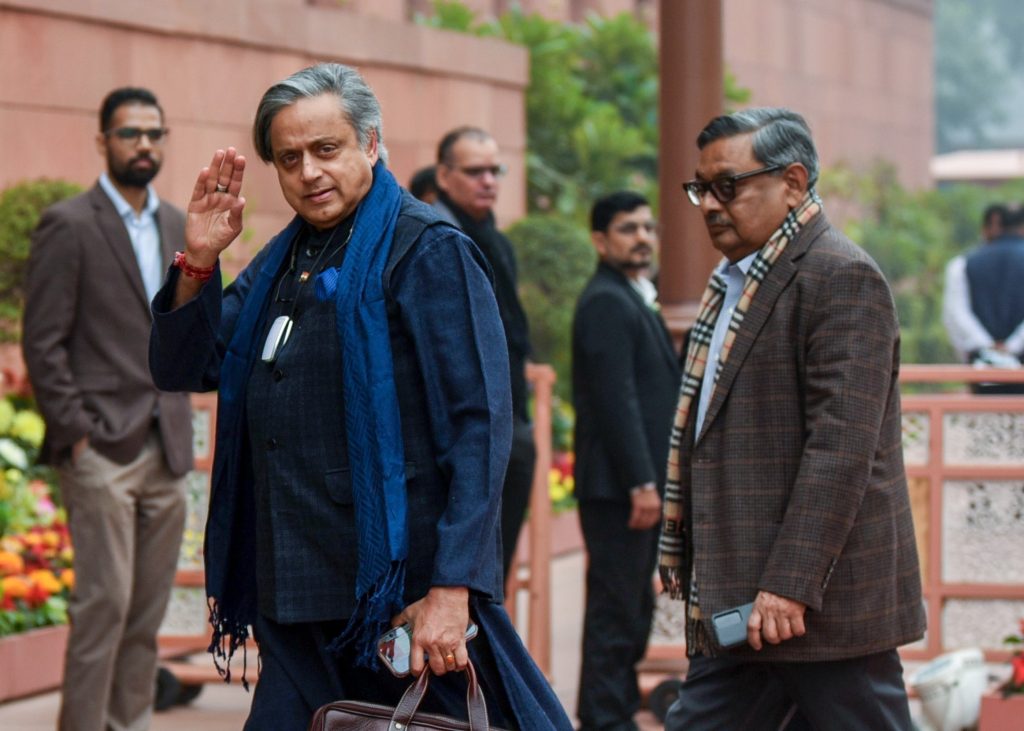
A public show of unity between Shashi Tharoor and Rahul Gandhi may help the Congress steady internal nerves, sharpen its campaign and present a cohesive front in Kerala’s crucial 2026 Assembly elections.
Our Bureau
New Delhi/Thiruvananthapuram
The meeting between Congress MP Shashi Tharoor and the party’s top leadership, including Rahul Gandhi and president Mallikarjun Kharge, may have been described as “cordial and constructive,” but its political significance goes far beyond personal equations. At a time when the Congress is preparing for a high-stakes Kerala Assembly election, even the perception of a thaw between Tharoor and Rahul Gandhi could prove strategically important for the party’s prospects in the state.
Kerala is one of the few remaining Congress strongholds, yet it is also a state where factionalism and leadership tussles have historically blunted the party’s electoral edge. With elections expected before May 2026 and the ruling CPI(M)-led Left Democratic Front aiming for a rare third consecutive term, the Congress-led United Democratic Front (UDF) can ill afford public displays of discord. Against this backdrop, the optics of Tharoor meeting Rahul Gandhi and Kharge help arrest speculation that internal differences might derail the party’s campaign.
The friction had become visible over the past week. Tharoor’s absence from an important All India Congress Committee meeting on Kerala election preparations, followed by reports that he felt “deeply insulted” after being ignored by Rahul Gandhi at the party’s Maha Panchayat in Kochi, triggered talk of a widening rift. Though the party maintained that Tharoor had prior commitments at the Kerala Literature Festival, the narrative of discontent gained traction, particularly in Kerala, where Tharoor enjoys a strong personal following beyond traditional Congress voters.
Tharoor’s subsequent statement that there were “issues” he wished to discuss with the leadership only added to the intrigue. In that sense, Thursday’s meeting and his careful public remarks afterwards appear designed to draw a line under the episode. By emphasising camaraderie and collective purpose, Tharoor signalled that he remains firmly within the party fold — a message as much for party workers in Kerala as for the national leadership in Delhi.
For the Congress, this patch-up matters because Tharoor occupies a unique political space in Kerala. A four-time MP from Thiruvananthapuram and the working president of the Kerala Congress, he combines intellectual appeal, media credibility and cross-party acceptability. In recent elections, he has demonstrated an ability to attract urban, middle-class and young voters, segments where the Congress often struggles against both the Left and the BJP. Marginalising such a leader, or allowing perceptions of alienation to fester, would have risked weakening the UDF at a time when it needs to broaden its appeal.
Equally important is Rahul Gandhi’s role in Kerala politics. As a former MP from Wayanad, Rahul retains a deep emotional connect with the state’s electorate. Any impression of discord between him and a senior Kerala leader like Tharoor could have been exploited by rivals to portray the Congress as divided and directionless. By engaging directly with Tharoor, Rahul Gandhi helps reinforce the message that internal debates will not be allowed to spill over into the public domain during an election cycle.
The timing of this reconciliation is crucial. Kerala is poised for a triangular contest involving the ruling LDF, the Congress-led UDF and the BJP-led NDA, which is aggressively seeking to expand its footprint in the state. For the UDF to mount a credible challenge to the Left’s decade-long rule, it must project unity, clarity of leadership and a compelling alternative narrative. A visibly aligned Tharoor–Rahul combine strengthens that effort, at least at the level of perception.
This does not mean that underlying differences have vanished. Tharoor has, in the past, articulated positions that diverge from the party’s official line, and he has occasionally drawn criticism from within the Congress for his independent streak. However, the willingness on both sides to engage privately and present a united public face suggests a pragmatic recognition of electoral realities.
From a campaign perspective, a reconciled leadership allows the Congress to deploy Tharoor more effectively — as a national-level communicator, a bridge to civil society and a credible face in Kerala’s urban centres. His presence alongside Rahul Gandhi in the run-up to the polls could energise cadres, blunt opposition attacks and counter the Left’s narrative of stable governance.
Ultimately, Kerala elections are won not just on arithmetic but on momentum and morale. The Congress has often faltered when internal rivalries overshadowed its message. By closing ranks now, the party gives itself a better chance to focus on issues such as employment, governance fatigue and federal concerns that resonate with Kerala voters.