








Archan Mehta
Indian cricket in 2025 didn’t stop, didn’t panic, and didn’t look back, it simply learned how to move on. 2025 will be remembered as the year Indian cricket finally accepted change. The warning signs came early during the Border-Gavaskar Trophy in Australia. India’s 1–3 loss wasn’t just about scorelines; it exposed fatigue, pressure, and the weight carried by senior players. The defining moment came in Sydney when captain Rohit Sharma dropped himself – an honest, painful decision that summed up the mood. By May, the inevitable happened. Within one week, Rohit Sharma and Virat Kohli retired from Test cricket, ending one of the most successful batting partnerships in Indian history. It felt emotional, but it also cleared space. Indian Test cricket didn’t collapse; it prepared to rebuild.
That rebuild began under Shubman Gill. Thrust into captaincy for a tough five-Test tour of England, Gill inherited a young team without the comfort of Rohit, Kohli, or even Ravichandran Ashwin, who had retired earlier. Expectations were low, but the response was strong. India fought hard to secure a 2–2 series draw, playing brave, disciplined cricket. Gill led from the front, scoring 754 runs at an average of 75.40, including four centuries and a double hundred. He looked calm, confident, and ready. The reality check came later in November when South Africa whitewashed India 2–0 at home, including a crushing 408-run defeat in Guwahati. It was a reminder that transitions take time and patience.
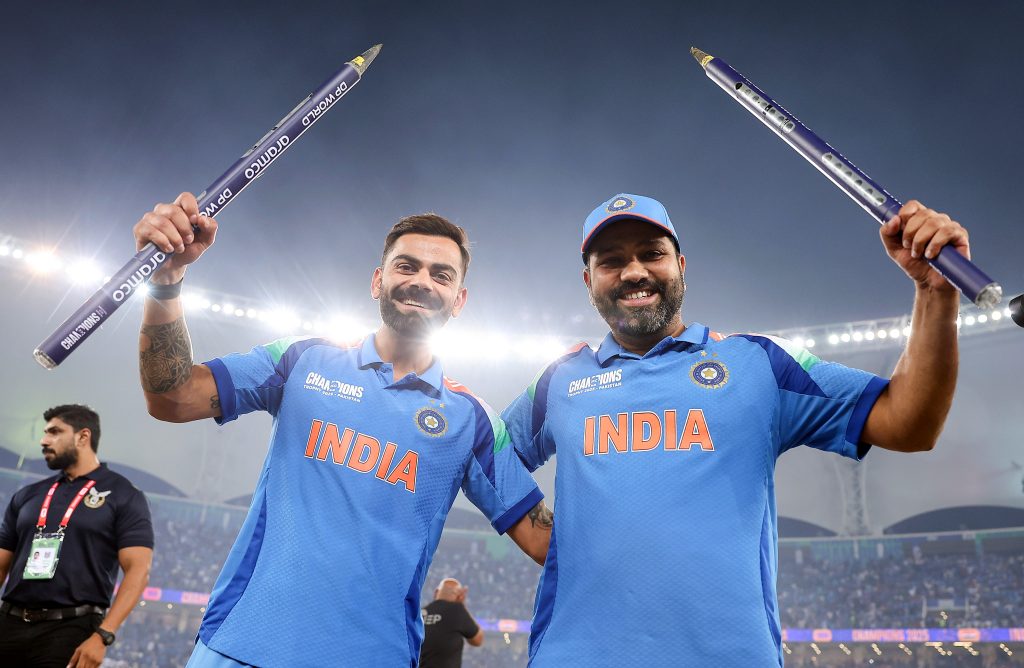
While Test cricket searched for balance, India’s white-ball teams operated with complete authority. Under Rohit Sharma’s leadership, India won the ICC Champions Trophy 2025, finishing the tournament unbeaten and defeating New Zealand in the final. Rohit played a crucial knock in the final and was named Player of the Match, while Virat Kohli topped the tournament’s run charts with typical consistency. It was vintage India, calm in pressure moments and ruthless when ahead. That dominance continued in the Asia Cup later in the year, where a second-string Indian side led by Suryakumar Yadav lifted the title. India defeated Pakistan three times in the tournament, despite political tension and off-field drama. By the end of the Champions Trophy, India had won 23 of their last 24 ICC matches, proving their white-ball system was the strongest in the world.
In a year full of big names and transitions, Indian women’s cricket delivered the most emotional moment. The Indian women’s team won their first-ever ICC title, changing the story forever. After losing three group matches in the Women’s ODI World Cup, they staged a remarkable comeback. Jemimah Rodrigues scored a brilliant century against Australia in the semi-final, while Shafali Verma’s fearless 87 helped India win the final against South Africa. Deepti Sharma was the backbone of the team, finishing with 22 wickets and earning Player of the Series honors. Smriti Mandhana had a historic year, crossing 10,000 international runs and ending 2025 as the highest ODI run-scorer in the world with 1,362 runs at an average of 61.90. By year’s end, this team was no longer chasing respect, they had earned it.
As legends stepped away, Indian cricket’s talent pipeline produced its most astonishing story yet. Vaibhav Suryavanshi, just 14 years old, became the youngest player in IPL history. He didn’t stop there; he smashed the fastest century by an Indian (35 balls) and dominated across formats. He became the youngest centurion in the Syed Mushtaq Ali and Vijay Hazare Trophies, and the fastest to score a Youth ODI hundred. Around him, India’s Under-19 team swept Australia 3–0 in ODIs and 2–0 in Tests on Australian soil. One loss in the U-19 Asia Cup final didn’t change the message: Indian cricket’s future wasn’t coming; it was already here.
The year ended with a beautiful contradiction. After retiring from Tests, Rohit Sharma and Virat Kohli returned to ODIs and reminded everyone why the format still matters. Rohit scored an unbeaten 121 in Sydney, while Kohli struck back-to-back centuries against South Africa. Both put in intense preparation, Rohit reportedly lost 10 kilos, and Kohli maintained peak discipline. Together, they crossed 26,000 ODI runs and 80 centuries, and their return to domestic cricket sparked massive fan interest. In a T20-driven era, Rohit and Kohli didn’t chase relevance, they created it.
2025 proved one thing clearly, Indian cricket doesn’t fear endings, because it always knows how to begin again.
Archan Mehta is a writer dedicated to telling compelling stories about athletes, teams, and the world of cricket