








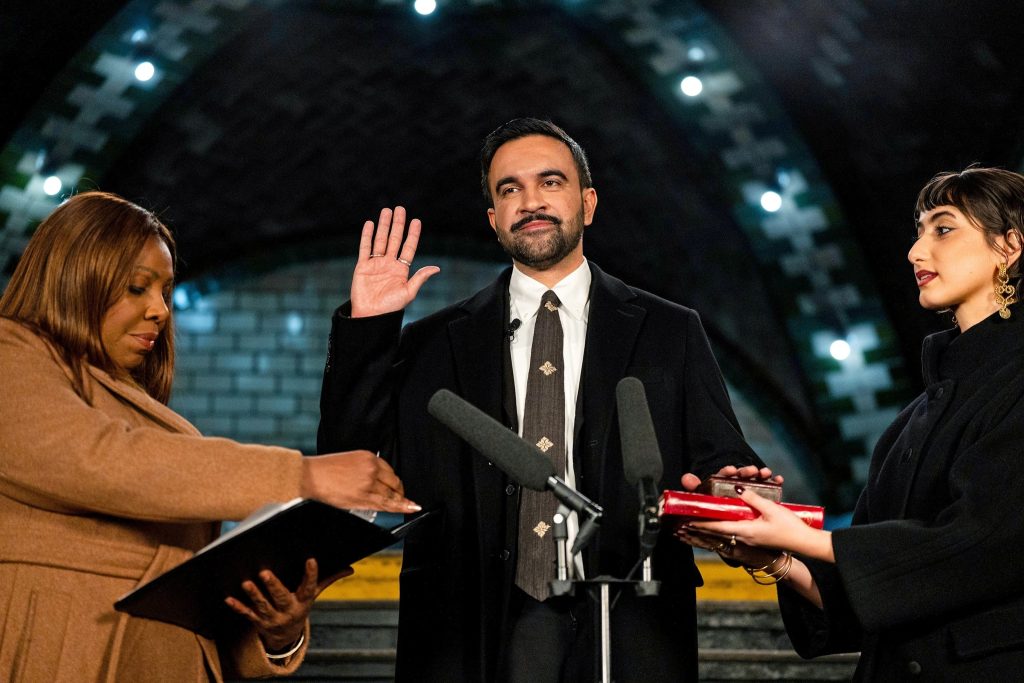
On his first day in office, Mayor Zohran Mamdani moved swiftly to define his administration, signing a series of executive orders focused on governance reform, housing justice, mass civic engagement and street safety.
Our Bureau
New York, NY
New York City’s new mayor wasted no time. Within hours of being sworn in, Mayor Zohran Mamdani signed a slate of executive orders that set the tone for his administration and outlined how City Hall will operate under his leadership. The decisions, announced across multiple events on his first day, underscored three core priorities: building an administration that serves working New Yorkers, confronting the city’s housing crisis head-on, and reshaping how residents engage with their government.
“Today marks the first step in building an administration that works for all New Yorkers,” Mayor Mamdani said. “We’ve established the foundations of it, and now it’s time to deliver on our affordability agenda, tackle the challenges facing New Yorkers, and usher in a new era for New York City.”
The mayor’s first two executive orders focused squarely on governance. The first revoked all executive orders issued on or after September 26, 2024, giving the incoming administration a clean slate, while selectively reissuing those deemed essential to maintaining continuity of services and value-driven leadership. The move was framed as both symbolic and practical, signaling a clear break with the past while ensuring uninterrupted city operations.
The second executive order formally established the structure of the Mamdani administration. It created five deputy mayor positions—First Deputy Mayor, Deputy Mayor of Housing and Planning, Deputy Mayor of Economic Justice, Deputy Mayor of Operations, and Deputy Mayor of Health and Human Services—and confirmed appointments to each role. Dean Fuleihan was named First Deputy Mayor, Leila Bozorg Deputy Mayor of Housing and Planning, Julia Su Deputy Mayor of Economic Justice, Julia Kerson Deputy Mayor of Operations, and Helen Arteaga Deputy Mayor of Health and Human Services. The order also formalized key City Hall leadership posts, including Chief of Staff and Chief Counsel, and outlined the continued operation of several mayoral offices.
Housing emerged as the defining focus of the day. Mayor Mamdani signed three additional executive orders aimed at addressing what he called New York City’s most urgent crisis. Central to that effort was the revitalization of the Mayor’s Office to Protect Tenants, which will now serve as a coordinating hub to defend renters’ rights, hold landlords accountable, and ensure rapid action by city agencies in cases of unsafe or illegal housing conditions.
The mayor appointed nationally recognized tenant organizer Cea Weaver as Director of the revitalized office. Weaver currently serves as Executive Director of Housing Justice for All and the New York State Tenant Bloc, and played a key role in securing passage of the 2019 Housing Stability and Tenant Protection Act.
On her first day in the role, Weaver stood alongside the mayor to announce what City Hall described as an unprecedented intervention: New York City will enter bankruptcy proceedings involving Pinnacle Realty, a landlord responsible for more than 5,000 housing violations, 14,000 complaints across 83 buildings, and significant unpaid debts to the city. Mayor Mamdani directed his Corporation Counsel nominee, Steve Banks, to pursue precedent-setting action in Bankruptcy Court to protect tenants, improve living conditions, and prevent displacement.
The announcement was made at a Pinnacle-owned building, where the mayor toured an apartment marked by broken walls, torn flooring and lack of heat. “On the day where so many rent payments are due, we will not wait to deliver action,” Mamdani said. Weaver called the move a clear signal that tenant protection would be a top priority.
Two new housing task forces were also established. The LIFT Task Force—Land Inventory Fast Track—will identify city-owned properties suitable for housing development by July 1, 2026, and is overseen by Deputy Mayor Leila Bozorg. The SPEED Task Force—Streamlining Procedures to Expedite Equitable Development—will work to remove bureaucratic and permitting barriers that slow housing construction and raise costs. SPEED will be jointly overseen by Bozorg and Deputy Mayor Julia Kerson.
Beyond housing, Mayor Mamdani signed an executive order creating the Mayor’s Office of Mass Engagement, a new City Hall office designed to transform how New Yorkers interact with their government. Tascha Van Auken, who led the mayor’s historic campaign field operation, was appointed Commissioner. The office will coordinate outreach across agencies, working with community organizations, faith groups and everyday New Yorkers to build long-term civic participation.
Finally, the mayor announced a major street safety decision. Alongside NYC Department of Transportation Commissioner Mike Flynn, Mamdani confirmed that the city will complete the long-delayed redesign of McGuinness Boulevard, reinstating parking-protected bike lanes along the entire corridor. The move was welcomed by Assemblymember Emily Gallagher and Councilmember Lincoln Restler, who called it a victory for community advocates and a sign of urgency from the new administration.
Taken together, the first day’s actions painted a clear picture of Mayor Mamdani’s governing approach: decisive, highly visible, and grounded in promises made during the campaign—to prioritize affordability, tenant protection, safety, and democratic participation from the very start.