








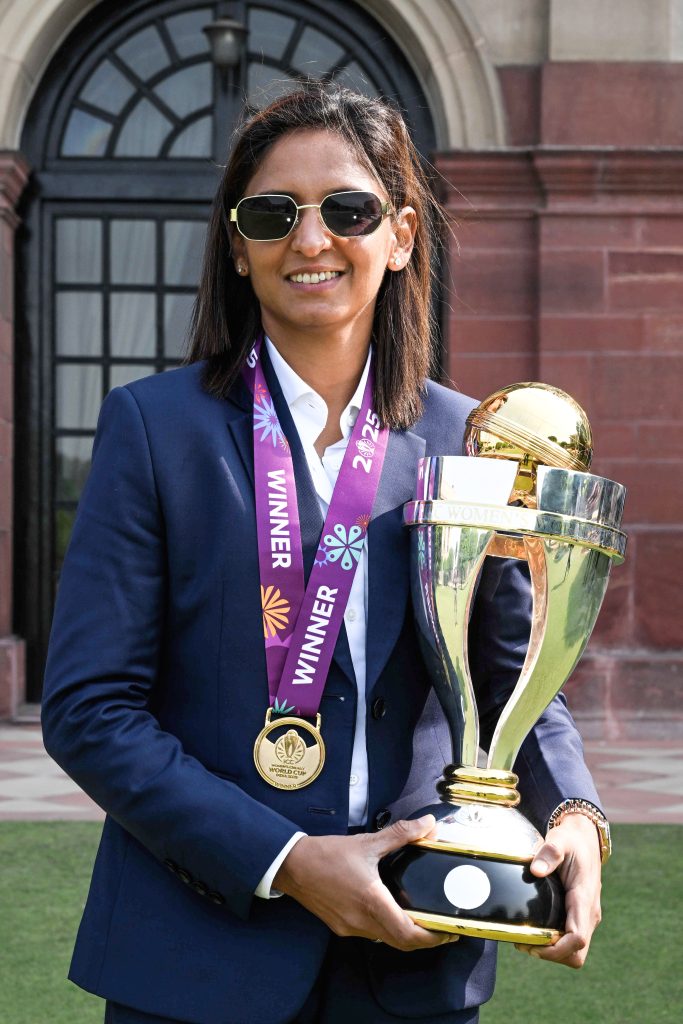
In 2025, Harmanpreet Kaur crowned a career of resilience by leading India to its first Women’s World Cup title and redefining leadership in the global game.
The year 2025 will be remembered as the moment Indian women’s cricket finally crossed its most formidable frontier, and at the heart of that breakthrough stood Harmanpreet Kaur. At 36, battle-hardened by defeats and near-misses, she emerged as the captain who delivered India’s maiden ICC Women’s World Cup title—and in doing so, secured her place among the great leaders the sport has known.
The defining image of India’s triumph came at the Dr DY Patil Stadium in Navi Mumbai. As South Africa pushed desperately in the final, Harmanpreet completed the catch of Nadine de Klerk to seal a 52-run victory. It was a quiet, composed moment, but one that carried the weight of years of unfulfilled promise. For Harmanpreet, it was redemption; for Indian cricket, it was history.
That World Cup win was not an isolated peak but part of a remarkable year of leadership. Earlier in 2025, Harmanpreet became the most successful captain in women’s T20 internationals, surpassing former Australia skipper Meg Lanning. She achieved the milestone after India’s emphatic eight-wicket win over Sri Lanka in the third T20I at Thiruvananthapuram. With 77 wins in 130 matches, she went past Lanning’s 76 wins in 100 games, also becoming the woman to lead a team in the most T20Is.
The numbers are imposing. England’s Heather Knight and Charlotte Edwards trail behind with 71 and 68 wins respectively. But statistics alone do not explain Harmanpreet’s impact. What sets her apart is the way she carried India through a period of transition—bridging generations, absorbing pressure, and turning belief into consistency.
Her journey to the World Cup crown was long and often painful. Before 2025, Harmanpreet had played in four ICC Women’s Cricket World Cups, collecting experience but also heartbreak. The most haunting of those moments came in the 2017 final against England, when India fell agonizingly short. That loss lingered, not as bitterness, but as unfinished business.
Eight years later, the circle finally closed. The 2025 World Cup became Harmanpreet’s redemption arc—proof that leadership matures not only through success, but through endurance. This time, India played with clarity and control, hallmarks of a captain who understood the rhythm of big tournaments and the psychology of pressure.
Harmanpreet’s leadership style is rooted in balance. She leads from the front when required, but equally trusts her players to take ownership. That approach was evident in her recollection of the night before the final, when a phone call from Sachin Tendulkar helped steady the team’s nerves. Tendulkar, himself familiar with World Cup heartbreak and eventual triumph, advised patience and control.
“The night before the match, Sachin sir called,” Harmanpreet recalled later. “He shared his experience and asked us to keep our balance. When the game is going fast, just slow it down a little.” The message resonated deeply. In the final, India resisted panic, allowing the moment to come to them rather than forcing it.
That capacity to slow the game down has defined Harmanpreet’s captaincy. Whether in T20 cricket or the longer World Cup format, she has emphasized composure under pressure. Her teams have reflected that temperament—disciplined in the field, adaptable with the bat, and increasingly confident in crunch situations.
Equally significant is what Harmanpreet’s success represents beyond the boundary. As the first Indian captain to lift a Women’s World Cup, she shattered a psychological barrier that had long separated Indian women’s cricket from its ultimate goal. Her achievement validated years of investment, struggle, and quiet progress in the women’s game.
In 2025, Harmanpreet did more than win trophies. She redefined what sustained leadership looks like in women’s cricket—longevity without stagnation, authority without rigidity. Leading India in 130 T20Is is a testament to trust, resilience, and an ability to evolve with the game.
For a generation of young cricketers, Harmanpreet Kaur is no longer just a power-hitter or a senior professional. She is the captain who stayed the course, learned from defeat, and finally delivered the prize that had eluded Indian women’s cricket for decades. In the story of India’s World Cup triumph, her name will stand not just at the top of the scorecard, but at the center of history itself.