








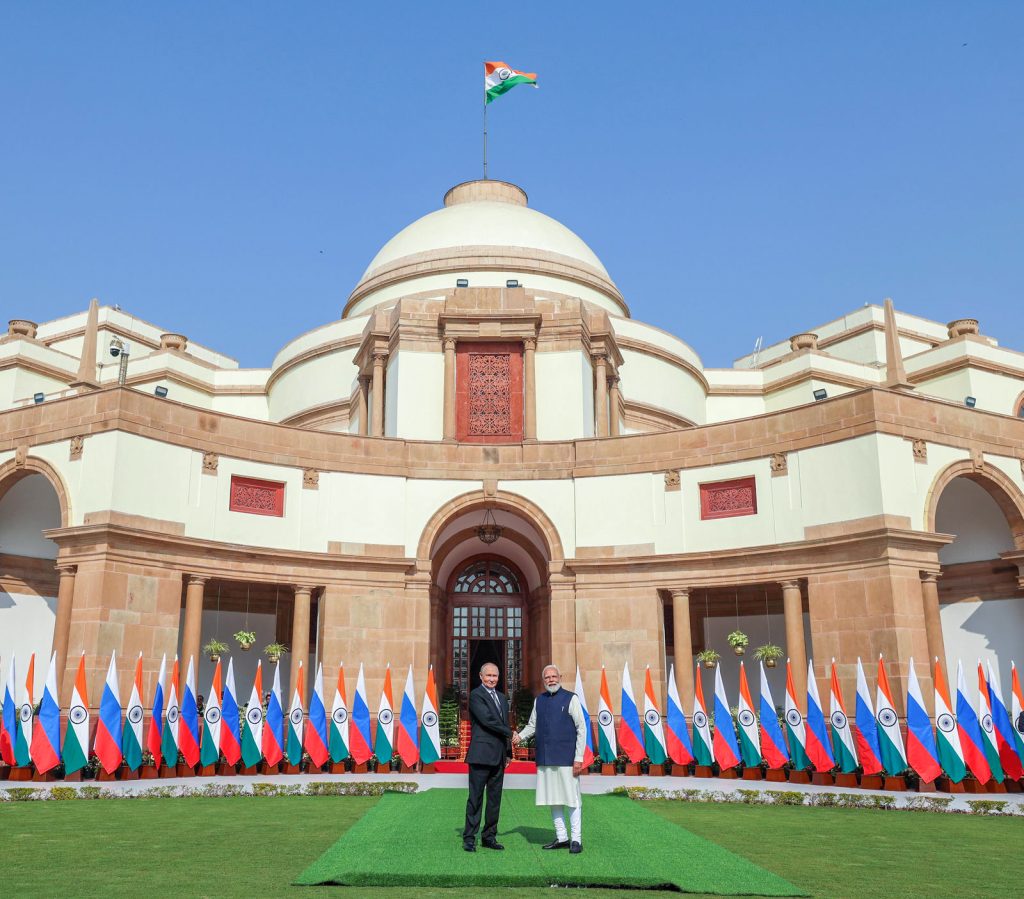
President Vladimir Putin’s high-profile visit to New Delhi has underlined a central geopolitical truth: India–Russia relations remain a cornerstone of India’s foreign policy even as the global order undergoes dramatic realignment
Our Bureau
New Delhi
President Vladimir Putin’s two-day state visit to India — his first in four years — comes at a time when the global landscape is marked by conflict, sanctions, supply-chain fractures, and fierce competition among great powers. Yet amid this turbulence, India and Russia have signaled a deliberate choice to consolidate a durable, time-tested partnership.
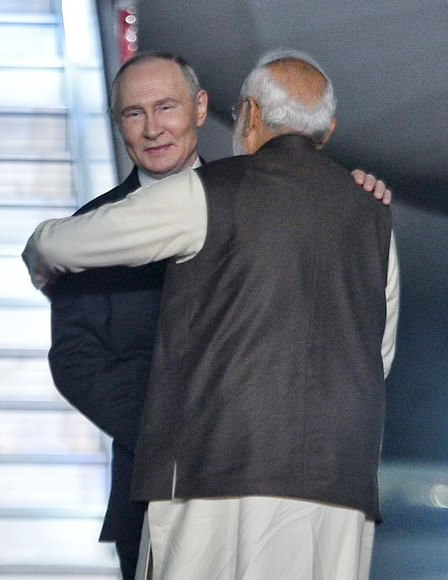
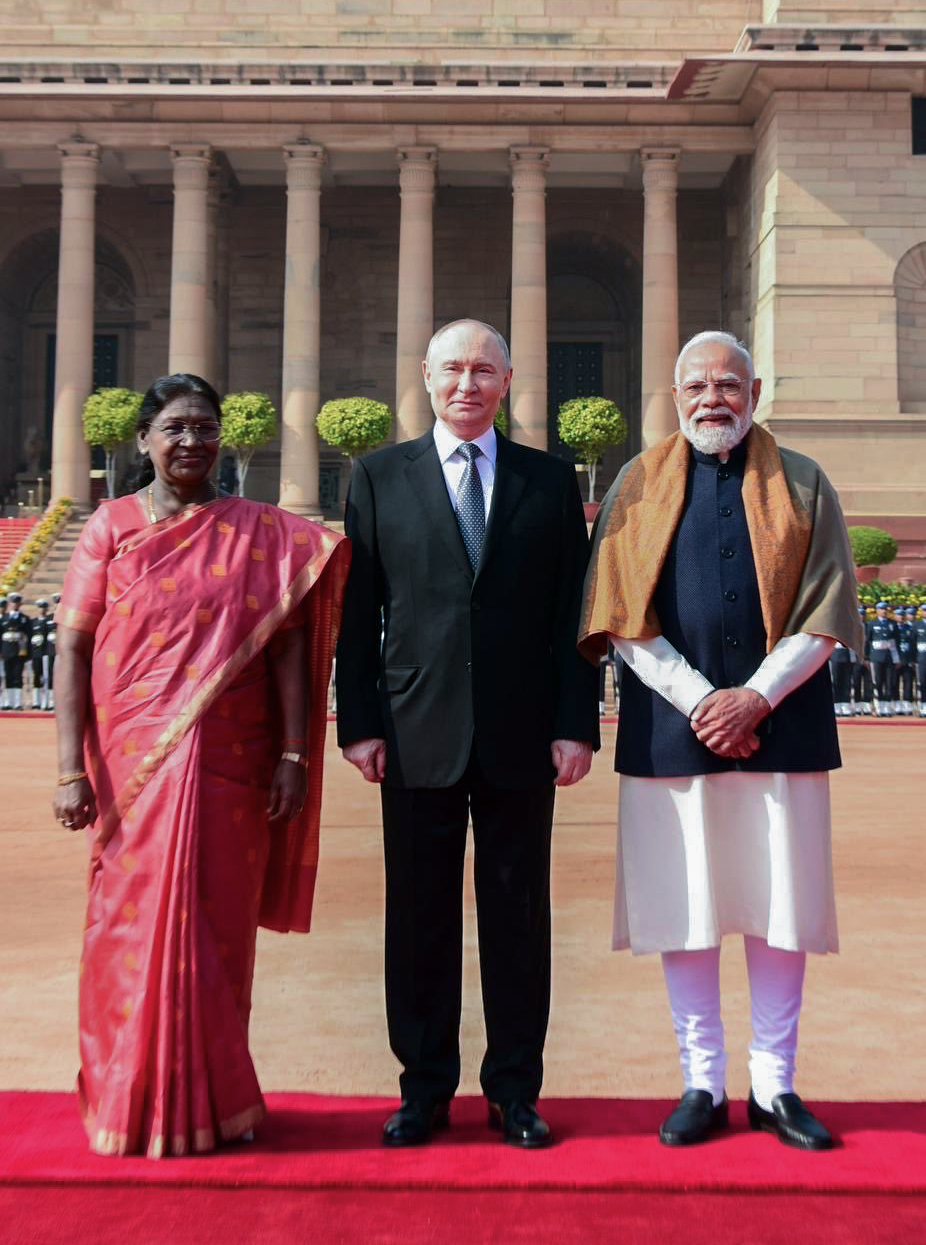
Prime Minister Narendra Modi set the tone during the joint statement at Hyderabad House, calling the bilateral relationship “steadfast like a pole star,” rooted in “mutual respect and deep trust.” The symbolism was unmistakable: a ceremonial welcome at Rashtrapati Bhavan, tributes at Rajghat, and Modi personally greeting Putin on the tarmac — a break from protocol that reflected political intent.
The warmth of the personal equation has strategic consequences. Both leaders used the visit to expand cooperation across energy, trade, connectivity, talent mobility, defense, and emerging technologies. The 23rd Annual Summit became not only a reaffirmation of old ties but also a blueprint for a more ambitious, future-facing partnership.
Putin, addressing Indian and Russian business leaders, praised India’s “independent and sovereign policy,” positioning New Delhi as one of the few global actors capable of maintaining balanced ties across geopolitical divides. He credited India’s economic performance — one of the fastest-growing in the world — to policy reforms and initiatives like Make in India, which he said were making the country “technologically sovereign.”
This convergence on strategic autonomy is central to why India–Russia ties continue to endure. Both countries resist forced alignment. Both argue for a multipolar world. And both see BRICS, the SCO and the “Global South” as platforms for shaping a fairer global order.
Modi echoed this confidence, stating that the “greatest strength of India–Russia relations is mutual trust.” That trust, he added, “gives direction and momentum to our joint efforts.”
Trade and Energy
A major outcome from the summit was the announcement of an Economic Cooperation Programme till 2030, aimed at diversifying trade and making investment flows sustainable. Modi and Putin also backed the early conclusion of the India–Eurasian Economic Union Free Trade Agreement, potentially unlocking significant market access.
Russia has become a critical supplier of discounted oil in the post-Ukraine war period, dramatically altering India’s energy calculus. Putin reassured India that Russia would remain a “steady and uninterrupted supplier” of oil, gas, and coal for its fast-growing economy. He also stressed expansion into civil nuclear energy, including small modular reactors, floating nuclear plants, and medical applications — a sign of deepening technological interdependence.
Russia’s status as an energy superpower — with the world’s largest natural gas reserves and massive oil output — continues to give India supply security at scale, particularly during global disruptions. Western sanctions have squeezed traditional markets for Russian energy, making India an indispensable consumer; this economic complementarity is now driving political convergence.
Modi underscored the “win-win” nature of this partnership: secure energy supplies for India and stable export revenues for Russia.
The New Frontiers
One striking feature of the Modi–Putin discussions was the emphasis on innovation, co-production, and co-creation. Modi highlighted India’s young talent pool as the “world’s skilled capital,” proposing the development of a “Russia-ready workforce” through language and soft-skills training. This aligns with Russia’s demographic needs and India’s employment ambitions.
In sectors like pharmaceuticals, EVs, textiles, ceramics, electronics, and advanced mobility solutions, Modi pointed to vast scope for joint manufacturing under the Make in India framework. Putin reciprocated by saying Russian companies were ready to increase purchases from India and expand investments in industrial production within India.
In defense and space — once the dominant pillars of the partnership — India has opened doors to private participation, creating opportunities for joint manufacturing, especially in high-tech areas.
Modi also announced cooperation on training Indian seafarers to navigate polar waters, opening avenues in Arctic logistics — a future trade route of enormous geopolitical significance.
A central theme was connectivity. Both leaders expressed urgency in operationalizing the International North–South Transport Corridor (INSTC) — linking Russia and India through Iran and Central Asia — and accelerating the Chennai–Vladivostok maritime corridor. These routes promise faster, cheaper, and geopolitically safer pathways for trade, reducing exposure to chokepoints dominated by rival powers.
Modi also floated the concept of virtual trade corridors, using digital platforms to streamline customs, logistics, and regulatory processes — a step toward modernizing India–Russia commerce for the digital age.
A Partnership That Defies Pressure
Despite criticism from Western capitals over India’s continued engagement with Russia after the Ukraine conflict, New Delhi has held firm. Modi reiterated during the summit that India “is not neutral — India is on the side of peace.” India supports diplomacy, de-escalation, and negotiation, but has refused to sever economic or strategic ties with Moscow.
This balancing act reflects India’s view that global stability cannot be restored by isolating major powers. For Russia, India serves as a crucial non-Western partner providing economic opportunity and geopolitical legitimacy.
Modi’s comments on terrorism — referencing attacks from Pahalgam to the Crocus City Hall tragedy — showed another area of convergence: both countries see themselves as victims of terrorism and share an interest in countering radical networks.
Putin used part of his address to highlight humanitarian and cultural exchanges, emphasizing youth engagement, academic partnerships, and the long-standing fascination Indians and Russians have had for each other’s traditions. This people-driven goodwill continues to cushion the relationship from geopolitical shocks.
Modi gifting Putin a copy of the Bhagavad Gita — and the visibly warm personal rapport — reinforced the symbolism of a relationship with deep civilizational roots.
Putin’s visit comes at an inflection point in global politics. The U.S., Europe, and China are locked in competing strategic blocs. Supply chains are being rewritten. Energy markets are being reshaped by sanctions and realignments. The Global South is asserting its voice.
In this shifting order, India needs a diversified set of partners, energy security, access to critical technologies, strong military capabilities, and room for diplomatic maneuverability.
Russia, meanwhile, needs stable partners, fast-growing markets, and geopolitical allies that do not treat it as a pariah.
The India–Russia relationship — built on history but rapidly adapting to new realities — gives both sides strategic depth.
The Road Ahead
Yet the timing of Putin’s New Delhi visit carries an additional layer of geopolitical significance: it comes as India’s relationship with the United States, particularly under President Donald Trump, enters a more complicated phase. While the India–US partnership has expanded in areas such as defence, technology and Indo-Pacific cooperation, Trump’s second term has introduced sharp frictions — from aggressive trade demands and visa restrictions to unpredictable tariff threats and public pressure on India over issues ranging from market access to geopolitical alignment. Washington’s transactional approach has, at times, clashed with India’s strategic autonomy, forcing New Delhi to assert its independent choices more firmly.
Against this backdrop, Putin’s warm reception in New Delhi serves as a reminder that India will not be pushed into exclusive alignments or zero-sum choices. Russia remains a critical pillar of India’s multi-vector foreign policy, and the symbolism of Modi personally receiving Putin — even as the U.S. signals discomfort with India’s continued engagement with Moscow — was unmistakable. The visit underlined that India’s external partnerships will be shaped not by pressure from any single capital, but by its own long-term interests. In that sense, Putin’s presence in New Delhi was not just a bilateral moment; it was a strategic signal that India intends to navigate great-power rivalry on its own terms, maintaining balanced relations with Washington while preserving its historic, high-value partnership with Moscow.
As Putin prepares to depart New Delhi after attending the India–Russia Business Forum and launching RT in India, both sides appear aligned on a more ambitious agenda for the next decade. The Economic Cooperation Programme to 2030, progress on the Eurasian FTA, expanded energy ties, new industrial corridors, Arctic cooperation, and deeper engagement in manufacturing all point toward a transformed partnership.
Modi summed up the future of the relationship with characteristic clarity: “Our friendship will give us the strength to face global challenges — and this trust will enrich our shared future.”
In essence, the visit reaffirms an unmistakable reality: for all the shifts in global power, India–Russia relations are not relics of the past but strategic assets for the future.