








Our Bureau
New Delhi
West Asia strategist Waiel Awwad on Thursday stated that if Prime Minister Narendra Modi’s consistent message of ending the Russia-Ukraine war resonates strongly with President Putin during his upcoming state visit, it could significantly see a reduction in mounting US tensions with New Delhi over energy imports and trade tariffs.
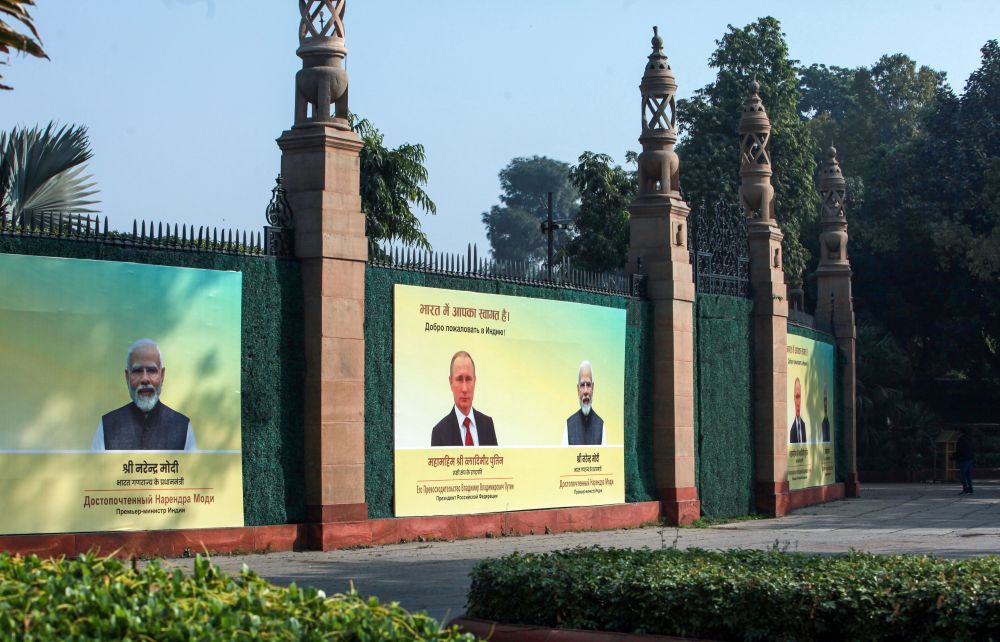
President Putin will take part in the 23rd India-Russia Annual Summit as part of two-day state visit to India, his first visit here since the Ukraine conflict began in 2022. The last time he visited the country was in December 2021.
Meanwhile, Prime Minister Modi is set to host a private dinner for Russian President Putin shortly after his arrival in New Delhi today.
On December 5, Putin will receive a ceremonial welcome and a tri-services guard of honour at Rashtrapati Bhawan, before he proceeds to the Raj Ghat to pay homage at the memorial to Mahatma Gandhi.
The two leaders will hold talks in a restricted format and with their delegations at Hyderabad House. There will be joint press statements following the talks.
Speaking ahead of Russian President Vladimir Putin’s two-day state visit to India, the West Asia strategist noted that Washington has been threatening tariffs on Indian imports, particularly due to India’s energy purchases from Moscow amid the ongoing war, and stated that India has sharply reduced Russian oil purchases under US pressure.
He stated that an end to the conflict would give India greater room to manage its energy ties and strengthen domestic manufacturing.
“India also has to present its view of the Ukraine war, which India has already been saying. The Prime Minister said many times that this is not an era of war, and he wanted to end the Russia-Ukraine war. If that message goes well with President Putin, especially when the United States is also using its own influential diplomatic channels to pressure Putin and Zelenskyy to agree to the peace plan, that will ease the tension on India,” Awwad said.
“India has also noticed that the American tariff has been threatening India, especially in the energy sector, where India has sharply reduced purchases from Russia while they are buying from the US. If this war is put to an end, then India will be more comfortable, not only in buying Russian oil but also to make ‘Make in India’ more successful,” he added.
Describing Russia as India’s “faithful strategic partner” over the past seven decades, the strategist emphasised that New Delhi must utilise Putin’s visit to present its independent stance on the Ukraine conflict firmly.
“Russia is considered by India not only as a strategic partner but also a faithful one. Over the last seven decades, we have seen that Russian involvement in Indian affairs has always been pro-India… India has to utilise the opportunity of the visit of the Russian President,” he said.
India has consistently maintained that the Russia-Ukraine conflict must be resolved through dialogue and diplomacy, with PM Modi repeatedly stating, “this is not an era of war.”
According to the Kremlin, the Russian delegation will hold comprehensive discussions with its Indian counterparts on cooperation in the political, trade and economic, scientific and technological, and cultural and humanitarian spheres during Russian President Putin’s state visit to India. Current international and regional issues will also be on the agenda, TASS reported.
According to the Russian state media, 10 intergovernmental documents and more than 15 agreements and memorandums between commercial and non-commercial entities of the two countries are being prepared for signing.
According to the MEA, Putin’s visit will provide an opportunity for the leadership of India and Russia to review progress in bilateral relations, outline the vision for strengthening the ‘Special and Privileged Strategic Partnership’, and exchange views on regional and global issues of mutual interest.