








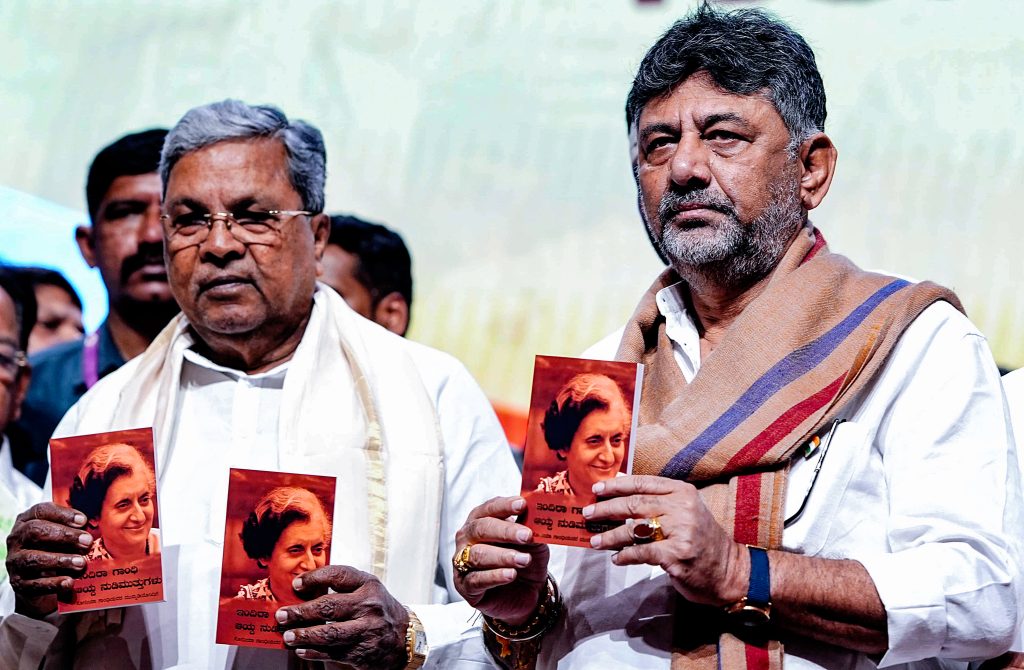
A simmering power struggle between Chief Minister Siddaramaiah and Deputy Chief Minister DK Shivakumar has pushed Karnataka’s Congress government into a crisis moment, raising fears over the stability of the party’s most crucial state
Our Bureau
Bengaluru / New Delhi
The Congress government in Karnataka — the party’s largest and most politically crucial state — is facing its most turbulent moment since sweeping to power last year. What began as quiet whispers about a power-sharing deal between Chief Minister Siddaramaiah and Deputy Chief Minister DK Shivakumar has now exploded into full-blown speculation, public posturing, and open lobbying, threatening to destabilize the government at a time when Congress can least afford internal fractures.
Through the last week, Congress leaders, MLAs and ministers have been pulled into a vortex of competing claims, factional pressures and murmurs that the party High Command may be preparing for a leadership intervention. In Bengaluru, every political movement is now being read as a signal. Every remark is parsed for meaning. And every silence is interpreted as deepening uncertainty.
On Thursday, DK Shivakumar — whose supporters have been pushing aggressively for him to take over the chief minister’s chair — attempted to appear conciliatory. Standing outside Vidhana Soudha, he said he would travel to Delhi “whenever the High Command calls”, signalling publicly that he would abide by whatever decision the central leadership takes. “There is nothing there,” Shivakumar insisted, denying reports of an internal tussle. “Whatever the party says, we will work together.”
But the denials have done little to cool the air. Hours earlier, Congress president Mallikarjun Kharge had said that a final decision on leadership would be taken only after a collective discussion that included Rahul Gandhi, senior central leaders, Siddaramaiah and Shivakumar. It was the clearest indication yet that the Congress leadership has taken note of the rift — and that the matter is far from settled.
The crisis traces back to the 2023 “power-sharing arrangement” between Siddaramaiah and Shivakumar, an understanding that Shivakumar would take over as Chief Minister halfway through the term. While no Congress leader has publicly acknowledged the agreement, it remains widely believed within the party — and it is Shivakumar’s claim to that promise that is now destabilizing the government.
Supporters of the two leaders have begun lobbying openly. While Siddaramaiah’s camp argues that he has earned the mandate to complete a full five-year term — pointing to the party’s strong welfare delivery and steady governance — Shivakumar’s loyalists insist that a transition of power was always the plan, and that delaying it would be a breach of trust.
The party’s troubles intensified on Wednesday, when senior MLA and former minister KN Rajanna bluntly suggested dissolving the Assembly and facing fresh elections under Shivakumar’s leadership. He later retreated slightly, saying his “personal wish” was for Siddaramaiah to complete his term, before floating another name — Home Minister G Parameshwara — as a possible consensus candidate. What Rajanna really did, however, was publicly confirm what everyone in Karnataka already sensed: the Congress government is deeply divided, and its leaders are working to position themselves if Delhi decides on a change.
The Congress High Command, aware that Karnataka is the party’s only major state, is treading cautiously. Any shift in leadership could trigger internal rebellion. But leaving the matter unresolved risks weakening the government from the inside, creating fissures that the BJP — eager to regain power — will exploit relentlessly.
For now, both Siddaramaiah and Shivakumar are trying to sound obedient and calm, repeating that they will “go to Delhi whenever asked”. But their supporters tell a different story: MLAs from both factions have already begun travelling to Delhi to lobby central leaders. Social media posts from Shivakumar hint at promises made and promises not kept. Siddaramaiah’s ministers insist the “people of Karnataka gave him a five-year mandate,” while Shivakumar’s camp says the time has come to “honor the agreement.”
The Congress has long been plagued by factionalism, but in Karnataka the stakes are higher. This is the party’s last big state. It is the engine for the Congress’s national finances, organizational strength and political credibility. Losing Karnataka — or even appearing unstable — would be a severe setback for a party trying to rebuild itself.
As the weekends, the crisis remains unresolved. The High Command will soon summon both leaders to Delhi, where a decision — whether continuity, transition, or compromise — will shape not just the future of Karnataka but also the national prospects of the Congress.
For now, the party’s most important government hangs in the balance, its future dependent on whether its two tallest leaders can put unity above ambition — and whether the High Command can contain a crisis that threatens to erupt fully into the open.