








In a sign of growing South-South cooperation under the BRICS framework, India and Brazil are expanding their strategic partnership across energy, defence, and trade, setting the stage for stronger economic integration between Asia and Latin America
Our Bureau
Mumbai / New Delhi
India and Brazil are taking significant steps to enhance collaboration in the energy sector, a key pillar of their bilateral relations. After meeting Brazilian Vice President Geraldo Alckmin in New Delhi, Union Petroleum and Natural Gas Minister Hardeep Singh Puri said that India currently imports around USD 2.5 billion worth of crude oil annually from Brazil. He emphasized that the relationship with Brazil’s state oil giant Petrobras and other energy players “has room for much greater cooperation.”
“We purchase approximately USD 2.5 billion worth of crude annually from Brazil. Many of our companies have entered into term agreements with Petrobras, and I think we could buy more,” Puri said. He added that India exports refined products like high-speed diesel and aviation fuel to Brazil, underscoring that “there’s tremendous scope for further enhancement.”
The recent MoU between ONGC and Petrobras on onshore exploration is seen as a milestone, marking renewed engagement in hydrocarbons. Puri, who earlier served as India’s ambassador to Brazil, highlighted the growing cooperation in biofuels and clean energy, noting that both countries are founding members of the Global Biofuels Alliance, which now includes 32 nations.
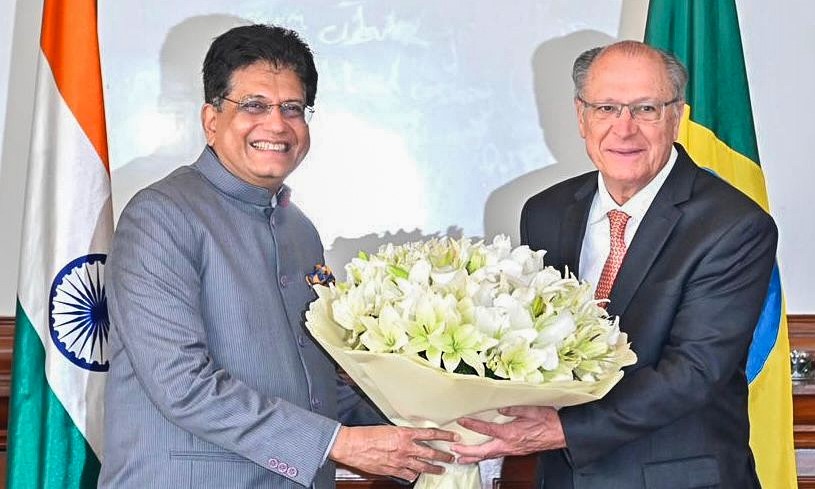
Trade relations between India and Brazil are being re-energized through a proposed expansion of the India-MERCOSUR Preferential Trade Agreement (PTA). During his meeting with Commerce and Industry Minister Piyush Goyal, Vice President Alckmin reaffirmed Brazil’s commitment to strengthening ties within the BRICS and MERCOSUR frameworks.
The two sides agreed to accelerate negotiations to expand tariff preferences and include non-tariff issues such as standards, logistics, and regulatory cooperation. A technical dialogue will begin soon, with the aim of concluding talks within a year. According to India’s Commerce Ministry, both countries are determined to make the PTA more comprehensive, benefitting a larger share of bilateral trade.
Brazil’s role as a core member of MERCOSUR, along with Argentina, Paraguay, and Uruguay, gives India an important entry point into the Latin American market. The trade bloc represents a combined GDP of over USD 2.7 trillion, and India’s existing agreement with it dates back to 2003.
Earlier, during Prime Minister Narendra Modi’s state visit to Brazil in July, both leaders set a goal of raising bilateral trade from USD 12.2 billion to USD 20 billion over the next five years.
Beyond trade and energy, the two countries are expanding cooperation into new and strategic domains. During his meeting with Defence Minister Rajnath Singh, Vice President Alckmin discussed the growing importance of defence and security collaboration. Singh called it “one of the five key pillars of India-Brazil relations,” citing shared democratic values and aspirations to play larger roles in global governance.
Both nations are also exploring joint ventures in defence manufacturing, research partnerships in pharmaceuticals and digital technology, and collaboration in artificial intelligence (AI) and space research. Alckmin met India’s Vice President CP Radhakrishnan to discuss ways to improve connectivity, promote investment, and expand cooperation in healthcare, agriculture, and digitisation.
The discussions align with Brazil’s broader aim to diversify its global partnerships and India’s push to strengthen ties with the Global South—a theme that has gained traction within BRICS, which now includes several new members such as Saudi Arabia, Egypt, and the UAE.
Alckmin’s visit follows the sixth India-Brazil Strategic Dialogue held in New Delhi earlier this month, where both sides discussed cooperation in defence, energy, critical minerals, and pharmaceuticals, as well as coordination in global platforms such as BRICS, IBSA, and COP-30, which Brazil will host next year.
The visit is expected to lay the groundwork for President Luiz Inacio Lula da Silva’s state visit to India in February 2026, a move that could elevate the relationship to a new strategic level. During his press briefing, Alckmin said, “We were very happy to receive Prime Minister Modi in Brazil in July 2024, and now President Lula will visit India early next year.”
The strengthening of India-Brazil relations comes at a time when BRICS nations are seeking to build alternative economic linkages that reflect a multipolar global order. With India driving digital and manufacturing growth and Brazil leading in biofuels and green energy, the partnership reflects a shared vision for sustainable development.
As both countries push for greater representation of developing nations in multilateral bodies, their cooperation within BRICS and beyond reflects the emergence of a South-South economic axis focused on sustainability, innovation, and inclusive growth.
With the upcoming Lula-Modi summit expected to deliver fresh agreements, India and Brazil are poised to transform their bilateral relationship into a model of cross-continental partnership—one that not only strengthens BRICS cohesion but also reshapes the economic narrative of the Global South.