








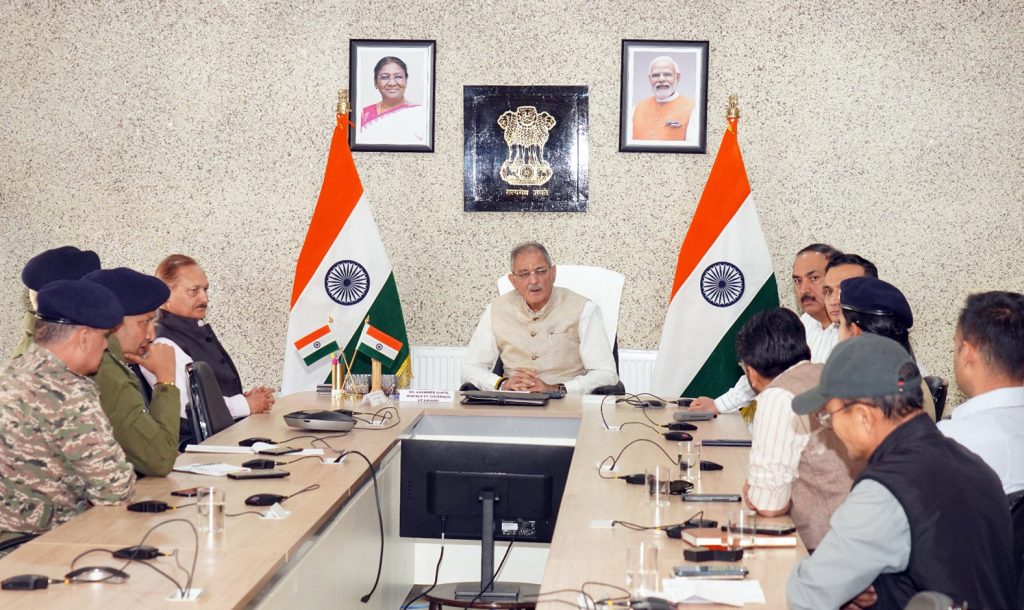
After deadly protests shook Leh, the administration is restoring order, even as the arrest of Sonam Wangchuk raises questions about dissent, democracy, and the search for lasting peace in the region.
Our Bureau
Leh/New Delhi
For the first time since violent clashes erupted in Leh on September 24, killing four people and injuring scores, a sense of normalcy is beginning to return to Ladakh. Markets are reopening, vehicles are back on the streets, and schools have resumed for lower classes. The administration, led by Lieutenant Governor Kavinder Gupta, has assured that calm will be preserved through dialogue, job creation, and a magisterial inquiry into the causes of the unrest.
Yet beneath this veneer of order lies a deeper tension: the government’s decision to detain climate activist and education reformer Sonam Wangchuk under the National Security Act (NSA), accusing him of inciting violence during protests demanding statehood and inclusion of Ladakh under the Sixth Schedule. The move has sparked a fresh debate—was Wangchuk unfairly targeted for being the most prominent voice of Ladakh’s aspirations, or does the government genuinely believe he crossed the line into provocation?
The protests, which had begun as peaceful demonstrations, spiralled into violence when agitators clashed with police and torched a political party office. Police retaliation left four people dead—Jigmet Dorjey, Rinchen Dadul, Stanzin Namgail, and Tsewang Tharchin.
The tragedy shocked the region, forcing the administration to impose curfews and restrict movement. For nearly a week, Ladakh’s bustling town of Leh resembled a ghost city. But in the days since, the administration has carefully relaxed restrictions, allowing markets to operate between 10 a.m. and 6 p.m., public transport to run, and schools up to class eight to reopen.
“After a day or two, everything will be completely normal,” LG Gupta said. “The incident of 24th September was truly painful and tragic, and should not have happened. We are ensuring it does not happen again.”
Behind the scenes, security agencies are focusing on restoring faith in governance. A magisterial inquiry has been announced to determine what triggered the clashes and whether the police response was proportionate. Citizens have been invited to share evidence—oral, written, or video—ensuring transparency in the process.
Amid this drive for peace, Wangchuk’s arrest has emerged as the flashpoint. Known globally for his pioneering work in education and environmental sustainability, Wangchuk has long advocated for Ladakh’s ecological preservation and constitutional safeguards. But the government alleges that his influence over local youth and protest groups may have crossed into instigation.
“Action has been taken based on evidence,” LG Gupta said, defending Wangchuk’s detention under NSA. While the specifics of the evidence have not been disclosed, officials argue that Ladakh’s status as a sensitive border region makes it imperative to clamp down on anything that risks spiralling into instability.
From the government’s perspective, the calculus is clear: Ladakh lies at the frontier with both China and Pakistan. Any escalation of unrest, especially if led by a figure as prominent as Wangchuk, risks not only internal law and order but also national security. The NSA detention, they argue, is a preventive rather than punitive measure.
At the heart of the conflict lies Ladakh’s long-standing demand for statehood and constitutional protections under the Sixth Schedule. Protesters argue that without these safeguards, Ladakh’s fragile ecology and unique culture are at risk of being overwhelmed by unchecked development and demographic changes.
Dialogue, LG Gupta argues, remains the only sustainable path forward. Leaders of the Apex Body of Leh and the Kargil Democratic Alliance have been invited for talks with the Centre, with discussions set to continue until October 6.
The return of daily life to Ladakh’s streets offers hope that the September 24 violence was an aberration rather than a new normal. Yet, the arrest of Sonam Wangchuk casts a shadow over this fragile peace.
For the government, it is a test of balancing security with democratic space. For Ladakh’s people, it is a question of whether their most trusted voices will be silenced or heard.
Ultimately, Ladakh stands at a crossroads: it can either move towards reconciliation through dialogue and trust-building, or risk deepening mistrust if popular leaders are branded as threats rather than partners in peace.
Despite internal unrest, Ladakh’s larger challenge remains the unsettled border with China. Since the deadly Galwan clash of 2020, both armies have engaged in multiple rounds of talks, leading to partial disengagement in some friction points. Yet, tensions persist at Depsang and Demchok, where Chinese presence restricts Indian patrols. The government has boosted infrastructure, building all-weather roads and advanced landing grounds to strengthen deployment. While Beijing insists on “status quo,” India stresses restoration of pre-2020 positions. For Ladakhis, peace at home feels incomplete without security along the frontier, where the shadow of China shapes every strategic calculation.