








With a whirlwind five-nation tour, Prime Minister Narendra Modi reaffirmed India’s growing global clout, blending strategic diplomacy, personal charm, and bold messaging at the BRICS Summit to elevate India’s place on the world stage
Shobhan Saxena
Rio de Janeiro (Brazil)
In the span of just one week, Prime Minister Narendra Modi traversed three continents, addressing parliaments, attending summits, forging bilateral ties, and receiving four of the highest civilian honors from countries across the Global South. From Accra to Windhoek, Modi’s July 2–9 diplomatic tour was not only unprecedented in scale but also profoundly symbolic of India’s rising global stature under his leadership.
The tour—which covered Ghana, Trinidad and Tobago, Argentina, Brazil, and Namibia—culminated in Modi’s participation at the 17th BRICS Summit in Rio de Janeiro, where he reaffirmed India’s hard line on terrorism, deepened economic ties, and made personal inroads with global leaders. Yet beyond the ceremonial grandeur and strategic memorandums, the visit underscored a larger narrative: India is no longer content being a balancing power—it aims to be a leading one.
Strategic Diplomacy in the Global South
In Ghana, PM Modi’s visit was historic—the first by an Indian Prime Minister in over 30 years. The meeting with President John Mahama led to the elevation of bilateral ties to a Comprehensive Partnership, with a particular focus on critical minerals, defense cooperation, and energy. Modi’s being conferred with The Order of the Star of Ghana, the country’s highest civilian award, reflected the depth of trust and mutual respect.
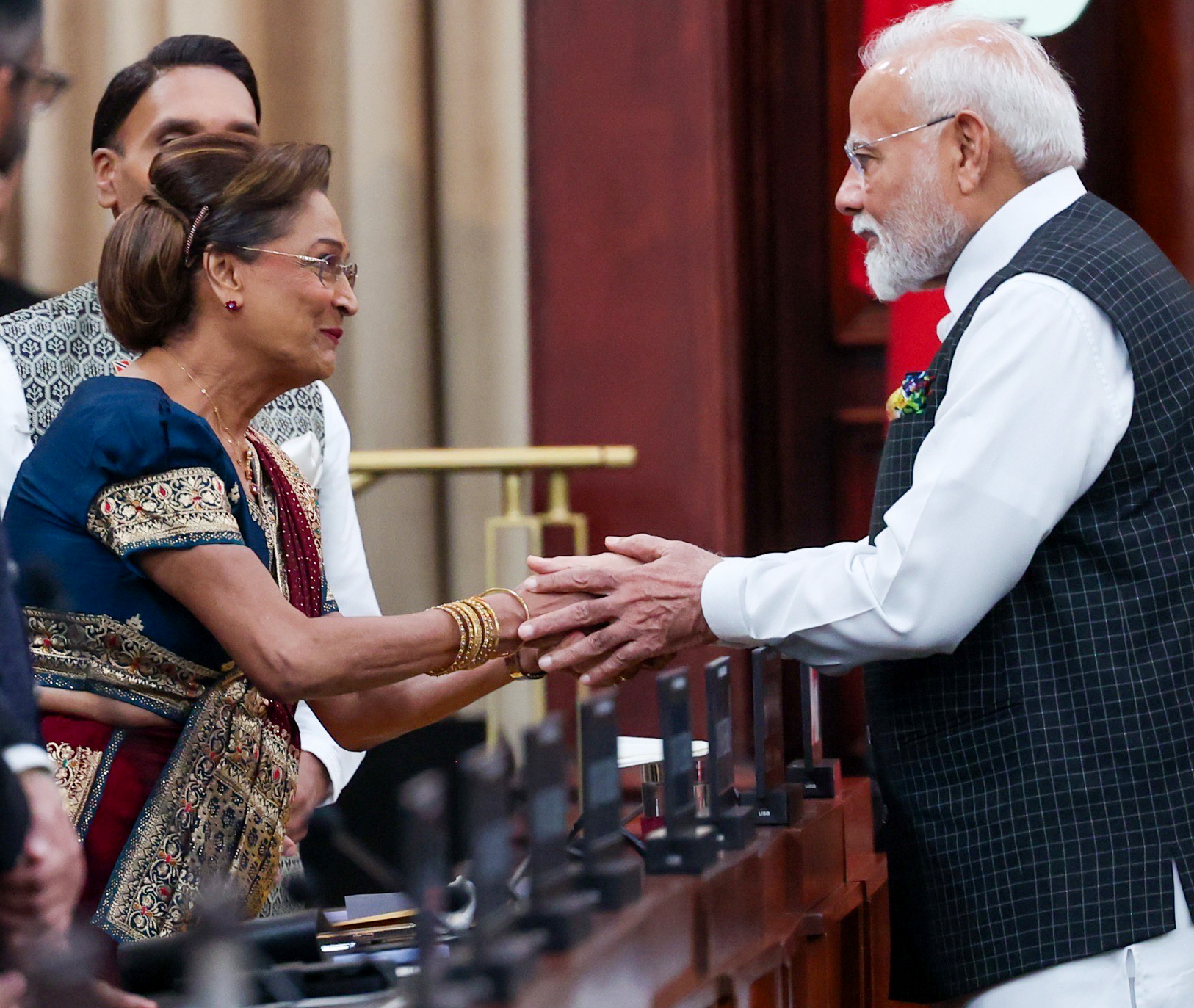
Next stop, Trinidad and Tobago, a country with deep-rooted Indian heritage. Here, Modi extended OCI eligibility to the sixth generation of the Indian diaspora and received The Order of the Republic of Trinidad and Tobago. More than policy, this was diplomacy of the heart—a recognition of cultural and emotional bonds that form the backbone of India’s soft power.
In Trinidad and Tobago, Prime Minister Narendra Modi received a rousing welcome from the vibrant Indian diaspora, many of whom trace their roots to Bihar and Uttar Pradesh. Addressing the community during a special event in Port of Spain, Modi celebrated the deep historical and cultural ties between India and the Caribbean nation, calling the diaspora a “living bridge” that has preserved and promoted Indian heritage for over 175 years.
Modi praised the community’s contributions to Trinidad and Tobago’s society and politics, including the rise of Indian-origin leaders to top positions. He also highlighted India’s growing global influence, urging the diaspora to take pride in their roots and act as ambassadors of India’s values and progress in their adopted homeland.
In Argentina, PM Modi’s meeting with President Javier Milei led to new momentum in India-Latin America relations, focusing on defense, agriculture, oil and gas, and renewable energy. The conferring of the Key to Buenos Aires and expressions of mutual interest in deeper collaboration marked a fresh chapter in the relationship.
BRICS: India Takes the Lead
The diplomatic highlight of the tour was clearly Modi’s role at the BRICS Summit in Brazil, where he not only made a strong case for equity in global governance but also ensured that India’s core concerns—especially on terrorism—were front and center in the final declaration. The BRICS joint condemnation of the Pahalgam terror attack was seen as a significant win for Indian diplomacy.
According to BJP spokesperson Sudhanshu Trivedi, Modi’s insistence that “victims and perpetrators of terror cannot be equated” was a major strategic achievement. It also contrasted with India’s recent refusal to sign a Shanghai Cooperation Organization statement that failed to mention the same attack—a calculated diplomatic move to assert India’s moral clarity.
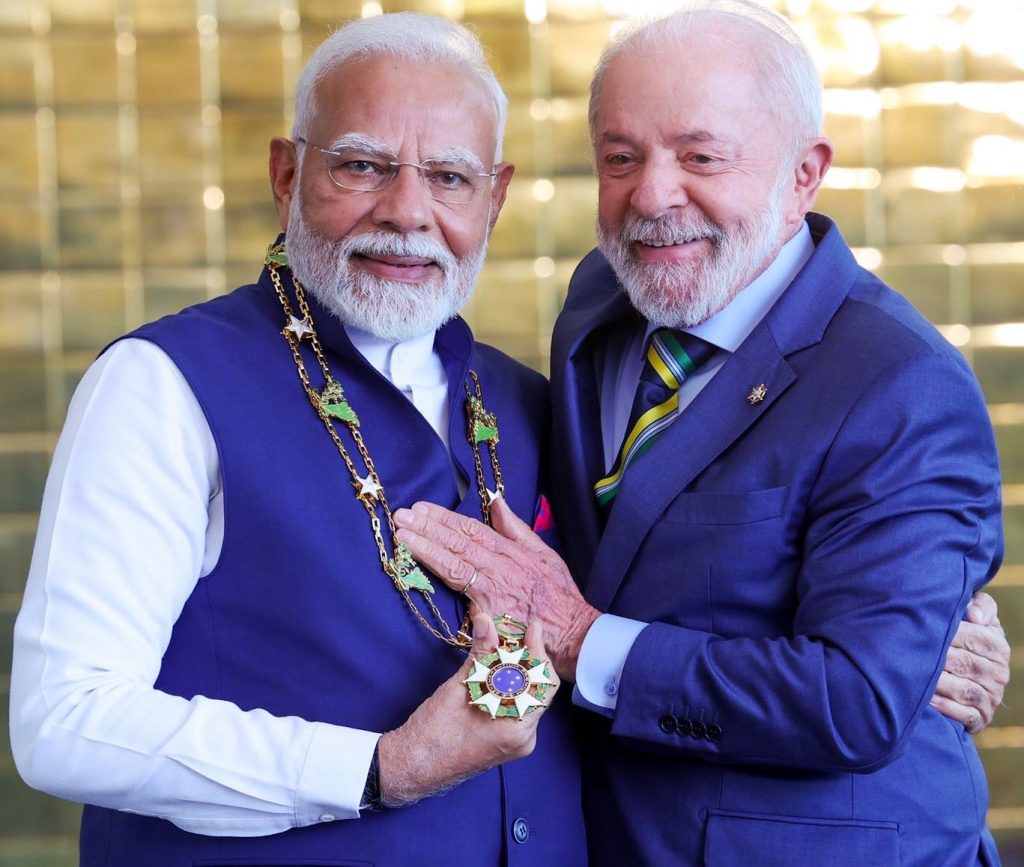
In Brasilia, Modi held a bilateral meeting with President Lula da Silva, where the two leaders discussed trade, technology, agriculture, and space cooperation, further strengthening the India-Brazil Strategic Partnership. For his efforts, Modi was conferred Brazil’s highest civilian honor, the Grand Collar of the National Order of the Southern Cross.
During his bilateral meeting with Brazilian President Luiz Inácio Lula da Silva in Brasília, Prime Minister Narendra Modi focused on deepening the India-Brazil Strategic Partnership, with both leaders aligning on a shared vision for equitable global governance and South-South cooperation. The discussions spanned a wide range of sectors including defense, space technology, agriculture, renewable energy, and health, reflecting a desire to elevate bilateral ties beyond traditional frameworks.

Notably, the two leaders agreed to enhance trade facilitation, promote bilateral investments, and expand collaboration in biofuels and digital innovation. Modi also emphasized the importance of Brazil’s role in strengthening multilateralism, and reiterated India’s commitment to climate action and technology transfer in coordination with Brazil’s priorities.
Their camaraderie was evident, with Lula lauding India’s G20 presidency and its role in bringing the African Union into the G20, a move that Brazil supported. The visit reaffirmed the deepening trust between two key BRICS partners.
From Geopolitics to People’s Power
The tour concluded in Namibia, where Modi addressed Parliament—his 17th such address in a foreign legislature, equaling the total of all Congress Prime Ministers before him. His speech, received with a standing ovation, focused on cooperation, not competition—a vision of shared growth with Africa.
Modi’s remarks were deeply aligned with Africa’s Agenda 2063, emphasizing local innovation, defense cooperation, and India’s $12 billion development partnership on the continent. Namibia also became the first country to adopt India’s UPI (Unified Payments Interface), a milestone in digital diplomacy.
PM Modi was awarded Namibia’s highest civilian honor, the Order of the Most Ancient Welwitschia Mirabilis, and paid homage to the country’s founding father at the Heroes Acre memorial. He described India-Namibia ties as born of “struggle, cooperation, and mutual trust”—not politics, but shared purpose.
The Modi Doctrine
Perhaps the most striking feature of Modi’s diplomacy is his ability to personalize the global stage. From recalling the Bihari roots of Trinidad and Tobago’s leadership to connecting with African parliaments on issues of mutual growth and dignity, Modi is bridging geography with identity, and geopolitics with emotion.
His speeches are often punctuated with cultural references, local languages, and historical allusions that resonate beyond policy frameworks. This ability to make personal connections with world leaders and foreign audiences is what sets his global outreach apart.
As BJP’s Trivedi remarked, the tour wasn’t just about signing deals—it was about setting a new era of strategic, cultural, and economic collaboration, particularly with Africa and the Global South.
Redefining India’s Global Role
Over the years, Modi has gradually shifted India’s global image from that of a non-aligned balancing actor to a proactive global player. His parliamentary addresses, multilateral speeches, and bilateral engagements—now across every inhabited continent—are shaping India’s identity as a civilizational power with 21st-century aspirations.

His diplomatic outreach is also layered with technological cooperation—from space collaboration with Brazil to UPI expansion in Namibia—and underpinned by India’s firm stance on terrorism, which finds growing resonance in a world increasingly wary of grey-zone conflicts.
The personal accolades PM Modi has received on this tour alone—not just four national honors but widespread public warmth—testify to how India is increasingly seen as a partner of choice by nations eager to diversify beyond traditional power centers.
Conclusion: India Rising
In seven days and five countries, PM Narendra Modi reshaped conversations, strengthened partnerships, and reasserted India’s voice on the global stage. The success of the tour was not just measured in handshakes and headlines—it lay in the clarity of India’s vision: inclusive growth, cultural respect, technological innovation, and uncompromising resolve on global terror.
As Modi returned to New Delhi, the message from Accra to Windhoek was loud and clear: India is not just participating in global diplomacy—it is helping define it.
1 thought on “Prime Minister Modi’s Global Connect: Five Nations, One Vision”
Very Well said, thanks to Mr. Shobhan ji.