








By Renu Mehta
Toronto
Phoolan Devi’s story has already been told many times. From Bandit Queen to numerous books, documentaries and adaptations, the life of India’s famed “Bandit Queen” has long occupied a complicated place in the public imagination.
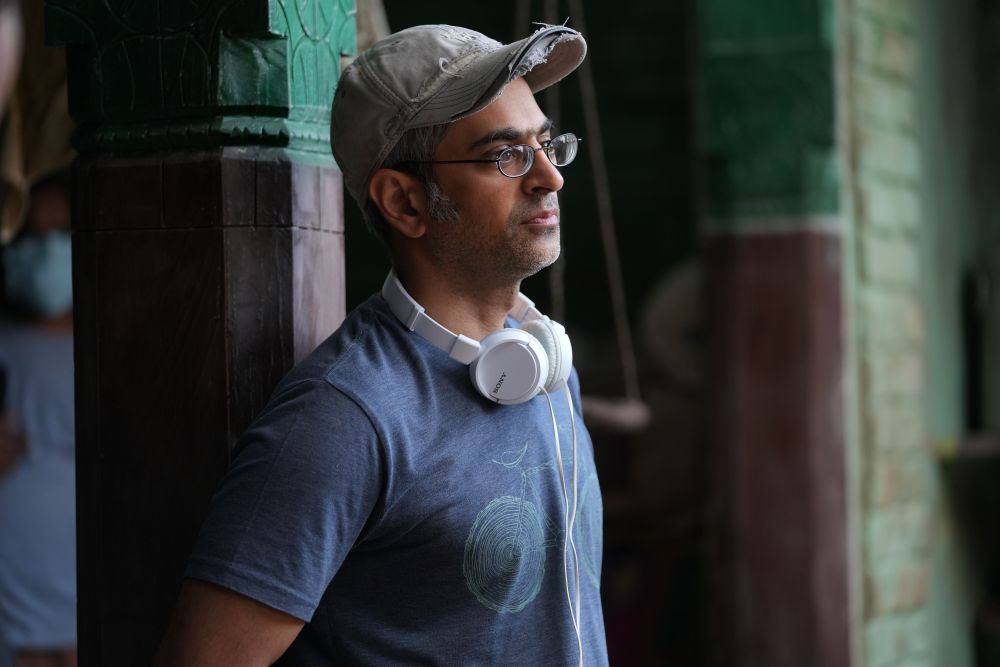
Film maker Richie Mehta is bringing that story to the Toronto International Film festival (TIFF) and talks on why he initially resisted telling the Phoolan story, the decision to focus on one defining chapter of her life, and the emotional and physical demands of bringing it to the screen.
For the Toronto based director, revisiting that story was never part of the original plan who initially questioned whether he was the right person to tell such a deeply Indian story. But after years of persistence from the film’s producers, extensive research and a process of rethinking how Phoolan’s life could be represented without exploiting her trauma, he eventually found his way in.
Rather than attempt to chronicle her entire life, Mehta chose to focus on one defining episode, using a focused, intensely personal story to explore the larger forces that shaped Phoolan Devi.
Here, he talks about that decision, discovering first-time actor Sneha Kumari, creating the film’s oppressive action sequences, and the emotional toll of immersing himself in Phoolan’s autobiography.
Q: Phoolan’s story has been told many times, starting with Bandit Queen. Why did you want to tell her story again?
Richie Mehta: I didn’t want to at the outset. As you said, the story had been told many times. And I thought, ‘Who the hell am I to tell it as an NRI Punjabi from Toronto?’
But there were these amazing producers in India from Namah Pictures – Shareen Mantri, Kanwal Kohli and Kishore Arora – who just wouldn’t leave me alone. They had acquired the rights to her autobiography and approached me about directing a project based on it.
I told them I didn’t think I was the right person, and I persisted on that track for a long time. But they were very, very nice people and just kept persisting the opposite and eventually wore me down.
I read the material because I wanted to read her words and understand her perspective. There was a whole process to it. I worked with my brother for a while, along with another writer, Anu Singh..
We explored various incarnations of the story, and for a while none of them were working. I remained unsure throughout the process whether I was even the right person to be involved.
Eventually, I had the idea to distill her story down and centralize it around one major incident. That opened up all kinds of possibilities of what we could explore and what I felt was relevant to who she was and what she might represent.
I kept saying to myself, If anyone wants to do it, they can. Please. And nobody did.
Eventually, I thought, Okay, well, nobody’s going to do it, so I’ll do it. I’ll hope for the best and do the very best I can with it.
Q: Why was it important to compress her story into such an intense period rather than tell her entire life?
Richie Mehta: The more we explored telling her life story which, as you said, has been told in different incarnations, the more blatantly obvious it became to me that you would have to show certain chapters in her life that, in my view, are unshowable.
You can’t just skip over those things when you’re showing someone’s entire life because they are crucial to the formation of who that person becomes.
For me, it was a cardinal rule that we would never, ever show the sexual violence. I just don’t think it was in any way right to do that.
With that omission, I couldn’t quite wrap my head around what to show and what the relevance of her story today could be in that context until I zeroed in on that particular incident, which is one chapter of her book.
I felt it encapsulated everything she was up against. It represented the macrocosm of the world she was fighting against.
If we did it right, despite the fact that there is some violence, but it is war violence, the kind of violence you’ve seen before in films. I felt that even younger viewers could watch it. Teenagers could watch it, and people who were her age could watch this, and may be ask the right questions coming out of it.
Q: How did you cast the actress who plays Phoolan?
Richie Mehta: It was laborious, but I have to hand it to my amazing casting director, Mukesh Chhabra, who just did the work. He and his team held workshops and auditions across various regions of Central India and eventually found Sneha Kumari, who we thought beautifully encapsulated the spirit of what we were trying to show. It was the first film she’s ever done. She had extensive theatre experience in the region, and we did more workshops with her. We also worked with Aakash Dahiya, who’s essentially her right hand during the assault, one of her trusted men.
We had them all work closely together, along with a couple of months of commando training that everyone received. By the end of that, we could really see the people we were trying to represent.
Q: Did you have to do extensive workshops, particularly for the action sequences?
Richie Mehta: Absolutely. The action is very much about rehearsal and planning. It’s geography-based and story-based.
I had written the action a certain way, then we found the location and adapted the action to it. Amritpal Singh, our action director and stunt coordinator, was incredible with his team. We just worked it out together.
I wanted the action to feel experiential and oppressive. Every moment, you as a viewer should feel the weight of what they are doing to her.
You can take it personally as much as the film allows you to in two dimensions. I wanted that weight to keep pummelling down on you so you understood the pressure she was feeling. Hopefully, we’ve achieved that.
Q: How did you approach the action without allowing the spectacle to overwhelm Phoolan’s humanity? She’s surrounded by thousands of armed men.
Richie Mehta: It’s all about point of view and perspective.
Every time we have an action moment or a scene, even if it’s big in scale, it’s either from her point of view or from the constable’s point of view. It’s from nobody else’s point of view.
That makes it experiential and very personal.
Also, most of the time, by the time you realize what is actually happening in a scene, it’s already over at that point. The scenes don’t last very long. They might feel like they do, but they don’t. So a lot of it was about not overstaying our welcome. It took a long time to work that out and make sure we weren’t indulging ourselves in the action we were depicting.
Q: You did extensive research on Phoolan Devi, including reading her autobiography and speaking to people connected to the events. Did that research change your understanding of her?
Richie Mehta: There were lots of things. Nothing changed my mind as much as it clarified certain things. It shed light on certain aspects because she would describe things from her point of view, and then sometimes you would get information from people on the ground that corroborated her point of view; it also gives you a different aspect of what happened.
One example of that is the mosque scene towards the end. I don’t want to ruin it if you’re publishing this, but she wrote about it from her point of view.
What I’ve shown from her point of view is as accurate as what I thought she wrote. But I also learned that something else was happening inside that space at the end, something she wasn’t necessarily privy to, but that people who were actually there knew had happened.
So I got two complementary versions of the same event which allowed me to create that moment.
Q: How long did the shoot take?
Richie Mehta: It was a couple of months in 2025 in Chambal. We moved very fast.
Q: How long did the entire project take, from concept to completion?
Richie Mehta: They approached me in 2019, and here we are.
Obviously, in the middle of that, I went and did the series Poacher. But my brother and I were working on this behind the scenes while I was doing Poacher. After Poacher was completed, I took it up again, had the idea of localizing it, and then fully dove into it for the last, I don’t know, I guess it’s been two and a half to three years now.
Q: What was the most challenging moment in making the film?
Richie Mehta: There are two types of challenges.
One is the mental and emotional challenge which is digesting the material. To write something like this, you have to absorb everything in the source material and to have it stuck in your mind. Very simply, what she has written is the most difficult thing I’ve ever had to read. It would be the most difficult thing that anyone’s ever had to read.
The emotional point of view she has on the experiences she’s endured, and just reading it, was harrowing for me, much less actually experiencing it. Its incomprehensible to me, especially for such a young girl.
To have absorbed all of that – absorbed, absorbed, absorbed – after a certain point becomes toxic. Then the cathartic part is getting it out, whether through writing or collaborating with amazing people. We had amazing people working on this. In fact, one of my conditions for working on the film was that you had to be a good human being.
I had to surround myself with positivity.
But that catharsis isn’t fully done yet because now comes the release of the film—getting it out there, having these discussions and understanding what it does, and hopefully fully expunging it from my system in a positive context.
The physical endurance of making the film was also very, very tough. It was 45 to 50 degrees where we were shooting those action scenes. Shooting in that region was extremely physically challenging. It was the most physically challenging thing I’ve ever done.