








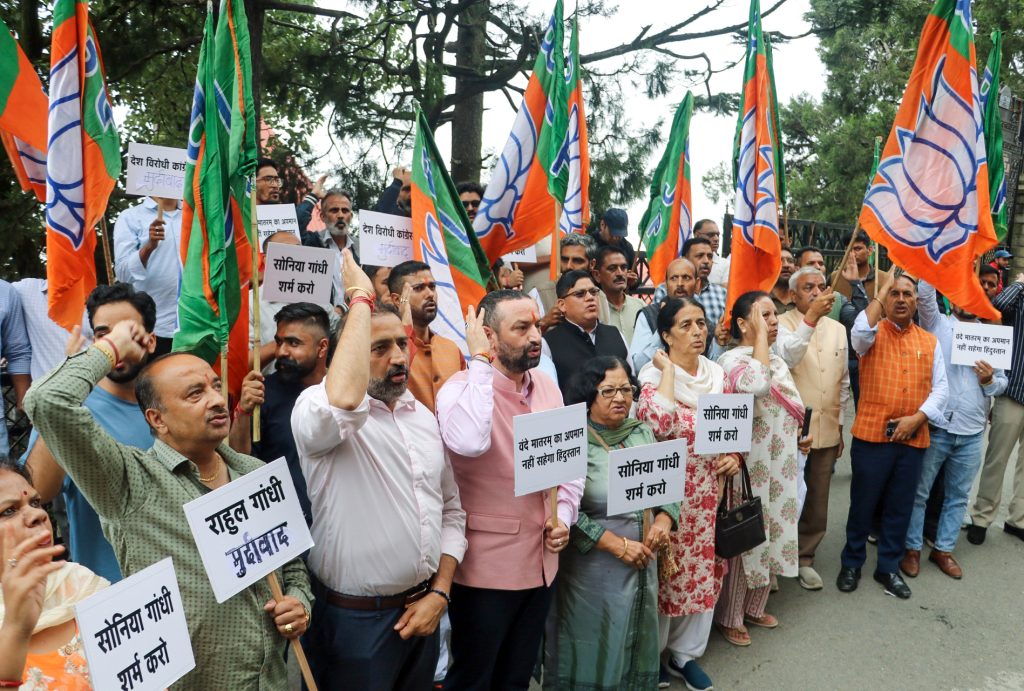
The battle over how India’s national song should be sung is rapidly turning into a larger political contest over patriotism, constitutional loyalty and the meaning of nationalism.
Our Bureau
NEW DELHI
Few songs in India’s political history carry the emotional and symbolic weight of Vande Mataram. Born in the freedom movement and closely associated with the struggle against British rule, the song has long occupied a special place in the country’s national consciousness. But a political controversy over how much of it should be sung is now turning the national song into something more contentious — a test of patriotism and loyalty.
The immediate trigger is the Congress Working Committee’s decision that only the first two stanzas of Vande Mataram would be sung at party events, with the party citing its 1937 resolution. The BJP has seized on the decision to accuse the Congress of appeasement and of disrespecting a song that inspired generations of freedom fighters.
Union Home Minister Amit Shah has gone further, arguing that the Congress decision repeats what he described as a historical mistake and linking the 1937 decision to the politics that preceded Partition. He has also praised the Narendra Modi government’s move to make the full rendition of Vande Mataram part of official programmes.
The political message is unmistakable: for the BJP, the full song is increasingly being presented not simply as a cultural or historical choice but as an expression of national commitment.
Union Minister Rajnath Singh made the argument even more explicitly. He said that refusal to honour the national song could put a question mark over a person’s patriotism, just as refusal to abide by parliamentary law could raise questions about constitutional loyalty.
This is where the controversy becomes politically potent. Once the debate moves from the appropriate rendition of a national song to questions about who is patriotic and who is not, Vande Mataram becomes a political loyalty test.
The Congress, however, is resisting that framing. Its argument, reflected in the statements of Congress leaders, is that there is no refusal to honour the national song. The disagreement is over which portions should be sung at party events and whether a historical convention should be altered.
Himachal Pradesh minister Jagat Singh Negi argued that the controversy was being manufactured to promote what he called “fake nationalism” and divert attention from issues such as unemployment, inflation, farmers’ concerns and the state’s apple economy. He maintained that Vande Mataram had played an important role in the freedom struggle but said national symbols should be used according to established rules and procedures.
The Congress’s response therefore seeks to move the debate away from patriotism and towards political priorities. Its leaders are effectively asking whether the country should be debating the number of stanzas in a national song when there are economic and social problems demanding attention.
Rajya Sabha MP Kapil Sibal has taken a similar line, questioning whether BJP leaders themselves have consistently sung all the stanzas of Vande Mataram at official or private functions since Independence. His argument is that the BJP is selectively using the issue for political advantage.
But the BJP’s counterargument is equally political: that the Congress’s decision cannot be separated from the history of the national song and the circumstances surrounding its partial adoption.
The danger for both sides is that the debate could reduce a complex historical legacy to a simple binary: sing the entire song and prove your patriotism, or restrict its rendition and invite suspicion.
The BJP has political reasons to push the issue. Nationalism remains one of its strongest ideological themes, and Vande Mataram provides a powerful historical symbol around which that narrative can be built. The Congress, meanwhile, cannot afford to allow the BJP to define patriotism exclusively on its terms.
The result is a contest in which a national song has become a proxy for a much larger political battle.
At one level, the argument is about two stanzas versus the complete song. At another, it is about competing visions of India — cultural nationalism on one side and a more explicitly pluralist interpretation of nationalism on the other.