








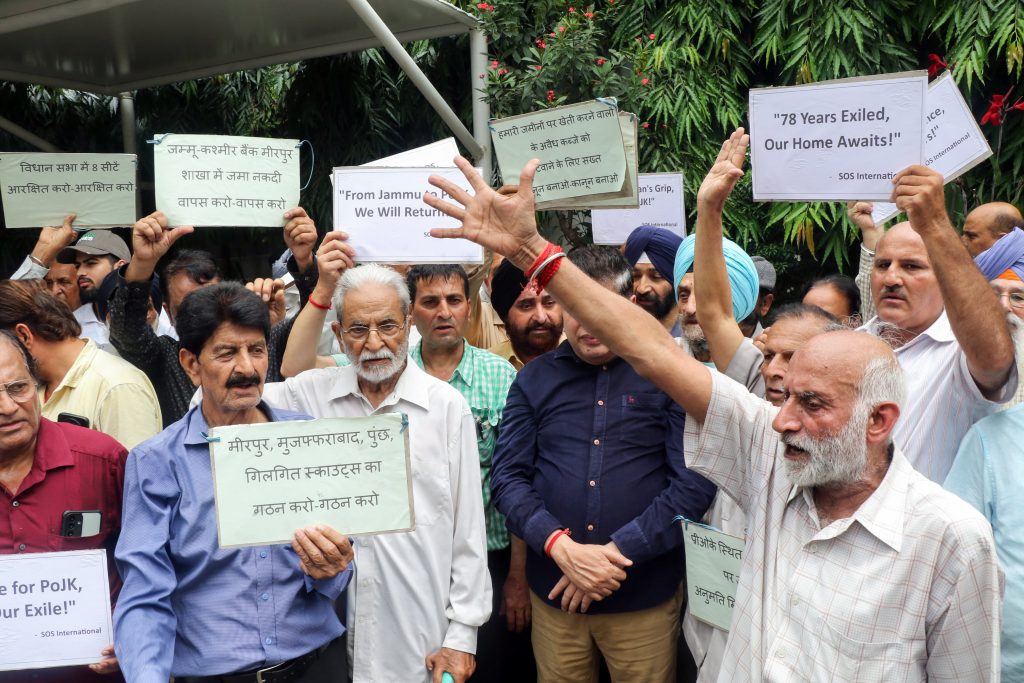
Violent unrest in Pakistan-occupied Jammu and Kashmir has become more than a local law-and-order crisis, exposing the widening cracks in Pakistan’s political legitimacy, economic stability and governance.
Our Bureau
Muzaffarabad [PoJK] / New Delhi
The latest violence in Pakistan-occupied Jammu and Kashmir (PoJK) has once again highlighted the growing internal challenges confronting Pakistan. While Islamabad has often sought to project itself internationally as a defender of the Kashmiri cause, the unrest in territories under its own control has raised uncomfortable questions about governance, democratic credibility and public dissatisfaction.
The immediate trigger has been protests, allegations of excessive force by security agencies and opposition accusations that the recently held elections in PoJK were manipulated. Pakistan Tehreek-e-Insaf (PTI) dismissed the polls as “fraudulent”, while the Human Rights Commission of Pakistan (HRCP) and opposition parties demanded an independent inquiry into reports of deaths and injuries during the unrest. The controversy has reinforced the perception that Pakistan is struggling to manage discontent even in territories it administers.
The political controversy surrounding the PoJK elections reflects a broader crisis of confidence in Pakistan’s democratic institutions.
Former Prime Minister of PoJK Sardar Qayyum Niazi alleged that the elections had been pre-arranged and questioned why polling in a territory of barely four million people required three phases when Pakistan itself conducts nationwide elections in a single phase. He further alleged that force had been used against peaceful protesters and claimed that dissent was being suppressed rather than addressed.
Whether or not all these allegations are independently verified, the fact that a major opposition party has boycotted the electoral process and publicly questioned its legitimacy weakens Pakistan’s democratic credentials. When elections themselves become contested, governments face increasing difficulty claiming public consent.
The calls by the HRCP for an impartial investigation further underline that concerns over the handling of protests are no longer confined to political opponents but have entered Pakistan’s wider civil society discourse.
The developments in PoJK do not exist in isolation.
Pakistan has simultaneously faced continuing unrest in Balochistan, security challenges along its western borders, economic hardship, political polarization and an uncertain relationship between civilian leaders and the military establishment. Each crisis reinforces the other.
Former Indian Ambassador Vidya Bhushan Soni argued that growing frustration is emerging because Pakistan’s expectations of improving its international standing and attracting economic assistance have not materialized. According to him, many groups now believe Islamabad is paying greater attention to projecting itself internationally than addressing domestic grievances.
His remarks point to an important reality. Countries experiencing prolonged economic stress often witness rising political mobilization as citizens become increasingly impatient with declining living standards and weak governance.
Pakistan’s economic difficulties form the backdrop to the unrest.
In PoJK, protesters have increasingly framed their demands around governance and accountability rather than purely constitutional questions. This indicates that everyday economic and administrative concerns are becoming central to political mobilization.
The perception that authorities are responding with force instead of dialogue risks further eroding public confidence.
Pakistan has long attempted to highlight alleged human rights concerns in Indian-administered Jammu and Kashmir before international forums.
However, unrest within Pakistan-administered territory complicates that diplomatic narrative.
Former PoJK Prime Minister Niazi himself acknowledged this dilemma, saying those who once campaigned internationally on Kashmir now found it difficult to defend Pakistan’s own record because of developments inside PoJK.
The Joint Awami Action Committee has gone a step further by calling upon the United Nations, international media and global human rights organizations to independently investigate recent events. Such appeals internationalize what Islamabad would likely prefer to treat as an internal security matter.
At the same time, India has renewed its diplomatic assertion that the territory remains an integral part of India. The Ministry of External Affairs recently criticized international media for describing the region as “Pakistani Kashmir”, reiterating New Delhi’s position that it is Pakistan-occupied Jammu and Kashmir.
The unrest in PoJK should not be viewed merely as an isolated regional disturbance. Rather, it reflects the cumulative pressures facing the Pakistani state.
Political distrust, allegations of electoral manipulation, economic hardship and growing regional dissatisfaction are combining to create an increasingly fragile domestic environment. Governments can often manage one crisis at a time, but simultaneous political, economic and security challenges are far more difficult to contain.
The immediate protests may eventually subside, but the underlying issues appear more structural than temporary. Unless Pakistan succeeds in rebuilding public confidence through credible institutions, economic recovery and greater political accommodation, similar episodes are likely to recur.
For India, the developments reinforce its longstanding contention that Pakistan’s internal governance challenges increasingly undermine Islamabad’s international messaging on Kashmir. More broadly, the events demonstrate that stability cannot be sustained through security measures alone. Lasting political legitimacy depends on institutions that command public trust—something Pakistan appears to be finding increasingly difficult to achieve.