








As the Narendra Modi government projects ethanol blending as a pillar of India’s energy security strategy, the Opposition has turned the policy into a political flashpoint, raising questions over fuel prices, vehicle performance, consumer choice and food security.
Our Bureau
Manila / New Delhi
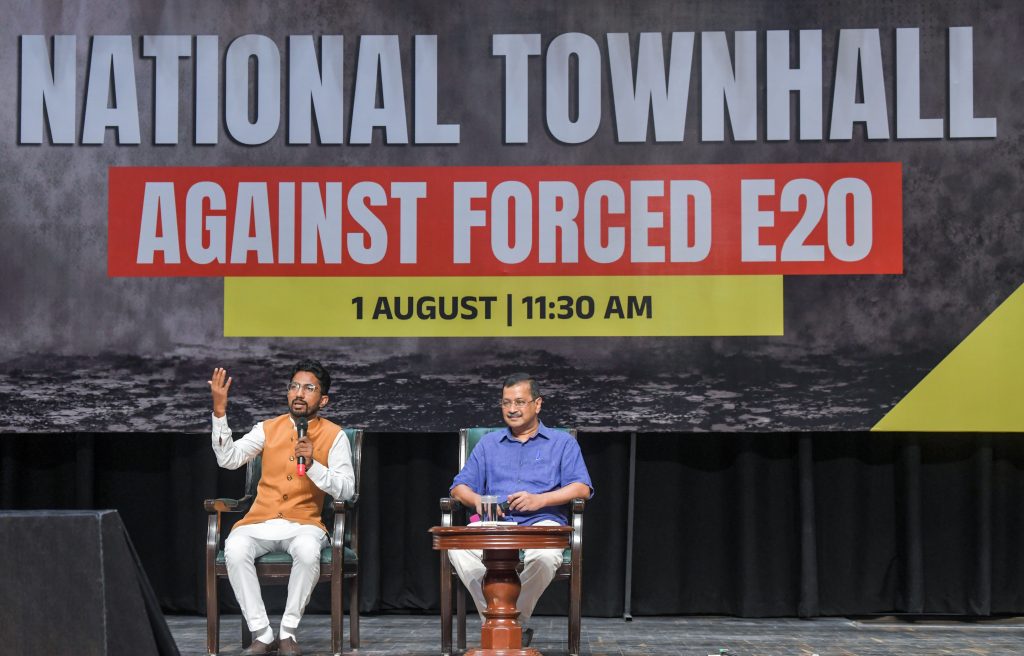
India’s ambitious ethanol blending programme, once viewed largely as a technical energy policy, has suddenly become one of the country’s most contentious political issues. The immediate trigger has been a campaign launched by the Aam Aadmi Party (AAP) and its national convenor Arvind Kejriwal against the Centre’s E20 (20 per cent ethanol-blended petrol) policy, accusing the government of imposing a fuel that allegedly damages vehicles while offering consumers no economic benefit.
The Bharatiya Janata Party (BJP)-led government, however, has responded aggressively, presenting ethanol blending as a strategic necessity that shields India from volatile global oil markets, reduces dependence on imported crude, cuts emissions and creates a massive new market for Indian farmers.
The debate has now expanded beyond fuel chemistry into economics, agriculture, consumer rights and electoral politics.
The Centre’s strongest argument revolves around energy security.
According to the Ministry of Petroleum and Natural Gas, ethanol blending protected Indian consumers during periods of exceptionally high global crude prices. The ministry argues that if petrol had contained no ethanol when crude prices surged to around USD 135 per barrel, petrol prices in Delhi could have touched nearly ₹125 per litre. Instead, consumers paid ₹94.77 per litre because one-fifth of every litre consisted of domestically produced ethanol purchased at stable prices.
The government describes ethanol not as a subsidy but as “India’s energy insurance,” claiming that the programme has generated foreign exchange savings exceeding ₹1.97 lakh crore, substituted more than 316 lakh metric tonnes of crude imports and reduced carbon emissions significantly. It also says the programme has channelled over ₹1.66 lakh crore directly to farmers and distillers, helping rural incomes while reducing India’s heavy dependence on imported crude oil.
The AAP has chosen a very different political framing.
Rather than challenging ethanol’s environmental credentials, Kejriwal has focused on consumer concerns. He argues that motorists are paying more without receiving any tangible benefit.
The party has demanded three immediate changes: consumers should be allowed to choose between pure petrol and E20 fuel at petrol pumps; E20 should be priced lower than regular petrol; and overall petrol prices should fall below ₹84 per litre.
The political messaging is straightforward.
If ethanol reduces mileage—as critics allege—then consumers effectively pay more per kilometre despite paying the same price at the pump. Kejriwal has further questioned whether adequate scientific studies exist and accused the government of forcing the policy on motorists.
By focusing on household expenses rather than technical fuel specifications, the Opposition is attempting to transform a specialized policy issue into a pocketbook concern.
AAP leaders claim ethanol blending reduces fuel efficiency and damages engines, especially older vehicles. They argue consumers deserve the freedom to choose fuels suited to their vehicles. The Petroleum Ministry has categorically rejected these allegations.
According to the ministry, there is “no verified evidence” linking E20 fuel to widespread engine damage after more than 25 years of phased implementation and scientific evaluation. It notes that over 20 crore two-wheelers and more than three crore petrol cars have successfully operated using E15-plus and E20 fuels. The ministry also cites service data from a major automobile manufacturer involving 2.84 crore vehicles—including approximately 1.5 crore older vehicles not originally certified for E20—which reportedly found no ethanol-related corrosion or abnormal wear.
Another important dimension involves agriculture.
The government presents ethanol blending as a major rural development initiative. Surplus sugarcane, broken rice and excess food grains are diverted towards ethanol production, creating stable demand for agricultural produce while providing farmers with an additional income stream.
Supporters from Punjab’s rice milling industry argue the programme has reduced pressure on millers while strengthening farm incomes by creating an assured market for surplus paddy.
This concern mirrors debates witnessed earlier in countries such as Brazil and the United States, where biofuel expansion periodically triggered discussions over agricultural land use and food prices.
The timing of the controversy is unlikely to be accidental.
With elections approaching in several states and fuel prices remaining politically sensitive, the Opposition has found an issue capable of connecting environmental policy with consumer economics. By demanding “choice” rather than outright abolition of ethanol blending, AAP is positioning itself as defending motorists against what it portrays as bureaucratic overreach.
Ultimately, the ethanol controversy reflects a broader reality of policymaking in India. Measures that may appear economically rational or strategically beneficial can still become politically contentious if consumers perceive immediate costs without equally visible benefits.