








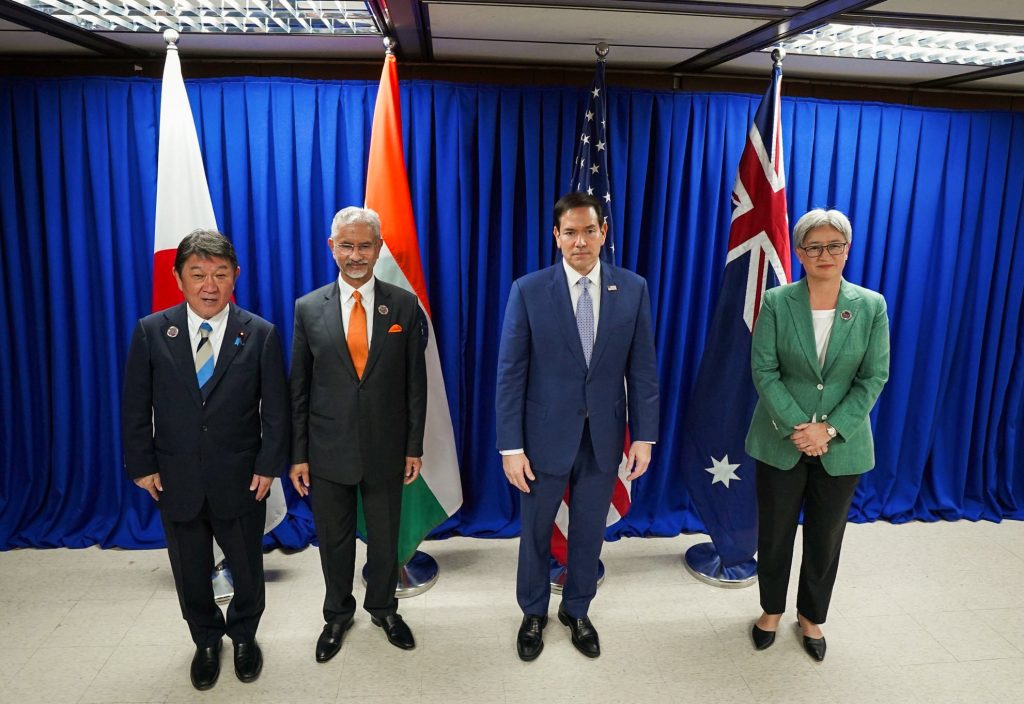
As New Delhi cautiously normalizes ties with Beijing while deepening cooperation within the Quad, India is pursuing a calibrated strategy that seeks stability on its northern border without compromising its Indo-Pacific partnerships.
Our Bureau
Manila / New Delhi
India’s evolving engagement with China and its simultaneous commitment to the Quad underline one of the defining features of New Delhi’s foreign policy: strategic balancing rather than strategic alignment. Recent diplomatic exchanges in Manila have illustrated how India is attempting to stabilize relations with Beijing after years of border tensions while continuing to strengthen security and economic partnerships with the United States, Japan and Australia under the Quad framework.
The parallel diplomatic engagements — External Affairs Minister S. Jaishankar’s meeting with Chinese Foreign Minister Wang Yi and the Quad Foreign Ministers’ Meeting — demonstrate that India sees no contradiction between improving bilateral ties with China and participating in regional groupings that seek to preserve a free and open Indo-Pacific. Instead, New Delhi appears to be pursuing a dual-track strategy that combines engagement with deterrence.
The latest round of India-China dialogue reflects a gradual thaw following the prolonged military standoff in eastern Ladakh that began in 2020. Chinese Foreign Minister Wang Yi described India and China as “partners, not competitors, and opportunities, not threats,” arguing that recent interactions between President Xi Jinping and Prime Minister Narendra Modi had placed bilateral ties back on a path of improvement. He called for expanded cooperation in trade, people-to-people exchanges and multilateral forums, while emphasizing that both countries, as representatives of the Global South, should contribute to a more multipolar international order.
The rhetoric from Beijing reflects China’s interest in reducing tensions with India at a time of increasing geopolitical competition with the United States. Stable ties with New Delhi would allow Beijing to avoid simultaneously managing strategic rivalry on multiple fronts while reinforcing its narrative of Asian cooperation.
India, however, continues to approach the relationship with greater caution. Jaishankar reiterated that peace and tranquility along the Line of Actual Control (LAC) remain the indispensable foundation for restoring normal bilateral relations. He stressed that stability on the frontier is a “pre-requisite” for broader diplomatic engagement and argued that any durable relationship must rest on mutual respect, mutual interest and mutual sensitivity. He also raised longstanding concerns regarding market access, trade imbalances and supply chain reliability, signaling that economic issues remain intertwined with the political relationship.
This emphasis reflects India’s post-2020 approach towards China. Unlike the earlier period when economic engagement often progressed independently of border disputes, New Delhi has increasingly linked broader bilateral normalization to sustained stability along the frontier. While disengagement efforts have reduced immediate military tensions, strategic trust remains limited.
At the same time, India’s participation in the Quad continues to expand. During the Foreign Ministers’ Meeting in Manila, India joined the United States, Japan and Australia in reaffirming their commitment to a free and open Indo-Pacific while expressing unwavering support for ASEAN centrality. The ministers discussed maritime security, critical technologies, economic resilience, humanitarian assistance and emerging regional challenges, underscoring the Quad’s growing role as a platform for practical cooperation rather than a formal military alliance.
The Quad’s agenda has steadily broadened beyond traditional security concerns. Cooperation now extends to resilient supply chains, critical and emerging technologies, infrastructure, disaster response and maritime domain awareness. This evolution has enabled India to deepen strategic partnerships without entering into treaty-based alliance commitments that could constrain its foreign policy autonomy.
The United States continues to frame the Quad within its broader Indo-Pacific strategy. At the Manila meetings, Washington reiterated its commitment to a free, open and prosperous Indo-Pacific and emphasized long-term engagement with ASEAN. US Secretary of State Marco Rubio reaffirmed that the Quad remains a strategic priority, describing the four democracies as sharing a common vision based on the rule of law, sovereignty and territorial integrity.
For India, however, the Quad serves a broader strategic purpose than simply balancing China’s growing influence. It enhances India’s profile as a leading Indo-Pacific power, strengthens defense and technology partnerships with advanced economies, and provides greater flexibility in responding to regional security challenges. At the same time, New Delhi has consistently resisted portraying the grouping as an anti-China alliance, preferring to emphasize its positive agenda centered on regional stability and development.
This balancing act is consistent with India’s larger vision of a multipolar Asia. Interestingly, both India and China now invoke the language of multipolarity, albeit with different strategic objectives. Beijing sees multipolarity as a means of diluting American influence, while India views it as creating greater strategic space for middle powers to pursue independent foreign policies.
The Manila meetings therefore reflect not a contradiction but the essence of India’s contemporary foreign policy. By keeping diplomatic channels open with China while reinforcing the Quad, New Delhi is seeking to reduce the risks of confrontation without compromising its long-term strategic interests.