








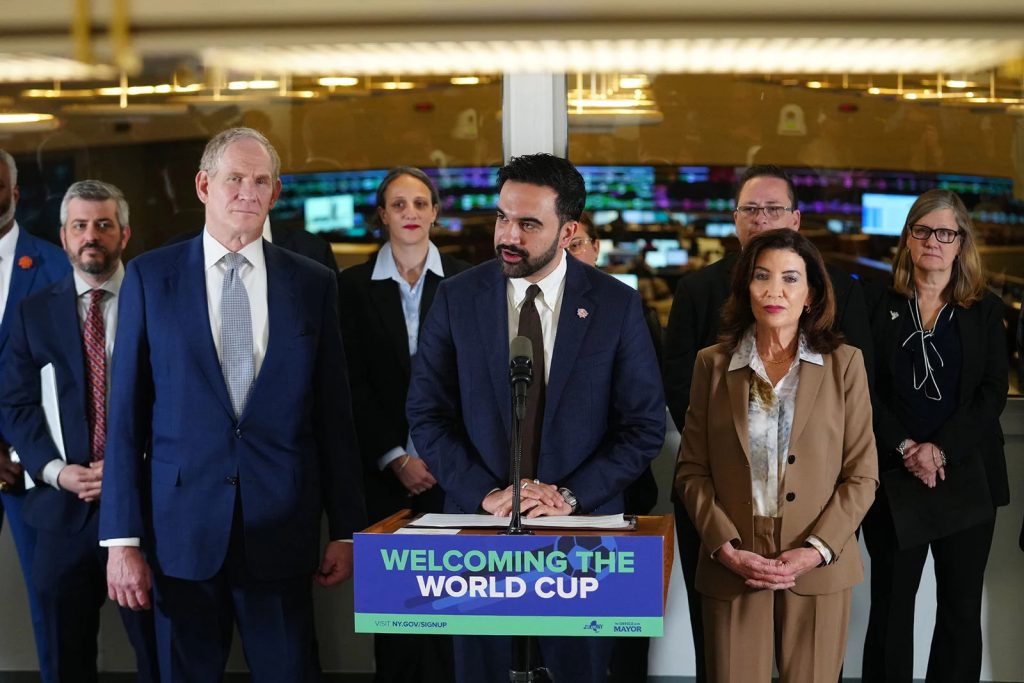
Affordable tickets, free fan zones and massive public celebrations aim to make football’s biggest event accessible to all New Yorkers.
Our Bureau
New York, NY
As the FIFA World Cup 2026 begins, New York City is preparing to welcome millions of visitors and ensure that the tournament becomes a celebration not just for ticket holders but for residents across all five boroughs. City authorities have launched an ambitious programme of public events, transportation measures, business initiatives and volunteer efforts designed to make the World Cup accessible, affordable and inclusive.
Mayor Zohran Kwame Mamdani has placed accessibility at the centre of the city’s preparations. “The World Cup belongs to New Yorkers,” he said while outlining a series of initiatives aimed at ensuring that the tournament is not limited to those who can afford premium match tickets. According to the mayor, New York is uniquely positioned to host the world’s most popular sporting event because it is “a city where every nation is already represented, where every language is spoken and every cuisine is eaten.”
One of the flagship measures announced by the city is the availability of 1,000 affordable World Cup tickets for New Yorkers priced at $50 each. The package includes free round-trip bus transportation to MetLife Stadium, where matches will be played.
Beyond stadium attendance, the city has created an extensive network of free public viewing opportunities. More than 100 free watch parties will be held across parks, plazas, marketplaces and theatres in all five boroughs. A free public screening of the World Cup final in Central Park is expected to attract more than 50,000 spectators.
“These events will help ensure the excitement and economic impact of the World Cup are felt throughout every neighborhood,” said Julie Coker, President and CEO of New York City Tourism + Conventions.
The city has also introduced “Soccer Streets,” transforming 50 streets into temporary football pitches and community gathering spaces. Additional recreational opportunities have been created through extended field lighting at more than 50 locations, generating an estimated 4,000 additional hours of play during the summer. A temporary “FIFA Arena” in Central Park will host free clinics, tournaments and open-play sessions throughout the competition.
Officials hope the tournament will generate significant economic benefits. More than one million visitors are expected to travel to the New York-New Jersey region during the World Cup. To encourage spending across the city rather than concentrating activity around match venues, the administration has launched the “NYC Neighborhood Passport.” Developed with community partners, the initiative encourages visitors to explore immigrant neighborhoods, cultural institutions and small businesses.
Restaurants are also being incorporated into the celebrations. Hundreds of establishments will participate in the “Five Borough Winners Special,” offering meal and drink promotions priced at $26.
Special attention is being given to immigrant-owned businesses and commercial corridors. The city has distributed a World Cup Business Toolkit and outreach materials to more than 56,000 New Yorkers, focusing particularly on areas such as Jackson Heights, Little Haiti, Koreatown and the South Bronx.
The administration has paired economic initiatives with efforts to protect vulnerable communities. A citywide “Know Your Rights” campaign has been launched to provide information on labour protections, legal services and constitutional rights. The Mayor’s Office of Immigrant Affairs has distributed multilingual information kits in more than ten languages. At the same time, the Department of Consumer and Worker Protection has contacted over 77,000 licensed businesses regarding workplace protection laws and plans a series of worker-rights awareness campaigns throughout the tournament.
Keeping the city functioning smoothly during the expected influx of visitors remains another major priority. Authorities have announced special transportation plans for each of the eight local match days, including dedicated bus and shuttle corridors, restrictions on non-essential vehicle traffic in key areas and expanded public transit messaging.
The city has also expanded ferry operations, adding vessels and trips on high-demand routes. Officials describe the initiative as the largest ferry service deployment in New York City’s history.
Emergency preparedness has been strengthened through a unified coordination structure involving multiple agencies. The city’s Emergency Operations Center has been activated, while specialised working groups are focusing on public safety, health services, transportation, infrastructure and community engagement. A Joint Information Center will provide multilingual public information during the tournament, and a dedicated alert system will allow residents and visitors to receive real-time updates by text message.
To help visitors navigate the city, New York has launched the Summer Welcome Corps, a volunteer programme involving NYC Service, New York City Emergency Management and New York Cares. Volunteers will be stationed at busy locations to provide directions, assist visitors, support people with accessibility needs and help distribute information during periods of extreme heat.
“For New Yorkers, this is light work,” Mayor Mamdani said. “We’re used to pointing visitors to the nearest subway station or answering questions from the millions of people who visit our beautiful city every year.”