








As campaigning intensifies, parties deploy contrasting narratives—welfare, anti-incumbency and identity—to shape voter choice
Our Bureau
Chennai
With Tamil Nadu heading into a single-phase Assembly election on April 23, political parties are sharpening distinct strategies that reflect both ideological positioning and electoral compulsions, turning the contest into a complex battle of narratives, alliances and voter mobilisation.
At the centre of the contest is the ruling Dravida Munnetra Kazhagam (DMK)-led Secular Progressive Alliance (SPA), which is framing the election as a defence of state identity, governance record and welfare politics. Chief Minister M. K. Stalin’s party has leaned heavily on emotional and ideological messaging, projecting the election as more than a routine political contest.
“This election is not merely between political parties but between Tamil Nadu and forces that oppose its interests,” DMK leader Kanimozhi said during campaigning, adding that it is about “upholding the dignity of the state” and ensuring that Tamil Nadu does not “bow its head.” This framing signals a strategy that blends regional pride with resistance to perceived external pressures, particularly from the Centre.
The DMK is also foregrounding its welfare record to consolidate its voter base. Kanimozhi highlighted schemes such as financial assistance for students, which she said would increase from Rs 1,000 to Rs 1,500 if the party returns to power, and the revival of the laptop scheme aimed at benefiting millions of students. The emphasis on continuity and expansion of welfare reflects a calibrated attempt to retain support among key constituencies, including youth and rural voters.
On the other side, the All India Anna Dravida Munnetra Kazhagam (AIADMK), leading the National Democratic Alliance (NDA) in the state, is pursuing a strategy centred on anti-incumbency and organisational mobilisation. Party chief Edappadi K Palaniswami has focused on attacking the DMK government’s performance and projecting confidence about a return to power.
“Our goal is to form the government again… we are actively campaigning… explaining our achievements and highlighting the shortcomings of the DMK government to gather votes,” Palaniswami said, indicating a dual strategy of defending past governance while targeting current incumbency.
The AIADMK’s campaign rhetoric has also turned sharply personal, with Palaniswami’s remarks on Stalin’s handling of crises sparking strong backlash. While such attacks have drawn criticism from DMK leaders as “vulgar” and “indecent,” they reflect a deliberate attempt to provoke and dominate the political narrative, particularly in a high-stakes election.
Crucially, the AIADMK’s alignment with the Bharatiya Janata Party (BJP) adds another dimension to its strategy. The NDA is projecting itself as a cohesive alternative, with central leaders actively campaigning in the state. Union Minister Piyush Goyal accused the DMK government of corruption and blocking development, alleging that “development had stagnated over the past five years due to corruption.”
Goyal also framed the contest as a choice between governance models, saying the NDA would deliver administration similar to that of former Chief Minister J. Jayalalithaa. At the same time, he attacked what he described as dynastic politics within the DMK, claiming the party was dominated by a single family.
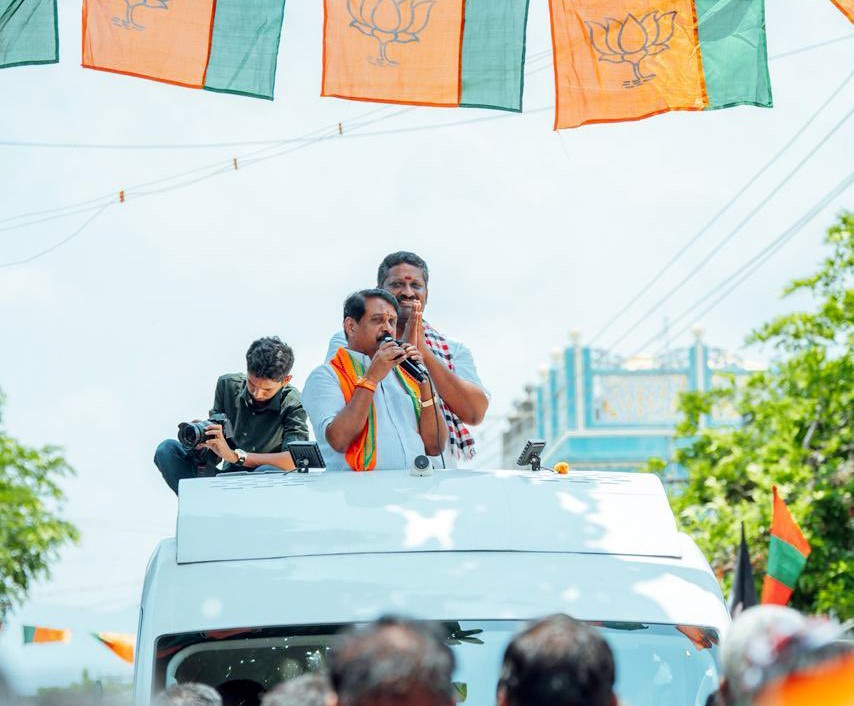
The BJP’s role within the alliance is significant. While historically a marginal player in Tamil Nadu, it is leveraging national leadership and development narratives to expand its footprint. Its strategy includes direct outreach, high-visibility roadshows and aligning with AIADMK’s regional base, attempting to merge national and state-level narratives.
Adding further complexity is the emergence of actor-turned-politician Vijay, whose party Tamilaga Vettri Kazhagam (TVK) is set to make its electoral debut. His entry introduces the possibility of a three-cornered contest, potentially reshaping vote shares and disrupting traditional alliances.
While Vijay’s campaign details remain less defined in comparison to established parties, his presence itself represents a strategic wildcard. In a state where cinema and politics have historically intersected, his appeal could draw younger voters and those disillusioned with existing options, forcing both DMK and AIADMK to recalibrate their outreach.
Across parties, a common thread is the intensification of rhetoric. DMK leaders have accused Palaniswami of being aligned with the BJP, with one leader stating he had become a “slave of the BJP,” while AIADMK and BJP leaders have countered with allegations of corruption and dynastic control. These exchanges highlight a shift toward more confrontational campaigning as polling day approaches.
Yet beneath the rhetoric lies a clear strategic divergence. The DMK is banking on welfare delivery, regional identity and governance continuity. The AIADMK-led NDA is relying on anti-incumbency, alliance strength and criticism of the ruling party’s record. Meanwhile, Vijay’s entry introduces uncertainty, potentially fragmenting votes and altering electoral arithmetic.
With 234 constituencies going to polls and counting scheduled for May 4, the outcome will depend not just on campaign intensity but on which of these strategies resonates most with voters. As parties refine their messaging in the final stretch, Tamil Nadu’s election is shaping up as a contest not just of numbers, but of narratives competing to define the state’s political future.