








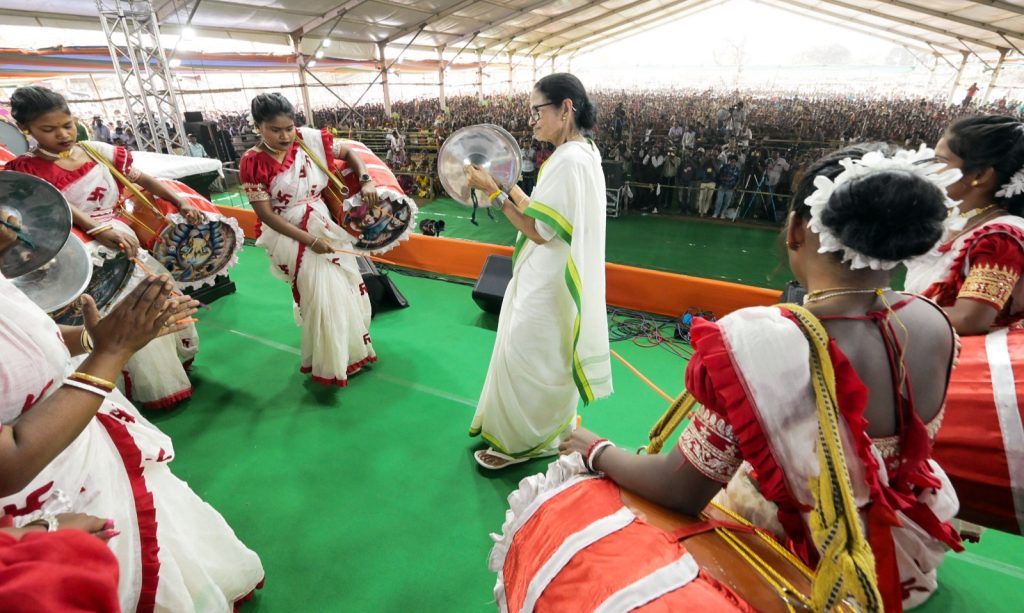
With voting approaching, parties in West Bengal are deploying sharply different electoral strategies centred on welfare, governance, identity, and grassroots mobilisation
Our Bureau
Kolkata / New Delhi
As West Bengal heads into a two-phase Assembly election on April 23 and 29, political parties are deploying sharply contrasting strategies—ranging from welfare-driven narratives to identity mobilisation—in a contest that could redefine the state’s political trajectory.
The ruling Trinamool Congress (TMC), led by Chief Minister Mamata Banerjee, is anchoring its campaign on governance and welfare delivery. The party’s pitch centres on schemes such as Lakshmir Bhandar and infrastructure improvements, while framing itself as a defender of Bengal’s autonomy against what it describes as central interference.
TMC leader Abhishek Banerjee has sharpened this narrative on the campaign trail. “Our Government is giving money to our Lakshmis… through various state schemes,” he said, contrasting it with the opposition. He also accused the Centre of withholding funds: “BJP is using a remote control to stop our rightful funds… Now it’s your turn to press the button for TMC.”
This strategy reflects a broader attempt by the TMC to consolidate women, rural, and welfare-dependent voters—groups that have been central to its electoral success. By highlighting direct benefit transfers and local development, the party is seeking to reinforce a governance-centric image while countering anti-incumbency.
In contrast, the Bharatiya Janata Party (BJP) is focusing on law and order, corruption, and political violence—issues it has consistently raised since emerging as the principal विपक्ष in the 2021 elections, when it secured 77 seats. The party is attempting to convert that base into a winning coalition this time.
BJP leader Dilip Ghosh struck an aggressive tone, saying, “I have fought with the goons and mafia here. I will fight again… This time… the BJP will come to power.” He added that governance would change drastically, warning that “everything will change after May 4.”
The BJP is also recalibrating its outreach to minority communities—traditionally seen as a TMC stronghold. Ghosh questioned the ruling party’s record, stating, “Even the parties which speak in favour of the Muslims… have realised that Mamata Banerjee has not done justice.” This reflects a nuanced shift from earlier polarisation-heavy campaigns to a mix of development and social outreach.
Organisationally, the BJP is emphasising grassroots mobilisation and manifesto participation through its “Bikosito Paschim Banga Sankalp Patra” campaign. By inviting public suggestions via digital platforms and on-ground “aspiration boxes,” the party is attempting to project inclusivity and policy responsiveness.
Meanwhile, smaller players and emerging alliances could play a spoiler role, particularly in minority-dominated constituencies. Asaduddin Owaisi’s All India Majlis-e-Ittehadul Muslimeen (AIMIM) has extended support to regional outfits, aiming to “build and strengthen independent political leadership for the Muslim minority,” as Owaisi put it.
This intervention introduces a new dynamic into Bengal’s electoral landscape. While the AIMIM may not be a major statewide force, its presence could fragment minority votes in closely contested seats—potentially benefiting the BJP in triangular contests, or complicating TMC’s consolidation strategy.
Economics is another undercurrent shaping campaign narratives. Rising prices of LPG, fuel, and essential commodities have become key talking points. Abhishek Banerjee directly targeted the BJP on inflation, saying, “The prices of LPG, petrol, milk… increased massively.” The BJP, in turn, is focusing on alleged corruption, governance deficits, and law enforcement failures at the state level.
The election also comes at a time when voter expectations are evolving. Welfare delivery remains crucial, but issues such as employment, small business growth, and infrastructure are gaining prominence. Both major parties are tailoring their messaging to address these aspirations—TMC through continuity and delivery, BJP through change and governance reform.
Structurally, the election remains bipolar, but margins could be influenced by micro-level factors—candidate selection, booth management, and turnout variations across regions like North Bengal, Junglemahal, and urban belts. The BJP’s expansion in northern districts and TMC’s entrenched rural network will be critical variables.
With voting scheduled across 294 constituencies and counting on May 4, the stakes are high for both sides. For the TMC, it is a test of incumbency and the durability of its welfare model. For the BJP, it is an opportunity to translate organisational growth into electoral victory in a politically significant state.
As the campaign intensifies, Bengal’s election is shaping up not just as a contest of parties, but of competing political narratives—welfare versus change, regional identity versus national integration, and consolidation versus fragmentation. The outcome will hinge on which of these strategies resonates most with voters in a rapidly evolving political landscape.