








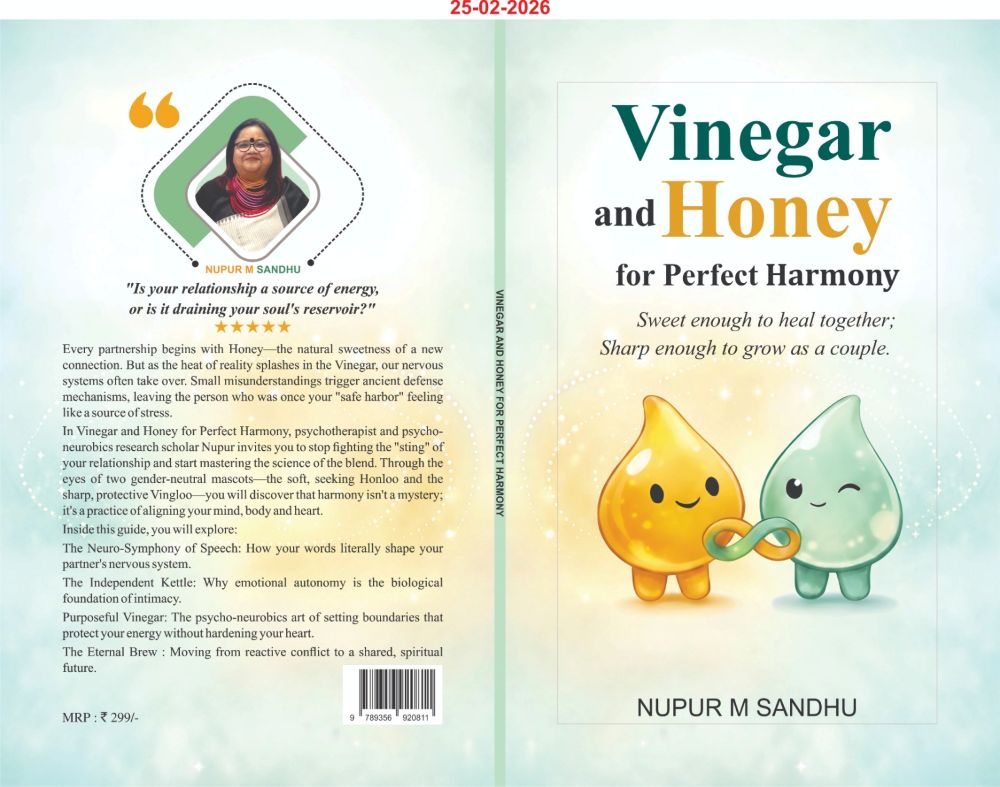
In a world saturated with relationship advice that often feels either too clinical or too “fairy-tale,” psychotherapist and psycho-neurobics research scholar Nupur M. Sandhu offers a refreshing, grounded alternative. Her latest book, Vinegar and Honey for Perfect Harmony, is less of a lecture and more of a warm, aromatic conversation over a cup of masala tea. It is a guide that acknowledges the sting of reality while providing the sweetness needed to heal.
THE ALCHEMY OF THE MASCOTS
The heart of the book lies in its ingenious framing through two gender-neutral mascots: Honloo and Vingloo. These characters serve as a “visual map” of the book’s core philosophy. Honloo, the golden honey-drop, represents empathy and sweetness—the “Honey” that allows a couple to heal. Vingloo, the teal vinegar-splash, represents the “Purposeful Vinegar”—the sharp truths and protective boundaries essential for growth.
Sandhu’s central thesis—the Vinegar & Honey Principle—is deceptively simple: in every interaction, we choose between being reactive and harsh (Vinegar) or soft and connecting (Honey). However, she avoids the cliché of painting vinegar as a “villain.” Instead, she introduces the concept of “PURPOSEFUL VINEGAR”a soul-driven boundary that protects one’s peace and values. As the author beautifully puts it, “May your vinegar never be a weapon, but let it be a shield”.
A SCIENTIFIC APPROACH TO THE SOUL
What sets this book apart from standard self-help fare is Sandhu’s integration of Psycho-neurobics. She explores the “Neuro-Symphony” of relationships—how our words literally shape our partner’s nervous system. To make this complex science accessible, she utilizes two recurring features:
• Neuro Sips: These sections explain the “why” behind our psychological and neurological patterns.
• Tea Sips: These offer “how-to” rituals, providing practical, tiny actions to move from theory to connection.
This structure ensures the reader isn’t just consuming information but experiencing a shift in perspective. The book covers a vast landscape of marital terrain, from the “Sacredness of Speech” and “Family Dynamics” to the often-taboo “Money and Marriage”.
THE ARCHITECTURE OF CONNECTION
Sandhu argues that marriages don’t typically break because love ends, but because the “emotional architecture” collapses. She identifies four critical pillars:
1. Honesty: Not just truth-telling, but showing up fully.
2. Communication: The discipline of understanding rather than just defending.
3. Responsibility: Taking ownership of the energy one brings to the relationship.
4. Emotional Safety: Building an environment where one can be imperfect without fear.
One of the most moving sections involves the “Two Lamps” short story, where Honloo and Vingloo use clay lamps to signal when they need warmth rather than fixing. It’s a poignant reminder that vulnerability is the ultimate bridge to intimacy.
MARRIAGE AS A MIRROR
Perhaps the most profound insight Sandhu offers is that marriage is a “spiritual path”. She posits that the relationship does not create our insecurities or triggers; it simply reveals the unhealed places within us that are asking for attention. By viewing triggers as “emotional alarms” from the past, partners can move from fighting with each other to healing together.
The author’s tone is remarkably empathetic. She acknowledges the “situation-ships” and “confusion-ships” of the modern era, offering a “bear hug” to those trying to navigate the chaos of love. Her writing is peppered with wit, noting that she wrote this for those whose “eyebrows said, ‘We are absolutely not fine'” even when their words said they were.
Chapter-by-Chapter: The Journey to Harmony
The book is structured into eleven insightful chapters, each peeling back a layer of the human heart.
• The Power of Tone (Chapter 1-2): Sandhu emphasizes the “Sacredness of Speech”. She posits that most conflicts are not about the issue itself, but the “flavor” of the words—whether they are offered as stinging vinegar or soothing honey.
• The Individual within the Union (Chapter 3-5): A significant portion of the book focuses on the “Me in We”. Sandhu challenges the myth of “perfect compatibility,” stating that true compatibility is something you create through emotional maturity and a willingness to repair. She highlights roles and responsibilities not as chores, but as part of the relationship’s “living space” or garden.
• Navigating External and Internal Pressures (Chapter 6-9): From “Family Dynamics” to the pragmatism of “Money and Marriage,” Sandhu provides a grounded framework for handling external stressors. She introduces the “Unwritten Rules of Marriage,” helping couples turn unspoken expectations into conscious agreements.
• The Spiritual Path (Chapter 10-11): The book culminates in a vision for a shared future. Sandhu presents marriage as a spiritual path that exposes us to our own egos, triggers, and “inner child” wounds. It concludes with the concept of a “Relationship Contract”—a proactive way to commit to growth rather than just survival.
The “Sip” Methodology: Theory to Action
What makes this book exceptionally practical are the Neuro Sips and Tea Sips.
• Neuro Sips explain the neurological “why” behind our reactions, such as how an old wound can trigger a large reaction to a small present moment.
• Tea Sips offer the “how,” providing tiny, practical rituals—like the “Two Lamps” story—to help couples pause.
Sandhu makes relationship advice into an interactive experience through games, metaphorical rituals, and structured commitments. These tools are designed to move couples from abstract theory into daily practices
The book utilizes storytelling and psychological metaphors to create “games” of emotional awareness.
Thru “Reflection Challenges”: At the end of each section, Sandhu provides questions that act as a self-audit “game,” such as asking, “Which part of the last conflict was yours?” to encourage ownership over blame.
The “Mini Vows” and Relationship Contract
The book culminates in Chapter 11: Our Final Vows and Relationship Contract, which moves beyond traditional wedding promises into functional, everyday commitments.
• Purposeful Vows: Rather than promising perfection, these vows focus on “willingness”—the willingness to listen, repair, and return after a conflict.
• The Relationship Contract: This is a proactive tool designed to turn “unwritten rules” and silent expectations into conscious, spoken agreements. It serves as a blueprint for the “Shared Future Vision” discussed in Chapter 10.
• Boundaries as Vows: The contract often includes “Purposeful Vinegar” commitments—firm “No’s” that act as a “soul-driven boundary” to protect each individual’s peace within the union.
FINAL VERDICT
Vinegar and Honey for Perfect Harmony is a rare gem that makes psychology “cute” without losing its depth. It is a book for the brave—for those who realize that love isn’t a fairy tale of perfect compatibility, but a conscious choice to grow.
Whether you are single and preparing for a future bond, or in a long-term marriage looking to soften the space between you, Sandhu’s “brew” of wisdom is exactly what the doctor ordered. It is a reminder that a healthy relationship doesn’t need to be perfect; it just needs to be “sweet enough to heal together and sharp enough to grow as a couple”.