








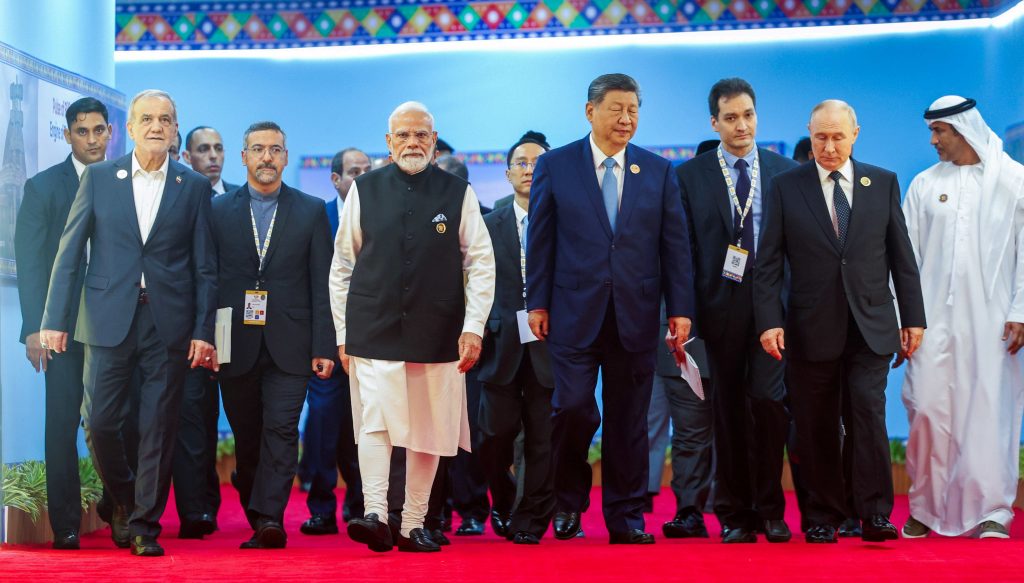
The New Delhi Summit strengthens Narendra Modi’s position as one of the key architects of an emerging multipolar order, marks a potentially historic turn in India-China relations, and highlights the growing strategic convergence between India and Brazil
By Leonardo Attuch
The BRICS Summit in New Delhi can be seen as a major Bharat achievement for Prime Minister Narendra Modi. Bharat is India’s ancient and civilizational name, enshrined in the country’s Constitution in the words “India, that is Bharat,” and increasingly used under Modi to express a national identity deeply rooted in Indian history. To speak of Bharat, therefore, is to speak of an India that seeks modernization and global power without abandoning its civilizational roots.
The summit represented an achievement for this project not merely because India managed to steer an increasingly large, diverse and complex grouping toward consensus, but because New Delhi revealed something deeper: India’s remarkable economic expansion is increasingly being converted into diplomatic influence and global political power.
Since Modi came to office in 2014, India has grown at an average real rate of more than 6 percent a year, despite the enormous disruption caused by the pandemic. Today, India presents itself not simply as a major emerging economy, but as a civilization claiming a greater role in shaping the rules of the international system.
This is the context in which Viksit Bharat 2047 should be understood: the ambition to make India a developed nation by the centenary of its independence.
The choice of the word Bharat is therefore far from semantic. It connects economic modernization, technological development, national sovereignty and civilizational identity. The India that Modi projects to the world does not seek simply to reproduce foreign models of development. It wants to modernize while remaining profoundly Indian.
From economic growth to global power
This transformation was evident in New Delhi. Modi presented the Global South not as a passive periphery of international politics, but as a force entitled to participate in writing the rules.
His formulation is powerful: countries of the Global South can no longer remain merely “rule takers.” They must become “rule shapers.”
This claim goes far beyond India itself. Modi is seeking to transform India’s longstanding demand for greater representation in international institutions into a broader cause for emerging and developing nations.
The underlying message is straightforward. The distribution of power established after World War II no longer corresponds to the realities of population, economic strength, technological capability and productive capacity in the 21st century.
BRICS has become one of the principal instruments through which that imbalance can be addressed.
Xi and Modi: partners, not rivals
Perhaps the most consequential development of the summit, however, was the rapprochement between Narendra Modi and Chinese President Xi Jinping.
Xi’s presence in New Delhi, his first visit to India in seven years, would already have been significant. But the political meaning of their encounter went much further.
Xi offered a formula that could define a new phase in relations between Asia’s two giants: China and India should be “partners, not rivals” and should regard each other’s development as an opportunity rather than a threat.
After the serious border clashes of 2020 and years of deteriorating bilateral relations, this represents a potentially historic turn.
This does not mean that disagreements have disappeared. China and India will continue to compete for markets, technology, political influence and strategic interests. Nor has the border question vanished.
What may be changing is something more fundamental: the assumption that competition must inevitably turn the two countries into strategic adversaries.
A change that could reshape the 21st century
China and India together account for roughly one-third of humanity. They are two ancient civilizations, two nuclear powers and two of the world’s most important economic centers.
If Beijing and New Delhi can manage their differences without allowing rivalry to become permanent hostility, the entire architecture of international relations could be affected.
For years, part of the American strategy in Asia has rested on the possibility of drawing India closer as a counterweight to China’s rise. India participates in the Quad alongside the United States, Japan and Australia and maintains important economic, technological and military ties with Washington.
Modi, however, appears determined to preserve what may be the most important inheritance of Indian foreign policy: strategic autonomy.
India can engage with the United States without becoming an instrument for containing China. It can maintain its historic partnership with Russia without breaking with the West. And it can deepen relations with Beijing without surrendering its own national interests.
This may be the essence of Modi’s emerging global role.
Brazil and India: Lula and Modi bring two giants closer
Brazil occupies a special place in this architecture.
Brazil and India are founding members of BRICS and two major democracies of the Global South. More importantly, President Luiz Inácio Lula da Silva and Narendra Modi have developed a relationship of mutual respect and considerable personal affinity that transcends their very different ideological backgrounds.
That relationship itself illustrates the nature of multipolarity.
Lula and Modi come from distinct political traditions, but they converge on fundamental international issues: national sovereignty, strategic autonomy, reform of multilateral institutions and a greater voice for developing countries in global decision-making.
Their relationship has also spanned successive presidencies of the G20 and BRICS. India and Brazil have been at the center of an important diplomatic cycle in which the Global South has brought development, poverty reduction, reform of global governance and greater representation for emerging nations to the heart of international debate.
Lula’s absence from the New Delhi Summit does not diminish this reality. Brazil, represented by Foreign Minister Mauro Vieira, remains one of the historical pillars of BRICS.
There is also an important complementarity between the two countries. Modi’s India increasingly claims the role of a voice and convener of the Global South. Lula’s Brazil seeks to exercise a similar function in Latin America and in the broader international system.
Rather than necessarily competing for leadership, the two countries can reinforce one another.
For Brazil, a stronger India strengthens multipolarity. For India, a sovereign and internationally engaged Brazil strengthens the legitimacy of a world order less concentrated in the traditional centers of power of the North Atlantic.
Dilma Rousseff and the bank of the Global South
There is another Brazilian figure who is central to this transformation: Dilma Rousseff.
As president of the New Development Bank, the NDB, the former Brazilian president leads perhaps the most important concrete institution created by BRICS.
The prominence given to the bank in New Delhi was therefore highly significant.
The summit underscored the NDB’s role in financing sustainable development, infrastructure and greater economic resilience across emerging economies. It also reinforced the importance of expanding local-currency financing and mobilizing resources for the development priorities of BRICS members and other countries of the Global South.
Under Rousseff’s leadership, the NDB is seeking to establish itself increasingly as a bank created by the Global South to address the development needs of the Global South.
In the days surrounding the summit, Rousseff was also involved in initiatives designed to expand the intellectual and institutional infrastructure of BRICS cooperation, including the BRICS-NDB Knowledge Portal, which seeks to facilitate the exchange of knowledge and development experiences among member countries.
This matters because BRICS is beginning to move beyond diplomatic declarations.
To build a new international order, it is not enough to demand reform of existing institutions. New institutions must also be built.
The NDB represents precisely this transition from ideas to instruments.
India as a bridge
Xi Jinping represents China’s extraordinary economic, technological and industrial rise. Vladimir Putin represents a Russia that has directly challenged important elements of the Western-led international order.
Modi is seeking to play a different role.
India wants to be a bridge.
A bridge between East and West. Between BRICS and developed economies. Between Russia and the United States. Between China and other Asian powers. And, together with partners such as Brazil, between the different regions and civilizations that constitute the Global South.
It is a sophisticated position because it requires New Delhi to resist binary choices between competing geopolitical camps.
In this sense, the New Delhi Summit was a demonstration of strategic autonomy.
A stronger BRICS
The thaw between China and India also has profound implications for BRICS itself.
Structural hostility between its two most populous members would always impose a limit on the grouping. If China and India can construct a relationship based on competitive coexistence, BRICS’ political capacity will expand considerably.
The adoption of a consensus declaration in New Delhi at a moment of intense international tension demonstrated that possibility.
The expanded BRICS brings together countries with very different histories, political systems, alliances and national interests. Its purpose is not to transform them into a homogeneous alliance, much less into a military counterweight to the West.
Its strength may lie precisely in the opposite approach: creating mechanisms of cooperation among different countries that share the conviction that no single power should determine the rules for everyone else.
It is multipolarity transformed into method.
Bharat 2047
There is finally a domestic dimension that cannot be overlooked.
Modi appears to understand that no foreign policy can be sustained without economic power. India’s international influence is increasing because its economy, infrastructure, technological capabilities and confidence in its own future are also expanding.
Viksit Bharat 2047 embodies this ambition.
The objective is not merely to increase GDP. It is to transform India into a developed, technologically sovereign power capable of exercising influence commensurate with the size of its population, economy and history.
This is why the word Bharat carries such significance within this project. It seeks to reconcile future and past, technology and tradition, modernization and civilization.
A major achievement for Modi
New Delhi did not resolve all of BRICS’ contradictions. Nor did it transform China and India overnight into strategic allies.
It would be premature to imagine that decades of mistrust disappeared after a summit.
But history often begins to change through new political formulas.
“Partners, not rivals” is one of them.
If this idea takes root, the New Delhi Summit may eventually be remembered as the moment when Asia’s two great powers began constructing a new way of living alongside one another: competing when necessary, cooperating when possible, and rejecting the assumption that the rise of one inevitably requires the containment of the other.
But New Delhi also demonstrated that multipolarity will not be built by China and India alone. Russia, Brazil and the expanded membership of BRICS are all part of this architecture. Lula’s Brazil contributes political weight, diplomatic tradition and a bridge to Latin America. And the NDB led by Dilma Rousseff provides something equally indispensable: institutional and financial capacity to transform South-South cooperation into concrete development.
For Modi, this is a major achievement.
After more than a decade of converting economic growth into national confidence, the Indian prime minister is increasingly converting that confidence into diplomatic power.
The message emerging from New Delhi is that Bharat does not merely intend to find its place in the world order.
It intends, alongside China, Brazil, Russia and the other emerging powers, to help build the next one.
Leonardo Attuch is the CEO and founder of Brasil 247 and the Global South Institute.