








Business Strategy with Hirav Shah Customers are not looking for the cheapest option. They are looking for the safest and smartest decision

Most businesses believe one simple myth: lower price means more sales.
In reality, customers rarely buy based on price alone. They buy based on a combination of price, perceived value, and trust.
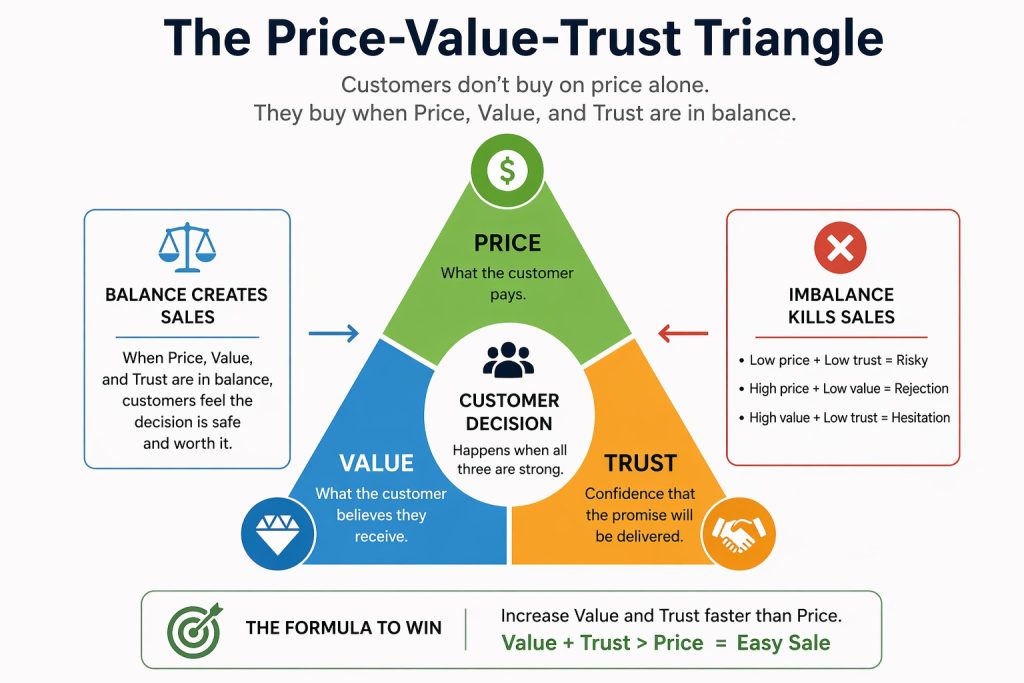
This is where the Price–Value–Trust Triangle becomes a useful decision framework.
What is the Price–Value–Trust Triangle?
Think of every buying decision as a balance between three forces:
- Price → What the customer pays
- Value → What the customer believes they receive
- Trust → Confidence that the promise will be delivered
If one side is weak, the entire decision collapses.
A low price without trust feels risky.
High value without trust feels exaggerated.
Strong trust without value feels overpriced.
The sale happens only when all three align.
Why Price Alone Fails
Discounting is the easiest lever to pull. But it is also the most dangerous.
When you compete only on price:
- You attract the wrong customers
- You reduce margins
- You create dependency on discounts
- You weaken brand perception
Customers don’t ask, “Is this the cheapest?”
They ask, “Is this worth it—and can I rely on it?”
Understanding “Value” — The Most Misunderstood Factor
Value is not your product. It is the customer’s perception.
Two businesses can sell the same product at different prices because they communicate value differently.
Value comes from:
- Problem solving ability
- Experience and convenience
- Brand positioning
- Differentiation
- Emotional connection
If your value is unclear, price becomes the only comparison point.
That is when you lose.
Trust — The Silent Decision Maker
Trust is rarely discussed, but it is the strongest force in the triangle.
It answers one core question:
“Will I get what I’m promised?”
Trust is built through:
- Consistency
- Social proof
- Past results
- Transparency
- Clear communication
Without trust, even a low price feels expensive.
With trust, even a high price feels justified.
The Real Formula to Win Customers
The goal is not to reduce price.
The goal is to increase perceived value and trust faster than price increases.
This creates what can be called a premium comfort zone, where customers feel confident paying more.
A practical way to think about it:
- If Price > Value + Trust → No sale
- If Value + Trust > Price → Easy sale
This is the real buying equation.
Common Mistake: Imbalance in the Triangle
Most businesses unknowingly distort the triangle.
- High price + low trust → rejection
- Low price + low value → ignored
- High value + low trust → hesitation
Only balanced positioning creates consistent conversions.
How the Triangle Changes Customer Decisions
Consider two companies selling the same service. Company A charges ₹50,000 but provides very little explanation, has no strong testimonials, and communicates inconsistently. Company B charges ₹65,000 but clearly explains the process, demonstrates previous results, shares genuine client experiences, and provides professional support.
Although Company B is more expensive, many customers will still choose it because the additional value and trust reduce the risk of making a wrong decision.
This is especially important when customers are buying something expensive, unfamiliar, or emotionally significant. The greater the perceived risk, the more trust they need before making a purchase. That is why people may pay more for an established doctor, consultant, builder, hotel, or technology brand.
As Business Strategist Hirav Shah explains, “Customers do not always choose the lowest price. They choose the option that gives them the highest confidence.”
Therefore, before reducing your price, identify the real reason behind the customer’s hesitation. The problem may not be affordability. It may be unclear value, weak communication, insufficient proof, or fear of making a mistake. Strengthening these areas can improve conversions without sacrificing your margins or damaging your brand.
How to Apply This in Your Business
1. Stop leading with price
Lead with outcomes, results, and clarity.
2. Strengthen value communication
Explain not just what you sell, but why it matters.
3. Build visible trust signals
Testimonials, case studies, real stories, and transparent messaging.
4. Align your positioning
Your pricing must reflect your value and trust level.
Final Perspective
Customers are not looking for the cheapest option.
They are looking for the safest and smartest decision.
Price is just a number.
Value is perception.
Trust is the trigger.
Businesses that understand this triangle don’t chase customers.
They become the obvious choice.
Hirav Shah is the Global Business Strategist, Game Changer, and Author of 19+ books—trusted worldwide for validating big decisions of entrepreneurs, sportsmen, and entertainers.
Email: [email protected]