








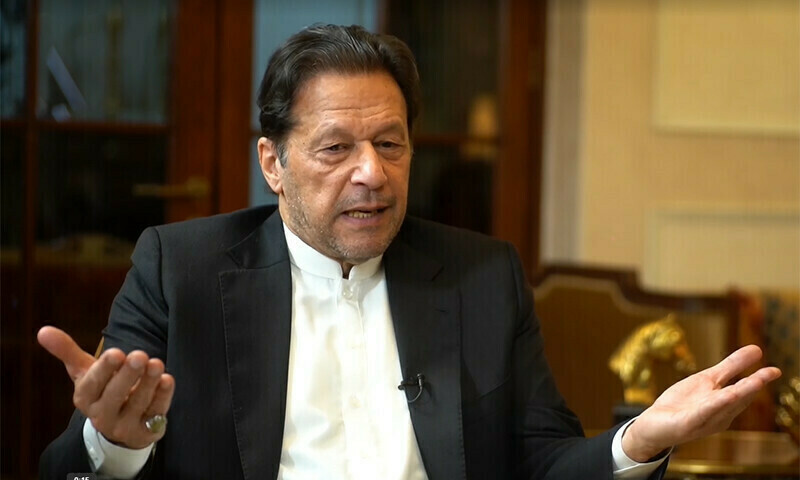
Three years behind bars have not diminished Imran Khan’s political influence; if anything, his imprisonment has turned him into the central challenge to Pakistan’s political and military establishment
Ashish K Singh
There is a simple question behind Pakistan’s continuing political crisis: if Imran Khan is as politically finished as the government and military establishment suggest, why is he still in jail?
Khan has been imprisoned since August 2023 and remains at Adiala Jail, despite several of the cases that once threatened to keep him behind bars having been overturned, suspended or otherwise weakened. He is still facing a formidable collection of legal cases, however, including corruption-related convictions. The most consequential is the Al-Qadir Trust case, in which Khan and his wife were sentenced in 2025 to 14 years in prison. Khan denies wrongdoing and says the prosecutions are politically motivated.
That is the legal explanation. The political explanation is more revealing.
Khan is not in prison simply because he is a convicted former prime minister. He is in prison because he remains the most formidable political challenger to Pakistan’s existing power structure.
His popularity was demonstrated dramatically in the February 2024 general election. Although Khan was behind bars and his Pakistan Tehreek-e-Insaf (PTI) was prevented from contesting under its party symbol, candidates backed by the party won the largest number of directly elected National Assembly seats. The result forced a coalition of rival political parties to form the government.
That election exposed the central weakness of the present arrangement: it can keep Khan away from power, but it has struggled to remove him from the political imagination of Pakistan.
The latest controversy concerns Khan’s health.
His family and PTI have raised serious concerns about his medical condition, particularly problems with his right eye. Khan has been diagnosed with central retinal vein occlusion, and his lawyers have argued that he requires specialist treatment. Jail authorities, meanwhile, have maintained that his condition has improved and that he is receiving adequate medical care.
The episode illustrates why Khan remains such a sensitive figure: even a hospital visit can become a political mobilisation point.
The current political order has survived partly because its most popular opponent has been physically removed from the political arena. His release would give PTI a leader capable of addressing supporters directly, organising protests and potentially challenging the government through elections.
More importantly, Khan’s confrontation is not merely with one political party. It is with a wider establishment that has traditionally exercised enormous influence over Pakistan’s political system.
Khan’s relationship with the military was once close. His rise to power in 2018 was widely seen as having benefited from military support. But the relationship collapsed spectacularly before his removal from office in April 2022. Since then, Khan has transformed himself into perhaps the strongest civilian critic of the establishment.
For the military establishment, therefore, the issue is not simply whether Khan becomes prime minister again. It is whether a politician who has openly challenged its political role can return to the centre of Pakistani politics.
The present government therefore has a legitimacy problem. It may possess parliamentary power, but parliamentary power and popular legitimacy are not necessarily the same thing.
That explains the extraordinary sensitivity surrounding Khan’s movements, prison access and medical treatment.
Khan has multiple cases and convictions, meaning that winning or suspending one case does not automatically free him. The state can continue to rely on other proceedings to keep him incarcerated.
But politics can move faster than courts.
If negotiations emerge between PTI and the establishment, if courts provide broader relief, or if the political cost of keeping Khan imprisoned becomes greater than the cost of releasing him, the calculation could change.
For now, however, the government’s behaviour suggests that it sees Khan’s release as a political risk rather than merely a legal decision.
For India, an unstable Pakistan is never a comfortable development.
A Pakistan consumed by an internal power struggle has less political bandwidth for economic reform, regional engagement and sustained diplomacy with its neighbours. At the same time, political instability inside Pakistan can increase the temptation to use nationalism and India-related rhetoric as a means of consolidating domestic support.
The more important Indian interest is stability — a Pakistan where civilian institutions function, elections command credibility and the military does not remain the ultimate arbiter of political power.
Imran Khan’s imprisonment has not solved Pakistan’s political problem. It has exposed it.
The irony is that every attempt to push Khan out of politics appears to reinforce his centrality. His opponents may control the government, parliament and much of the state machinery. But as long as a jailed politician can remain the most powerful symbol of opposition, the question confronting Pakistan is not whether Imran Khan matters.
It is how long the system can continue to keep him behind bars without confronting the political forces that put him there.