








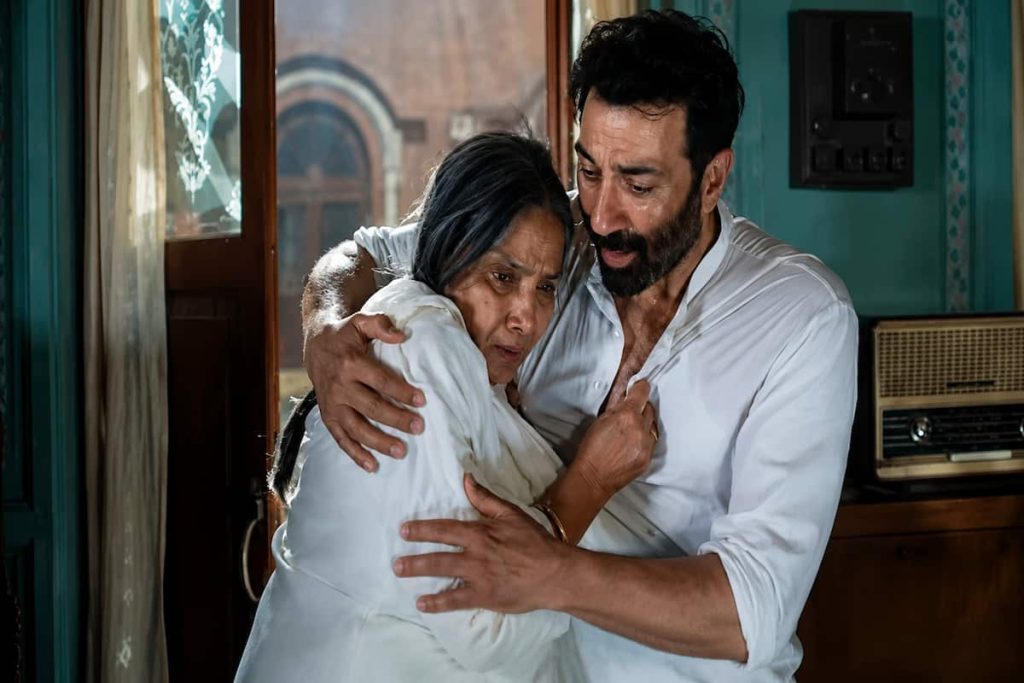
Rajkumar Santoshi’s Partition drama is finding resonance across generations and communities by combining patriotism with a deeply human story of loss, migration and communal harmony.
Our Bureau
Mumbai
In a year when patriotic films often compete for attention through spectacle and action, Batwara 1947 is finding a different route to audiences — by revisiting one of the most painful chapters in India’s history and placing human emotions at the center of its story.
Directed by Rajkumar Santoshi and produced by Aamir Khan Productions, the Sunny Deol and Preity Zinta-starrer has struck an emotional chord with moviegoers in Mumbai, while also attracting appreciation from people across different sections of society. The response suggests that the story of Partition, nearly eight decades after 1947, continues to have the power to connect with contemporary audiences.
For many viewers, the film’s timing has been an important part of its appeal. Released on August 14, just ahead of Independence Day, Batwara 1947 has tapped into the patriotic mood surrounding August 15 while simultaneously asking audiences to remember the enormous human cost behind India’s independence.
One Mumbai viewer described the film as “very emotional” and “heart-touching”, saying it offered a glimpse into what ordinary people experienced during Partition and Independence. Her decision to watch the film was also influenced by her preference for patriotic subjects.
That response points to one of the film’s biggest strengths: it does not rely solely on nostalgia for the freedom struggle. Instead, it connects patriotism with personal stories of families separated by violence, fear and forced migration.
The film is set against the backdrop of the 1947 Partition and follows a family whose life is transformed as communities that had lived together are torn apart. It is a familiar historical setting, but one that remains deeply relevant because Partition continues to shape family memories, politics and relations between communities in India and Pakistan.
The response to the film has also been notable because viewers have not been responding to just one aspect of it. For some, it is the patriotic message. For others, it is the historical narrative. Still others have been drawn by the performances of an ensemble cast led by Sunny Deol, Preity Zinta and Shabana Azmi.
Sunny Deol, in particular, appears to have brought an established audience to the film. Viewers associate the actor with high-energy patriotic and action-oriented roles, and Batwara 1947 provides some of that familiar cinematic appeal while giving him an emotionally demanding character.
But if there is one performance that repeatedly stands out in the early audience response, it is that of Shabana Azmi. Viewers have described her portrayal as authentic and emotionally powerful, saying it appeared as if she was actually living the experiences of her character rather than merely performing them.
The film has also generated discussion because of its portrayal of Hindu-Muslim relations during Partition. One viewer described the treatment as realistic while acknowledging that some audiences could find aspects of the story uncomfortable.
The film’s message has received an endorsement from veteran actor Hema Malini, who described it as a film promoting “humanity, mutual respect and harmony” rather than hatred and division. Her appreciation of Santoshi’s direction and the performances of Sunny Deol, Shabana Azmi, Karan Deol and Preity Zinta adds another dimension to the film’s public reception.
That multi-generational appeal could prove important for a film dealing with an event that belongs to history but remains alive in the memories of millions of families.
The film’s reach has also extended beyond conventional movie audiences. Santoshi recently hosted a special screening for spiritual leaders from different faiths. According to the filmmaker, the process began when a friend watched the film and spoke about it to a mufti, who became emotional after hearing about the story and subsequently watched it.
The spiritual leader’s response — that the film was important and that Santoshi had shown courage in making it — underlines the broader ambition of Batwara 1947. Its subject is divisive by definition, but the filmmakers appear to be attempting to use the Partition experience to make a larger argument about coexistence.
Ultimately, the wider appeal of Batwara 1947 may lie in its ability to speak to different audiences for different reasons. For younger viewers, it offers a cinematic entry point into a traumatic period they know primarily through textbooks and family stories. For older generations, it can evoke memories passed down through parents and grandparents. For filmgoers seeking patriotic entertainment, it arrives at an appropriate moment. And for audiences concerned about communal harmony, it offers a reminder of the terrible consequences of division.
The film’s central proposition is therefore both historical and contemporary: remembering Partition is not only about remembering how India was divided, but also about understanding the value of the humanity that existed before, during and after that division.