








India is showing signs of resilience, powered by domestic demand, manufacturing, government capital expenditure and improving corporate earnings.
Our Bureau
New Delhi / Mumbai
At a time when the global economic outlook remains clouded by geopolitical tensions, commodity price shocks and weak external demand, the Indian economy is offering a more positive picture. The latest indicators suggest that growth is broadening, corporate earnings are improving and domestic demand continues to provide an important cushion against global uncertainty.
India’s GDP is estimated to grow by 7-7.2 per cent in the first quarter of FY27, compared with 6.8 per cent in the same quarter last year, according to a Bank of Baroda report. The expected acceleration is significant because it comes against a difficult external backdrop, including the continuing West Asia crisis and volatility in energy and commodity markets.
The growth story is increasingly being driven by sectors that have a strong connection with domestic investment and consumption. Manufacturing, electricity and construction are expected to outperform their levels of a year ago, helped by sustained government capital expenditure and healthy growth in the financial sector.
Industrial growth is projected at 6.8 per cent, with manufacturing expected to expand 7.8 per cent. Electricity and construction are forecast to grow by 7 per cent and 6 per cent respectively. Services, meanwhile, are expected to expand by 8 per cent, led by financial, real estate and professional services.
This composition of growth is important. India’s relative strength is not simply the result of one booming sector. It reflects the increasing contribution of manufacturing, infrastructure, services and domestic investment.
Government capital expenditure remains one of the key pillars of this momentum. The Bank of Baroda report points to improving government capex alongside healthy credit and deposit growth as important factors supporting economic expansion.
The picture is not uniformly positive. Agriculture is expected to grow by only 3.5 per cent in Q1FY27, down from 4.4 per cent a year earlier, with delayed monsoon conditions and extreme heat posing risks.
The bigger challenge, however, comes from outside India’s borders.
The continuing West Asia crisis has pushed up prices of key commodities. International crude prices rose 44.7 per cent and urea prices 73.5 per cent during Q1FY27, according to the Bank of Baroda report. Such increases can feed into India’s import bill, inflation and corporate costs.
Yet the manufacturing sector has so far demonstrated considerable resilience. The report notes that manufacturing continues to face uncertainty and cost pressures but is being supported by the capex push and steady investment activity.
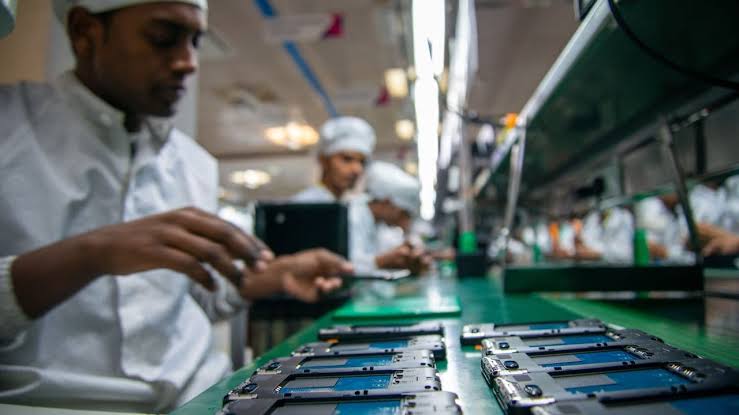
Another encouraging sign is the government’s attempt to move Indian manufacturing beyond assembly towards greater domestic value addition and globally competitive Indian brands.
The Mobile Phone Manufacturing Scheme, with an allocation of Rs 62,500 crore over five years from FY27 to FY31, is designed not only to expand production but also to promote Indian intellectual property, design and brands. The government expects cumulative mobile phone production to double from around Rs 20 lakh crore to Rs 40 lakh crore during the scheme period, while employment in mobile phone and electronics manufacturing has already crossed 25 lakh.
This marks an important shift in India’s industrial ambitions. The objective is no longer simply to make products in India, but increasingly to create Indian companies, technologies, designs and supply chains capable of competing globally.
The financial markets are also reflecting some of this optimism.
According to JP Morgan, India’s earnings outlook has improved, with MSCI India earnings growth estimated at 11 per cent in CY26 and 13 per cent in CY27. The first quarter of FY27 began stronger than expected, with revenues of MSCI India companies rising 19 per cent year-on-year and profit after tax increasing 16 per cent.
The strength was not confined to large companies. Nifty Midcap 100 companies, excluding energy, recorded 42 per cent growth in profit after tax, while Nifty Smallcap 100 companies registered 39 per cent growth.
This suggests that India’s economic story is becoming increasingly domestic-demand driven. That does not make the country immune to global shocks, but it gives the economy a degree of protection that many more externally dependent economies lack.
Companies, however, are not ignoring the risks. Corporate managements have remained cautious, emphasising profitable expansion, calibrated pricing and margin discipline rather than chasing growth at any cost. Most companies have retained their full-year guidance while keeping an eye on geopolitical and monsoon-related uncertainties.
But the underlying domestic engines appear stronger than they were in previous periods of global stress. Government investment is supporting infrastructure and manufacturing. Credit is growing. Corporate profitability is improving. Services remain strong. Domestic consumption continues to cushion external weakness.
The immediate challenge will be to convert this resilience into sustained, high-quality growth — one that creates jobs, raises productivity, strengthens domestic supply chains and enables Indian companies to compete globally.
For now, however, the contrast is striking: while much of the world is worrying about slowing growth and rising uncertainty, India enters the second half of 2026 with an economy that continues to show considerable momentum.