








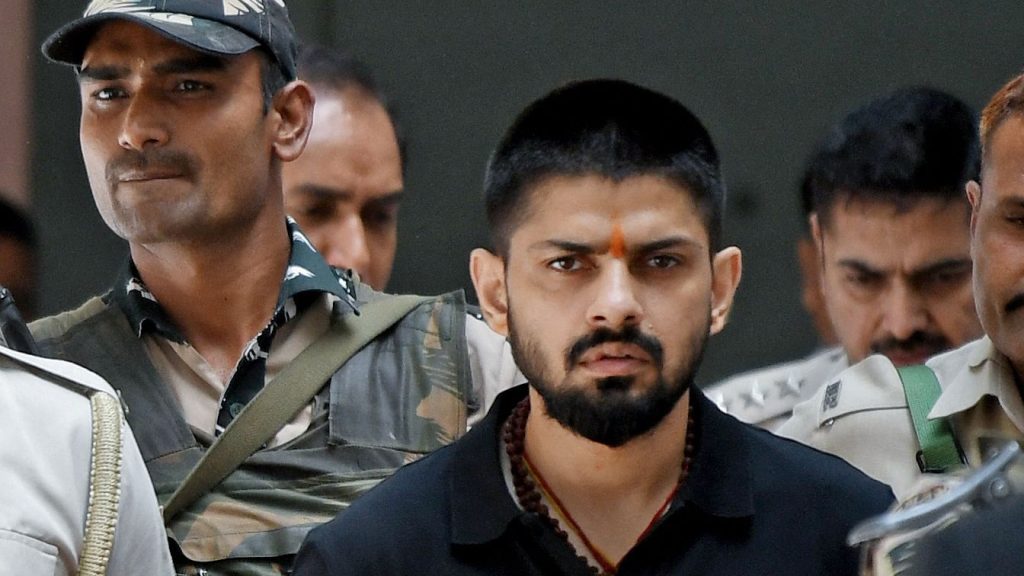
The sweeping US crackdown on Lawrence Bishnoi and Goldy Brar marks the first time US investigators have publicly mapped the international reach of an India-based organized crime network
Our Bureau
Washington, DC / New Delhi
When the US Department of Justice unveiled “Operation Hard Ball” this week, it did more than announce criminal charges against some of India’s most notorious gangsters. It signaled a fundamental shift in how Western law enforcement agencies view organized crime emanating from the Indian subcontinent.
For years, Lawrence Bishnoi and his close associate Satinderjeet Singh alias Goldy Brar were largely seen in India through the prism of Punjab’s gang wars, extortion rackets and high-profile murders. The latest US indictments, however, portray a far more sophisticated organization — one operating across multiple jurisdictions, using international drug trafficking networks, extortion rings and contract killers while stretching from India to Canada, the United States, Mexico and Europe.
The operation also marks the first major American criminal prosecution directly linking the Bishnoi organization to the June 2023 assassination of Khalistani separatist Hardeep Singh Nijjar outside a gurdwara in Surrey, British Columbia. US prosecutors have alleged that Bishnoi and Brar orchestrated the killing, though they emphasized that the charges remain allegations until proven in court.
Transnational crime network
The significance of Operation Hard Ball lies less in the names of those charged than in the architecture investigators claim to have uncovered.
According to the US Department of Justice, the operation has resulted in 37 defendants being charged through three federal indictments, while 24 suspects linked to India-based organized crime groups have already been arrested across the United States, Canada and Europe.
Investigators allege the syndicates are no longer confined to traditional criminal activities in India. Instead, they have evolved into transnational enterprises involved in violent crimes, narcotics trafficking, firearms smuggling and international extortion. Cocaine and firearms were seized during the operation, suggesting investigators are examining financial and logistical networks that extend well beyond India’s borders.
The indictments also identify other alleged organized crime figures, including Jaggu Bhagwanpuria and Ravinder Singh Dhanda. Prosecutors allege Dhanda operated an international drug distribution network, while the Bhagwanpuria organization-maintained members across the United States, Canada, Britain, Europe, Australia and New Zealand.
Collectively, these allegations suggest investigators are examining an ecosystem rather than isolated gangs.
Once largely confined to Punjab’s gang wars, Lawrence Bishnoi has emerged as one of India’s most feared organized crime figures, with investigators linking his syndicate to a string of high-profile murders, extortion rackets, arms trafficking and intimidation campaigns. Operating despite spending years behind bars, Bishnoi allegedly built a decentralized network that used associates across several states and abroad to target businessmen, politicians, celebrities and rival gangsters. The 2022 killing of Punjabi singer Sidhu Moosewala brought unprecedented attention to the gang’s reach. Indian investigative agencies believe the syndicate has increasingly expanded beyond domestic crime, forging links with transnational narcotics networks and using overseas operatives, particularly in Canada and North America, to coordinate extortion, contract killings and organized criminal activities. The latest US indictments suggest that what began as a regional criminal enterprise has evolved into a global organized crime network.
The priority target
The FBI’s announcement of a reward of up to USD 50,000 for information leading to Goldy Brar’s arrest reflects the central role investigators believe he now plays.
The FBI alleges that Satinderjeet Singh, better known as Goldy Brar, heads the Lawrence Bishnoi Organized Crime Group in North America. A federal arrest warrant was issued on July 1 after prosecutors charged him with racketeering conspiracy, attempted interference with commerce by extortion and conspiracy to distribute controlled substances.
According to investigators, Brar maintains links to Sacramento and Fresno in California while also operating across Canada, India and Mexico. Those geographical connections indicate investigators believe the organization has established multiple operational hubs capable of coordinating criminal activities across borders.
For American authorities, Brar appears to represent more than an individual fugitive. He is alleged to be the operational bridge connecting criminal networks in India with activities across North America.
The Nijjar investigation
Perhaps the most politically significant aspect of Operation Hard Ball is its treatment of the Nijjar assassination.
Since former Canadian Prime Minister Justin Trudeau alleged that there was credible intelligence linking Indian agents to Nijjar’s killing, the issue has dominated India-Canada relations. India consistently rejected those allegations.
The American indictments introduce an alternative legal pathway by alleging that the killing was orchestrated by members of an organized crime syndicate rather than directly attributing responsibility to any state actor.
That distinction is significant because it shifts the immediate legal focus from diplomatic accusations to criminal prosecution.
The Justice Department nevertheless cautioned that indictments remain allegations until proven beyond reasonable doubt in court.
Former Indian High Commissioner to Canada Sanjay Verma described Operation Hard Ball as a joint effort involving investigators from the United States, Canada and Europe.
He stressed that investigative findings would ultimately have to withstand judicial scrutiny and argued that international cooperation against organized crime should not be viewed through the lens of diplomatic confrontation.
“India and the U.S. are great friends,” Verma said, adding that investigative agencies regularly exchange information with one another to pursue international criminals.
His remarks also sought to separate criminal investigations involving Indian nationals from questions about India’s international standing.
“India is not under investigation,” he noted, arguing that only specific individuals accused of criminal offences are facing legal scrutiny.
Following the money
Although the indictments focus on violent crime, investigators appear equally interested in financial infrastructure. Extortion has emerged as one of the defining features of the Bishnoi-Brar organization. Prosecutors have charged Brar with conspiracy to interfere with commerce through extortion, suggesting investigators believe intimidation of businesses and individuals forms an important revenue stream.
Drug trafficking appears to provide another pillar of the organization’s finances.
The alleged involvement of Ravinder Singh Dhanda in an international narcotics network, combined with cocaine seizures during Operation Hard Ball, indicates investigators are mapping how illicit profits move through international criminal channels.
Political fallout in Punjab
The American investigation has also reverberated within Punjab.
Shiromani Akali Dal leader Bikram Singh Majithia seized on reports that an FBI case also involves Punjab Police officer Gurinderjit Singh Nagra in an alleged USD 400,000 extortion case.
Majithia alleged the development pointed to a deeper nexus involving gangsters, politicians and sections of the police force, though those claims remain political allegations.
Whether such allegations withstand legal scrutiny remains to be seen, but they underscore how international investigations can quickly reshape domestic political debates.
The road ahead
Operation Hard Ball reflects a broader evolution in organized crime.
Criminal groups increasingly exploit diaspora networks, encrypted communications, international banking systems and global narcotics markets.
The FBI’s decision to place a monetary reward on Brar and publicly identify his North American operational role suggests US authorities believe dismantling leadership structures is now as important as arresting individual gunmen.
For India, the investigation raises uncomfortable questions about how local criminal organizations acquire global reach. For Canada and the United States, it highlights how domestic public safety is increasingly affected by organized crime that originates thousands of kilometers away.
The indictments do not represent convictions. Every defendant remains presumed innocent until proven guilty, a point repeatedly emphasized by the US Justice Department.
But Operation Hard Ball already represents a watershed moment.
It is the most comprehensive public effort yet by American authorities to expose what prosecutors describe as an international organized crime enterprise rooted in India but operating across continents. The arrests, indictments and FBI reward suggest investigators are no longer treating the Bishnoi-Brar organization as a regional gang. Instead, they are pursuing it as a transnational criminal network with the reach, finances and operational sophistication of a global organized crime syndicate.
Whether the prosecution ultimately secures convictions will be determined in court. Yet, irrespective of the judicial outcome, Operation Hard Ball has fundamentally altered the conversation. What was once viewed as a series of isolated gang rivalries in Punjab is now being investigated as part of an interconnected criminal enterprise whose influence extends far beyond India’s borders, forcing governments across North America, Europe and South Asia to confront a new generation of globally networked organized crime.