








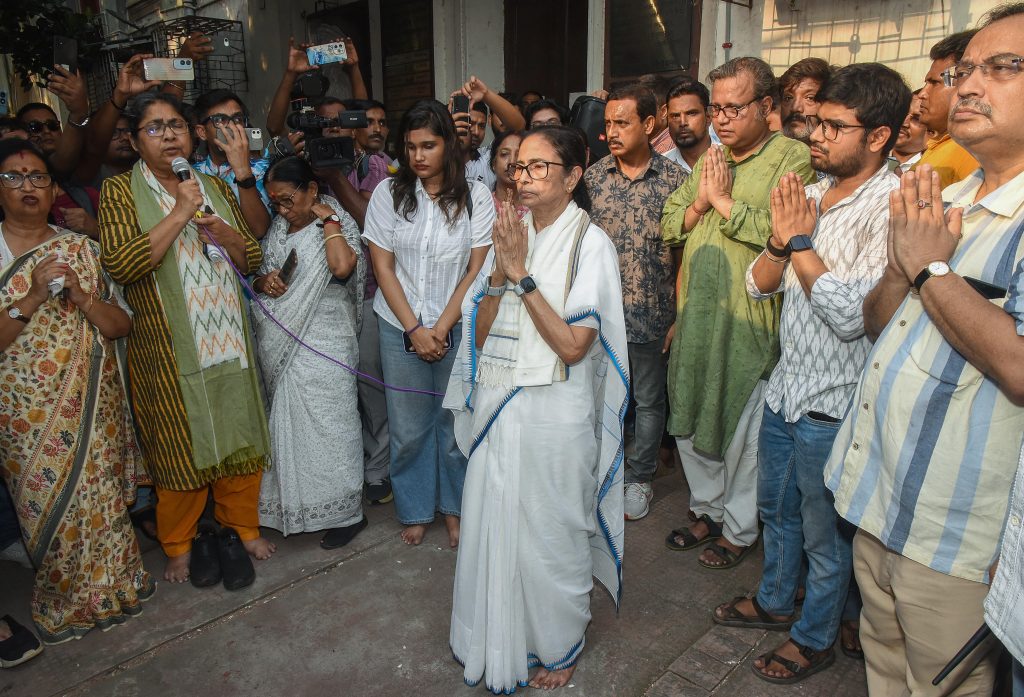
The Trinamool Congress faces its gravest crisis as mass defections, corruption allegations and a leadership revolt threaten to reshape West Bengal politics.
Our Bureau
Kolkatas / New Delhi
The Trinamool Congress (TMC), which dominated West Bengal politics for nearly a decade and a half under the leadership of Mamata Banerjee, is confronting what may be the biggest crisis in its history. Within days of losing power in the state, the party has been rocked by a dramatic internal rebellion, public allegations against its leadership, and a series of corruption-related arrests involving its leaders.
The developments have exposed deep fissures within the party and raised serious questions about its future as a cohesive political force.
The most immediate challenge comes from an unprecedented revolt within the TMC legislature party. In a stunning setback for the party leadership, 58 of the party’s 80 MLAs reportedly approached Assembly Speaker Rathindranath Bose, claiming control of the TMC Legislature Party and electing recently expelled MLA Ritabrata Banerjee as the Leader of the Opposition.
If sustained, the move would represent not merely a rebellion but a fundamental shift in the balance of power within the party. The rebel legislators have effectively challenged the authority of the official leadership while asserting that they represent the majority of elected TMC lawmakers.
What makes the rebellion particularly significant is that it is not being framed as a revolt against Mamata Banerjee herself. The dissident faction has repeatedly stated that the former chief minister remains their leader and has even proposed that she serve as a chief advisor to guide the opposition.
Instead, the rebellion appears to be directed primarily against the growing influence of Mamata Banerjee’s nephew and Diamond Harbour MP, Abhishek Banerjee.
Expelled TMC leader Sandipan Saha has provided insight into the grievances that triggered the revolt. According to him, the turning point came after the party’s electoral defeat when legislators were allegedly instructed not to criticize Abhishek Banerjee and were instead asked to applaud him for his performance.
“No one was permitted to utter a single word of criticism regarding Abhishek. Instead, we were instructed that he had performed exceptionally well and that everyone must rise to accord him a standing ovation,” Saha alleged.
The claim reflects a broader perception among dissidents that internal democracy within the party has weakened and that criticism of the leadership is no longer tolerated. Saha suggested that even veteran legislators who had been active in politics long before Abhishek Banerjee entered public life were compelled to publicly endorse him.
These accusations have transformed the crisis from a routine factional dispute into a debate over leadership style, accountability and decision-making within the party.
The rebellion has also sparked a bitter dispute over procedural legitimacy. Rebel leaders have alleged irregularities in the selection of the official Leader of the Opposition and claimed that some MLAs’ names appeared on documents despite their absence from meetings.
According to Saha, concerns over these alleged irregularities prompted legislators to seek intervention from the Assembly Speaker, eventually leading to the formation of the breakaway group.
The TMC leadership, however, has rejected the rebels’ claims. Senior leader Kunal Ghosh has questioned the authenticity of signatures submitted by the dissident faction and argued that the matter requires legal examination.
As both sides battle for legitimacy, the dispute could ultimately move beyond the political arena and into the courts.
Compounding the party’s troubles is a series of corruption-related arrests involving TMC leaders. Investigative agencies have launched action in multiple cases across West Bengal.
The crisis has also triggered fierce political reactions. TMC MP Mahua Moitra accused the rebel legislators of betraying the mandate of voters who elected them under Mamata Banerjee’s leadership.
She argued that the legislators won on explicitly anti-BJP votes and challenged them to resign and seek a fresh mandate.
“The TMC secured 41 per cent of the vote under Mamata Banerjee’s name and the TMC symbol,” Moitra said, insisting that the rebels could not separate themselves from the political platform on which they were elected.
At the same time, Moitra portrayed the rebellion as an opportunity for what she called a “purification” of the party, suggesting that dissenters were free to leave.
Meanwhile, the BJP has seized upon the turmoil. Senior BJP leader Tapas Roy described the collapse as “inevitable” and argued that the TMC was now experiencing the same political fragmentation that it had previously encouraged in rival parties.
The broader significance of the crisis extends beyond internal party politics. The TMC’s ability to function as a strong opposition force in West Bengal will depend on whether it can resolve the leadership dispute, restore organisational discipline and rebuild public confidence.