

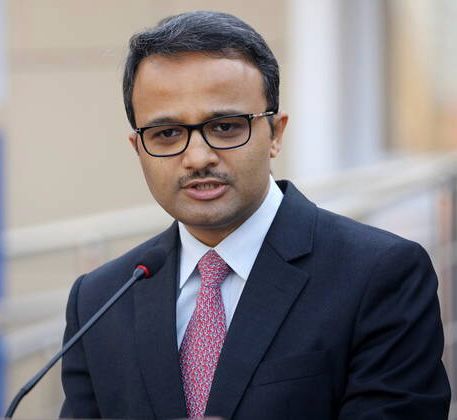
By Amb. Binaya Srikanta Pradhan
Consul General of India in New York
Artificial Intelligence (AI) is no longer a distant technological frontier. It is rapidly becoming a defining force shaping economies, governance systems, and everyday life. From healthcare and education to climate resilience, financial inclusion, strategic sectors and public services, AI is transforming how nations grow and how citizens live. The central challenge today is ensuring that this transformation remains ethical, responsible, equitable, and broadly beneficial.
India will host the India AI Impact Summit in New Delhi from 16 to 20 February 2026. This will be the first global AI summit of its kind hosted in the Global South. The Summit’s theme, Sarvajan Hitaya, Sarvajan Sukhaya meaning Welfare for All, Happiness of All, reflects India’s long standing belief that technological progress must serve humanity. Its guiding principles focus on People, Planet, and Progress, with discussions structured around seven priority areas including human capital, social inclusion, safe and trusted AI, resilience, innovation and efficiency, scientific advancement, democratization of AI resources, and AI for economic growth and social good. Not surprisingly, India is taking active interest in all 5 layers of AI.
In New York, the Consulate General of India has organised series of events focused on interface of AI with different sectors and supported several initiatives in the run up to the Summit. Most recently, a pre-summit engagement at JPMorgan Chase headquarters brought together global leaders on AI including CEO Jamie Dimon. Few other events are:
- Healthcare, AI & Cancer: India–USA Partnership Summit with Mount Sinai Hospital on 1 October 2025 to explore areas of collaboration in healthcare using AI.
- NASSCOM CEO Forum was launched in the Consulate where leadership of Indian IT industry look for win-win partnership between India and the US with major focus on AI related developments.
- February 2026, Columbia University Engineering School signed a MoU with IIT Bombay to set up Columbia-IIT Bombay Centre of AI for Manufacturing. This is a path breaking initiative under which the scientific minds of both premier institutions will help the Indian and American industries to use AI for manufacturing purposes.
These engagements reflect the broader momentum in India–US technology cooperation. American companies are making substantial investments in India’s AI ecosystem. Recent announcements indicate major commitments from hyperscalers such as Amazon at about US$35 billion, Microsoft at US$17.5 billion, and Google at US$15 billion, largely directed toward cloud infrastructure, data centers, and AI compute capacity. Announced investments exceeding $80 billion over the coming years represent one of the largest waves of foreign investment in India’s AI landscape.
A vital and often under-acknowledged pillar of this collaboration is the India–US diaspora, whose leadership across industry, academia, philanthropy, and innovation continues to shape the global AI landscape. Indian-origin leaders in technology, finance, healthcare, and manufacturing form a powerful bridge between the two countries, translating cutting-edge research into scalable, real-world solutions while remaining deeply connected to India’s development priorities. Encouragingly, philanthropy is also strengthening this ecosystem. The Rs. 100 crore endowment by Ms. Chandrika Tandon for an AI Centre of Excellence to her alma mater at IIM Ahmedabad highlights how India–US knowledge partnerships continue to deepen. For us, engagement with the diaspora particularly in industry and technology is an area of strategic interest, as it amplifies innovation, strengthens trust, and ensures that AI cooperation between India and the United States remains both globally competitive and socially responsible.
The United States brings leadership in advanced research, innovation ecosystems, and computing infrastructure, while India offers scale, talent, diverse datasets, and a rapidly expanding digital economy. Together, these complementary strengths can generate AI solutions with global relevance.