Sanju Samson’s move from Rajasthan Royals to Chennai Super Kings felt like the end of one era and the start of another. For 11 years, he was Rajasthan’s captain, record-holder, and identity, so walking away was never easy
Archan Mehta
Sanju, a cricketing tale where timing is priceless, until it suddenly isn’t. Cricket moves between brilliance and chaos, and Samson has experienced both on his good days the ground feels too small, and on his bad days the noise around him feels impossible to ignore. Late 2024 was his peak, the kind of run that turns talent into legend: back-to-back T20I centuries followed by another unbeaten hundred that didn’t just put him in the record books, but announced him as something special. In a format obsessed with power, match-ups, and brute force, Samson reminded everyone that pure timing can still dominate bowlers. But Indian cricket is rarely patient, brilliance earns attention, not security and that is where Samson’s story now stands, shifting from comfort to challenge, from art to anxiety.
That record-breaking run wasn’t loud; it was elegant domination. A 111 off 47 against Bangladesh in Hyderabad, followed by twin hundreds against South Africa, capped by an unbeaten 109 and a monstrous 210-run partnership against South Africa felt like Samson had finally cracked the T20 code on his own terms. The numbers were outrageous: over a thousand T20I runs at a strike rate brushing 150. But what truly separated him was how he scored them. No slog-sweep spasms, no baseball swings, just a straight bat, soft hands, and a refusal to look ugly. When he hit five sixes in an over, it wasn’t brute force; it was geometry. Bowlers weren’t smashed, they were educated. Somewhere during that phase, Samson became every coach’s favorite example and every bowler’s recurring nightmare.
Sanju Samson’s move from Rajasthan Royals to Chennai Super Kings felt like the end of one era and the start of another. For 11 years, he was Rajasthan’s captain, record-holder, and identity, so walking away was never easy. CSK were not just signing a batter; they were planning for the future, with MS Dhoni watching closely. The ₹18-crore price tag brought heavy expectations, because in Chennai, past reputation means little without present form. Just as Samson looked set, injuries slowed him down and selection doubts returned. Despite his T20I centuries, the team management shifted focus to Shubman Gill, pushing Samson down the order. Roles kept changing, confidence slipped, and when Samson finally returned as an opener, the pressure had doubled, forcing him to fight doubt as much as bowlers.
Yet, just as momentum seemed set, cricket did what it always does, it complicated things. Injuries slowed Samson’s IPL rhythm, and selection uncertainty returned like an uninvited guest. Despite those three T20I centuries, the management pivoted towards Shubman Gill, pushing Samson down the order. The irony was harsh, Samson lost his place even as Gill struggled to score runs. His role kept changing, his confidence dropped, and his career once again became unpredictable. When Samson finally returned as an opener, the pressure was even higher. Expectations had piled up, and he was no longer batting just against bowlers, but against his own doubts.
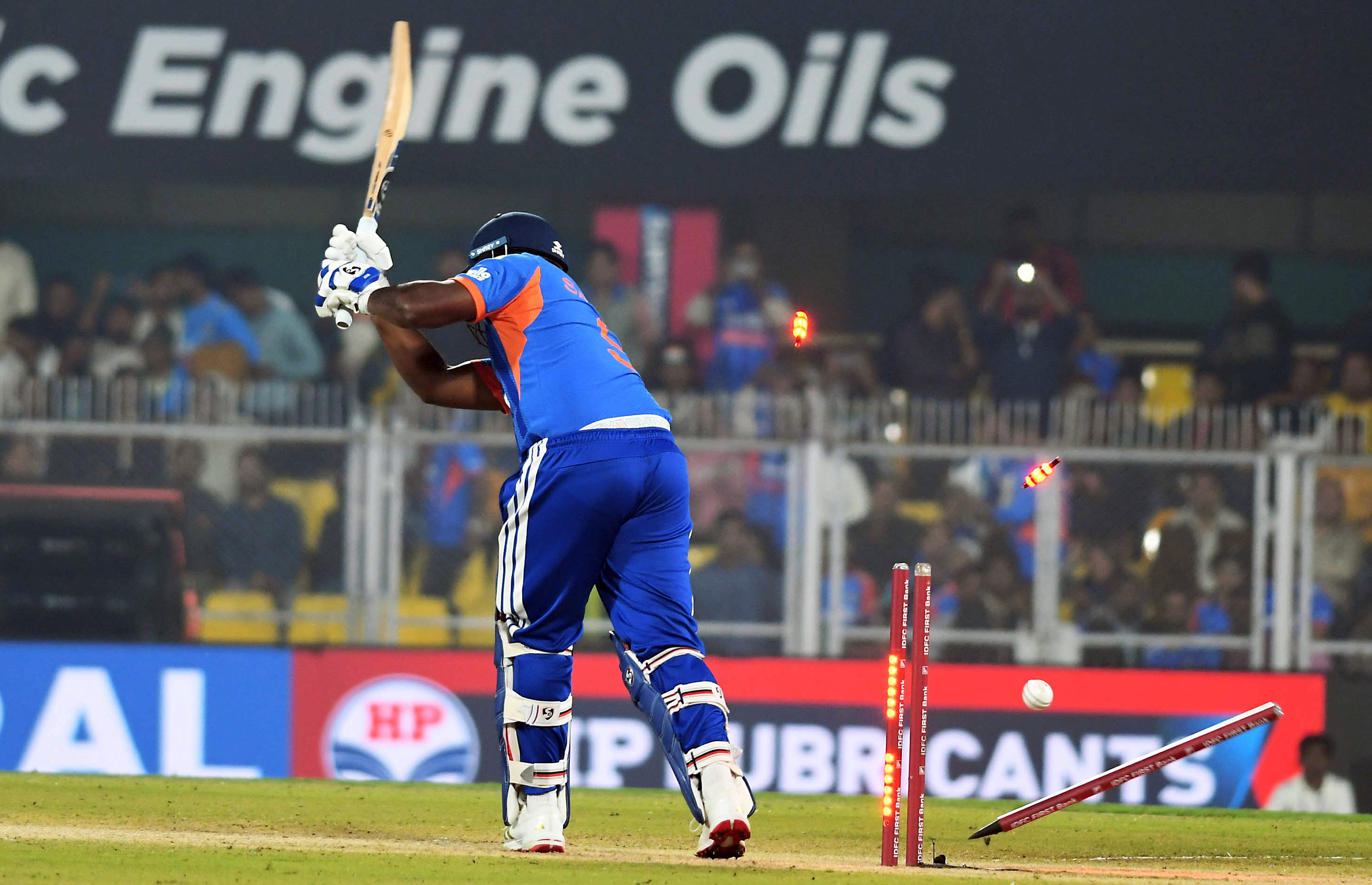
The current slump has been brutal. Since January 2025, numbers that once dazzled now disturb an average barely touching double digits, PowerPlays becoming quick exits, and a technical flaw ruthlessly exposed. New Zealand’s pacers didn’t out-skill him; they out-planned him. Short balls into the body, straight lines, minimal room and Samson’s static footwork did the rest. Sunil Gavaskar’s critique cut deep because it was accurate: no movement, exposed stumps, late reactions. The golden duck in Guwahati, first ball from future CSK teammate Matt Henry, felt symbolic as if destiny was bowling in-swingers. Meanwhile, Ishan Kishan was cashing in, Tilak Varma was waiting, and Abhishek Sharma had already locked the door. As selectors juggle options, Samson’s margin for error has vanished.
The final truth is clear and tough, talent gives you chances just not guarantees. In Indian cricket, timing matters most, and right now, even time seems to be working against him.
Archan Mehta is a writer dedicated to telling compelling stories about athletes, teams, and the world of cricket