

As a new US ambassador takes charge in New Delhi, ambition in the India–US partnership collides with strategic uncertainty, erratic signals from Washington and an unresolved trust deficit
Indian Interest by SHOBHAN SAXENA
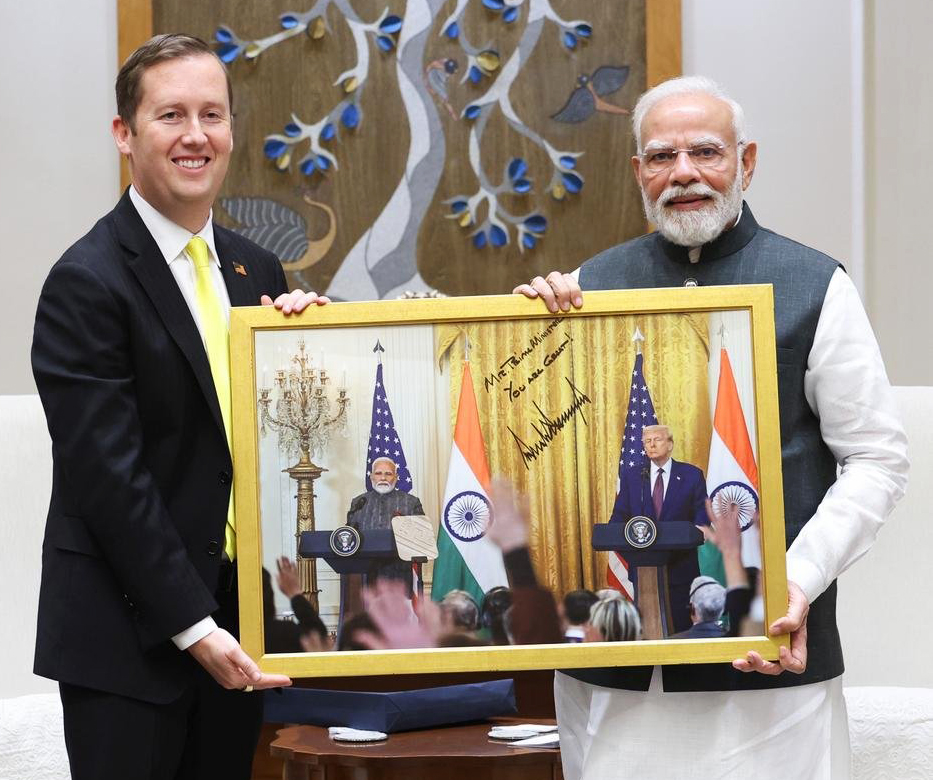
The arrival of a new American ambassador in New Delhi is usually a procedural moment, marked by polite platitudes and predictable promises. Yet Sergio Gor’s presentation of credentials to President Droupadi Murmu comes at a time when India–US relations are anything but routine. Beneath the talk of “promise and opportunity” lies a relationship facing familiar frictions, new uncertainties and, most worryingly, a lingering trust deficit that neither side can afford to ignore.
Gor has been explicit about his ambition. He wants to take the partnership “to the next level,” focusing on defense, trade, technology and critical minerals. On paper, this agenda aligns neatly with India’s own priorities—strategic autonomy with stronger military capabilities, access to advanced technologies, resilient supply chains and a bigger role in the global economy. New Delhi has little reason to resist such a framework. Indeed, India has repeatedly shown that it wants deeper engagement with the United States, provided it is based on mutual respect and strategic consistency.
That caveat matters. The central challenge in current India–US relations is not a lack of shared interests but a lack of predictability. Washington’s foreign policy has become increasingly erratic, shaped by domestic political compulsions and sharp swings in tone depending on who is speaking. This unpredictability complicates decision-making in New Delhi, where long-term strategic planning is prized and sudden policy reversals are viewed with suspicion.
Donald Trump’s comments on India and Prime Minister Narendra Modi illustrate the problem. Ambassador Gor insists that Trump’s friendship with Modi is “real” and that “real friends can disagree.” That may be true at a personal level. But public remarks that question India’s trade practices, hint at punitive tariffs, or frame relations in purely transactional terms are not helpful. They feed a narrative in India that the United States is an unreliable partner, quick to demand alignment but slow to acknowledge India’s constraints and interests.
Trust, once dented, is hard to rebuild. India remembers past sanctions, technology denials and moments when US strategic priorities shifted abruptly. Even as defense cooperation has deepened and military exercises have expanded, the shadow of conditionality has never fully disappeared. For Indian policymakers, the concern is not whether the US values India today, but whether that valuation will survive the next election cycle or policy pivot in Washington.
This is where Gor’s role becomes significant. His background as a political operative close to the Trump ecosystem gives him access and credibility within the American system. If used wisely, that proximity could help translate Indian concerns into Washington’s political language. His emphasis on high-level relationships and his attempt to project warmth and familiarity are signals that he understands the importance of optics and reassurance in diplomacy.
India, for its part, is likely to respond positively. New Delhi has shown remarkable consistency in engaging successive US administrations, irrespective of party. It has invested heavily in defense interoperability, welcomed American companies into its market, and aligned with the US on issues ranging from the Indo-Pacific to critical technologies. India’s response to Gor’s agenda will not be obstructionist; it will be cautious, calibrated and pragmatic.
But positivity alone cannot bridge a trust gap. That requires a conscious effort from the US side to demonstrate strategic steadiness. If Washington wants India to play a larger role in balancing China, securing supply chains and stabilizing the Indo-Pacific, it must also accept India’s need for autonomy and policy space. Pressure tactics, public admonitions or abrupt policy shifts only reinforce Indian skepticism.
The larger truth is that the US needs India as much as India needs the US—perhaps more than Washington is willing to admit. In a fragmented world marked by geopolitical rivalry and economic decoupling, India stands out as a rare convergence point: a large democracy, a growing economy and a strategic actor with independent credibility. For the US, partnership with India is not a favor; it is a strategic necessity.
A positive response, therefore, must begin in Washington. Clear signals on trade, restraint in rhetoric, and consistency in strategic commitments would go a long way in restoring confidence. Ambassador Gor can play an important role in conveying this reality back home. Diplomacy, after all, is not just about ambition; it is about reassurance.