

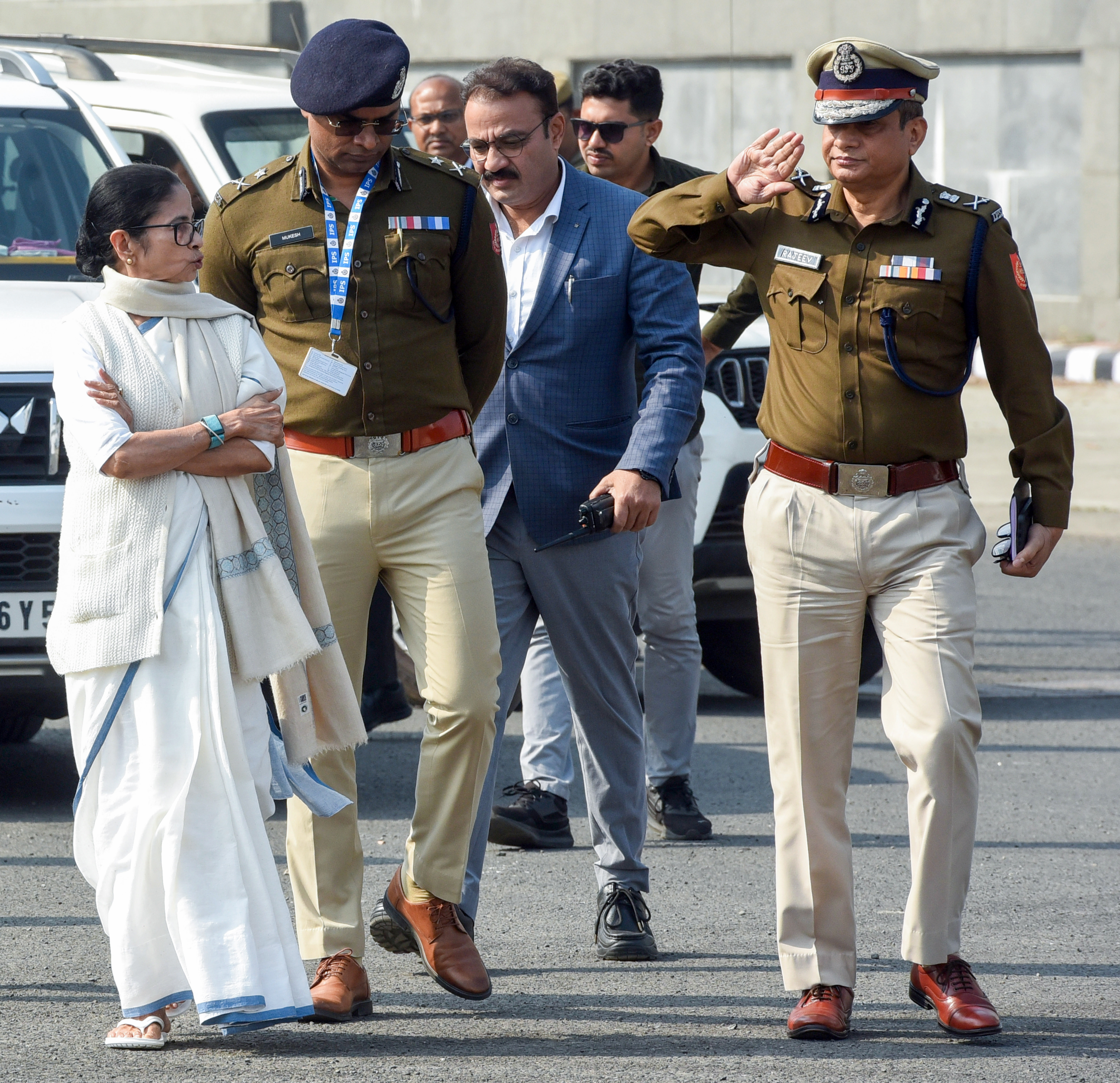
By staying FIRs against Enforcement Directorate officers and issuing notice to West Bengal’s Chief Minister, the Supreme Court has signalled that the confrontation between central agencies and state authority can no longer be brushed aside as routine political noise.
Our Bureau
New Delhi
The Supreme Court’s intervention in the standoff between the Enforcement Directorate and the West Bengal government marks a critical moment in India’s evolving federal balance. What began as a raid at the premises of political consultancy firm I-PAC has now escalated into a constitutional confrontation—one that raises uncomfortable questions about the rule of law, the autonomy of investigative agencies, and the limits of political power in states governed by parties opposed to the Centre.
At the heart of the case lies an extraordinary sequence of events on January 8, when ED officials conducting searches in connection with an alleged coal-smuggling and money-laundering case were confronted by West Bengal Chief Minister Mamata Banerjee, senior police officials, and a large police contingent. The ED has alleged that during the search, “key evidence,” including documents and electronic devices, was removed, and that an ED officer’s mobile phone was taken away. Soon after, the West Bengal police registered FIRs against the ED officers themselves—an action that prompted the central agency to seek urgent relief from the apex court.
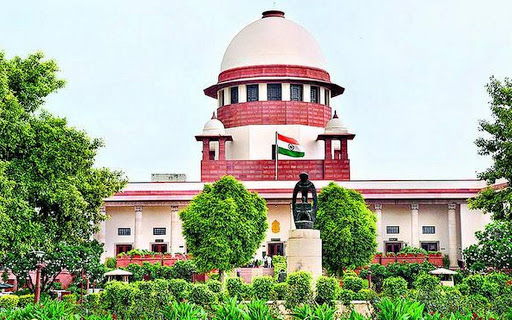
On Thursday, the Supreme Court stayed those FIRs, directed preservation of CCTV footage from the searched premises, and issued notices to the Chief Minister and senior state police officials. More significantly, the Bench of Justices Prashant Kumar Mishra and A.G. Masih framed the issue not as an isolated law-and-order dispute, but as a matter with “serious and far-reaching” constitutional implications.
The court’s language was unusually stark. If such issues are left undecided, it warned, the country could drift towards “lawlessness” in states governed by different political outfits. Offenders, the Bench observed, cannot be allowed to hide behind the shield of state law-enforcement agencies. This was not merely a procedural observation; it was a clear signal that the court sees the potential erosion of institutional boundaries as a threat to the federal structure itself.
Appearing for the ED, Solicitor General Tushar Mehta painted a disturbing picture. He alleged a pattern in West Bengal where the Chief Minister routinely intervenes when central agencies conduct investigations. According to the ED, not only was incriminating material relating to proceeds of crime worth over ₹2,742 crore removed, but central officers were intimidated, demoralized and obstructed from performing their statutory duties. Past incidents, including the alleged gherao of a senior CBI officer’s residence, were cited to underline what the ED called a hostile environment for central agencies in the state.
Mehta went further, alleging attempts to influence judicial proceedings themselves. WhatsApp messages purportedly circulated by the ruling Trinamool Congress’ legal wing, calling supporters to assemble in court, were placed before the Bench. At one point, the court remarked that it appeared as if the High Court had been turned into “Jantar Mantar”—a telling comment that reflected judicial unease over the politicization of court spaces.
The West Bengal government, however, has mounted a robust defense. Senior advocate Kapil Sibal, appearing for Mamata Banerjee, argued that the ED’s plea was not maintainable and accused the agency of forum shopping. He questioned the timing of the raid—why now, close to elections, when the last statement in the case was recorded in early 2024? Sibal maintained that the premises housed sensitive election-related data and that the Chief Minister had visited the site in her capacity as party chairperson after being informed that unauthorized persons had entered.
Senior advocate Abhishek Manu Singhvi, representing the state and its police leadership, challenged the ED’s version of events, pointing to alleged inconsistencies in the panchnama and the timeline of police intimation. He also stressed that the Chief Minister enjoys Z-plus security, making it obligatory for senior police officials, including the DGP, to accompany her.
Yet, even as the court refrained from making findings of fact at this stage, it was unwilling to dismiss the matter as routine political sparring. By staying coercive action against ED officers and calling for detailed affidavits, the Bench signalled that the questions raised go beyond partisan claims and counterclaims.
The political reactions were swift and predictable. BJP leaders hailed the court’s intervention as a rebuke to Mamata Banerjee, accusing her of undermining constitutional norms. The Trinamool Congress, for its part, continues to allege political vendetta, linking ED action to election cycles and accusing central agencies of overreach.
The Supreme Court has, for now, drawn a red line. Its warning against “mobocracy replacing democracy” and its insistence on preserving evidence reflect an attempt to restore equilibrium. The February 3 hearing will be closely watched, not just for its outcome, but for the principles it may lay down.