

With a record tenth term as Chief Minister after a sweeping 2025 victory, Nitish Kumar has reinforced his stature as one of India’s most durable leaders and a consequential figure in national politics.
In November 2025, Nitish Kumar returned to office as Chief Minister of Bihar for an unprecedented tenth time, a milestone rarely seen in Indian democracy. Sworn in on November 20 following a landslide victory for the National Democratic Alliance (NDA) in the Bihar Assembly elections, Kumar’s latest mandate was more than a personal triumph. It was a resounding endorsement of his governance model and a signal that his political influence now extends well beyond the borders of Bihar.
The 2025 Bihar Assembly elections, held in two phases on November 6 and November 11 with results declared on November 14, delivered a decisive verdict. The NDA secured 202 of the 243 seats in the Assembly, a commanding majority that left little doubt about voter sentiment. The Bharatiya Janata Party emerged as the single largest party with 89 seats, while Kumar’s Janata Dal (United) followed closely with 85 seats. Alliance partners such as the Lok Janshakti Party (Ram Vilas), Hindustani Awam Morcha, and Rashtriya Lok Morcha added to the scale and breadth of the victory, underlining the cohesion of the coalition.
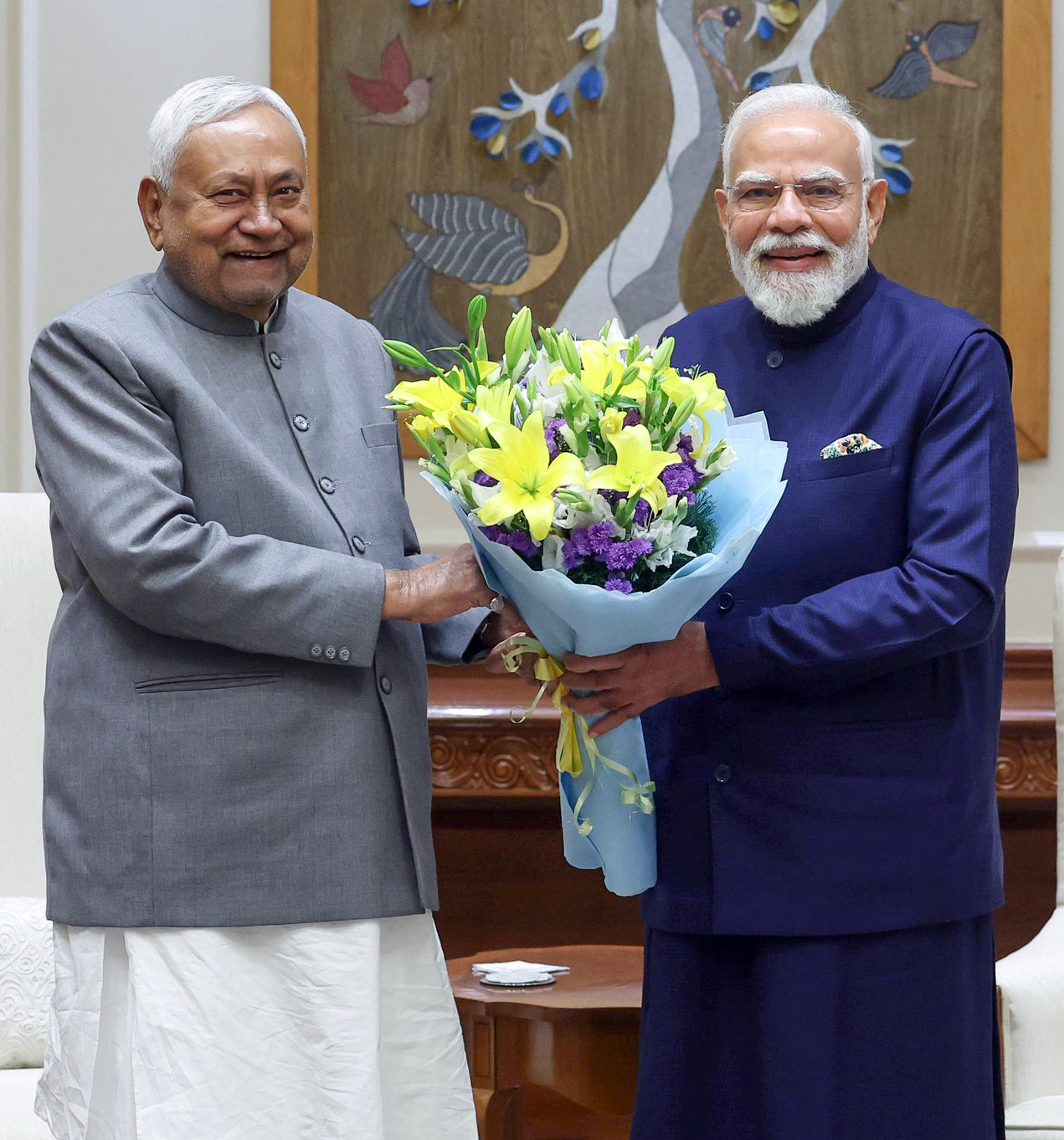
Kumar’s return for a tenth term placed him in rare company and earned recognition from the World Book of Records, underscoring the historical significance of the moment. The oath-taking ceremony at Patna’s Gandhi Maidan was deliberately grand and symbolic, attended by Prime Minister Narendra Modi and senior leaders from across the NDA. The message was clear: Bihar’s verdict mattered nationally, and Nitish Kumar remained central to the alliance’s political narrative.
Over the years, Kumar has cultivated a reputation as an administrator focused on delivery rather than rhetoric. His governance philosophy has rested on what his supporters describe as “performance-based schemes,” particularly in areas that directly affect everyday life. Law and order, once a defining weakness of Bihar, became an early focus of his tenure. Improvements in policing and administrative accountability helped change perceptions of the state and created the foundation for subsequent development efforts.
Among his most widely cited initiatives is the Jeevika Project, formally known as the Bihar Rural Livelihood Project. Supported by the World Bank, Jeevika has transformed rural livelihoods by organizing millions of women into self-help groups. These “Jeevika Didis” have been linked to formal banking, access to credit, and skill training, enabling them to become economic actors in their own right. The project has been credited not only with improving household incomes but also with shifting social dynamics by enhancing women’s agency at the grassroots level.
Women’s welfare has been a consistent pillar of Kumar’s political identity. The decision to provide bicycles to school-going girls, aimed at reducing dropout rates, proved to be a quiet revolution in social policy. The scheme significantly increased school attendance and contributed to a rise in female literacy. Complementing this was the introduction of a 50 percent reservation for women in Panchayati Raj institutions, a move that reshaped local governance and brought women into leadership roles across rural Bihar.
Infrastructure development has been another defining feature of Kumar’s long tenure. Village electrification, expansion of road networks, and improvements in basic public services have altered the state’s physical and economic landscape. In his current term, which began in November 2025, Kumar has outlined an ambitious agenda aligned with the idea of a “Developed Bihar.” Central to this vision is a plan to generate 10 million jobs over the next five years, reflecting an acute awareness of Bihar’s demographic pressures and the aspirations of its youth.
The government has also moved to position Bihar as an emerging center for technology and industry in eastern India. Proposals for a defense corridor and the development of technological hubs are intended to attract investment and diversify the state’s economic base. In parallel, symbolic and substantive investments in sports and culture have gained momentum. The inauguration of the world-class Rajgir Sports Complex and Cricket Stadium aims to nurture sporting talent, while institutions such as the APJ Abdul Kalam Science City in Patna signal a commitment to scientific temper and education.
Cultural and civilizational heritage has not been neglected. Projects like the Buddha Samyak Darshan Museum and Memorial Stupa in Vaishali reflect an effort to link development with Bihar’s historical identity, while also boosting tourism and global engagement.
Nitish Kumar’s political journey has often been marked by adaptability and strategic recalibration. Critics have pointed to his shifting alliances over the years, but his supporters argue that this flexibility has allowed him to safeguard Bihar’s interests and secure stability.
Today, as the longest-serving Chief Minister in Bihar’s history and a leader with proven electoral appeal, Nitish Kumar occupies a distinctive place in national politics. His ability to combine welfare-driven governance with coalition management has made him a reference point in debates on federal leadership. The tenth term is not merely a record; it is a statement that Nitish Kumar has evolved from a regional stalwart into a national leader whose influence will continue to shape India’s political discourse.