

In 2025, two Indian military officers stepped into the national spotlight, not on the battlefield but before the nation, embodying a new era where women stand at the forefront of India’s security and strategic resolve.
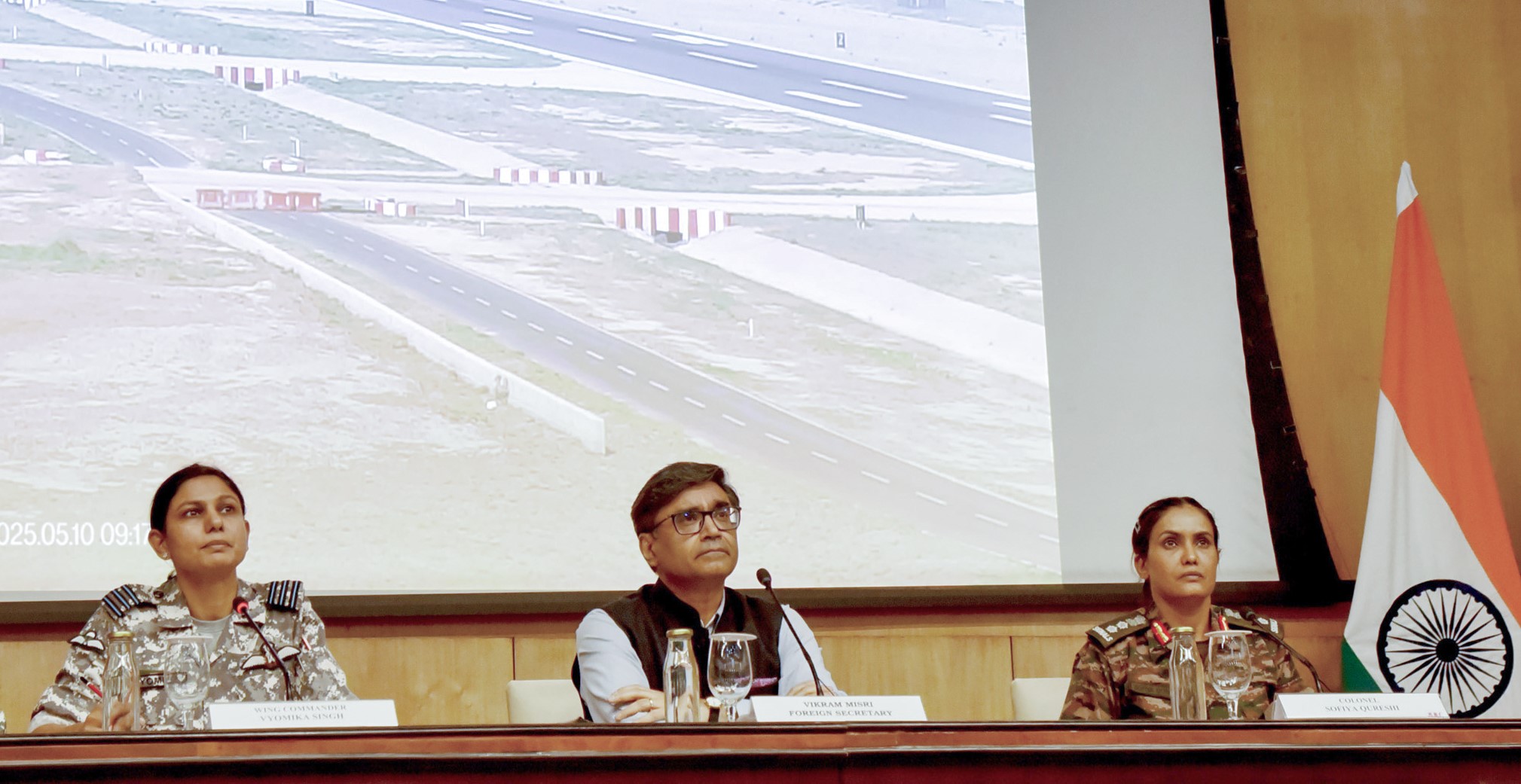
In May 2025, as India responded to the terror attack in Pahalgam with a calibrated retaliatory operation named Operation Sindoor, the country witnessed a moment that went beyond military messaging. For the first time, a high-profile military media briefing on a sensitive national security operation was jointly led by two women officers: Colonel Sofiya Qureshi of the Indian Army and Wing Commander Vyomika Singh of the Indian Air Force. Calm, precise, and authoritative, they became the unmistakable public faces of the operation — and, in the process, powerful symbols of the changing role of women in India’s armed forces and in New India itself.
Operation Sindoor was a moment of national gravity. The briefing demanded clarity, credibility, and composure under intense public and international scrutiny. Colonel Qureshi and Wing Commander Singh delivered exactly that. Standing shoulder to shoulder, representing two different services, they conveyed operational details with restraint and confidence, reinforcing the seriousness of India’s response while projecting institutional professionalism. The visual itself carried meaning: India’s security narrative was being articulated by women officers at the highest level of trust.
Colonel Sofiya Qureshi, an experienced Indian Army officer, brought to the briefing a reputation built over years of service in operational and leadership roles. Known within the force for her analytical approach and steady command presence, she represented the Army’s expanding confidence in placing women officers in roles that demand both strategic depth and public accountability. Her presence underscored how women have moved decisively beyond support roles into the core of military decision-making and representation.
Wing Commander Vyomika Singh, a helicopter pilot in the Indian Air Force with extensive flying hours, brought a different but complementary strength. Trained to operate in high-risk, high-pressure environments, Singh symbolized the operational edge of India’s air power. Her role in the briefing highlighted the Air Force’s growing integration of women into combat and operational aviation roles, once considered exclusively male domains. Together, Qureshi and Singh reflected not exceptionality, but institutional change.
The national response to the briefing was immediate and telling. Across television screens, newspapers, and digital platforms, the focus quickly expanded beyond Operation Sindoor itself to the two officers delivering the message. They were widely praised for their composure and clarity, but also for what they represented: a confident, modern India where authority is defined by competence rather than gender.
By the end of 2025, both officers featured prominently in media retrospectives and recognitions, including Femina’s Fab List, which acknowledged women who broke barriers and reshaped public perceptions during the year. Yet their impact extended far beyond awards. For many Indians — especially young women — Colonel Qureshi and Wing Commander Singh became tangible proof that national service, leadership, and visibility at the highest levels were no longer constrained by tradition.
Their emergence as the faces of Operation Sindoor also aligned with a broader transformation underway in India’s armed forces. Over the past decade, women have entered new streams across the military — from permanent commissions to fighter aviation, naval operations, and command-track roles. The 2025 briefing did not create this shift; it revealed it. It showed a system confident enough to place women at the forefront during moments of national consequence.
Equally significant was the symbolism embedded in the operation’s public communication. In a country where women have often been portrayed primarily as victims or beneficiaries of security, Qureshi and Singh represented women as providers of security — professionals entrusted with defending the nation and explaining its actions to the world. This reframing carried deep resonance in the context of “New India,” a phrase increasingly associated with self-assurance, institutional reform, and social change.
Their story also cut across regional, social, and professional divides. One from the Army and the other from the Air Force, one grounded in land operations and the other in the air, they embodied diversity within unity. That they spoke with one voice reinforced the idea of jointness — not only among services, but across gender lines in national leadership.
In the months that followed, references to the “Operation Sindoor briefing” entered public discourse as a shorthand for women’s rising visibility in strategic spaces. Educational institutions, military aspirants, and civil society forums cited the moment as inspirational. For young women considering careers in uniform, the message was unmistakable: leadership was no longer theoretical; it was visible, current, and real.
Colonel Sofiya Qureshi and Wing Commander Vyomika Singh did not seek celebrity. Their prominence was a by-product of duty performed at a critical juncture. Yet history often turns on such moments — when representation meets responsibility. In 2025, as India asserted its security interests, these two officers also asserted something quieter but equally enduring: that the story of India’s defense, and of New India itself, is increasingly being written by women in uniform.