

Archan Mehta

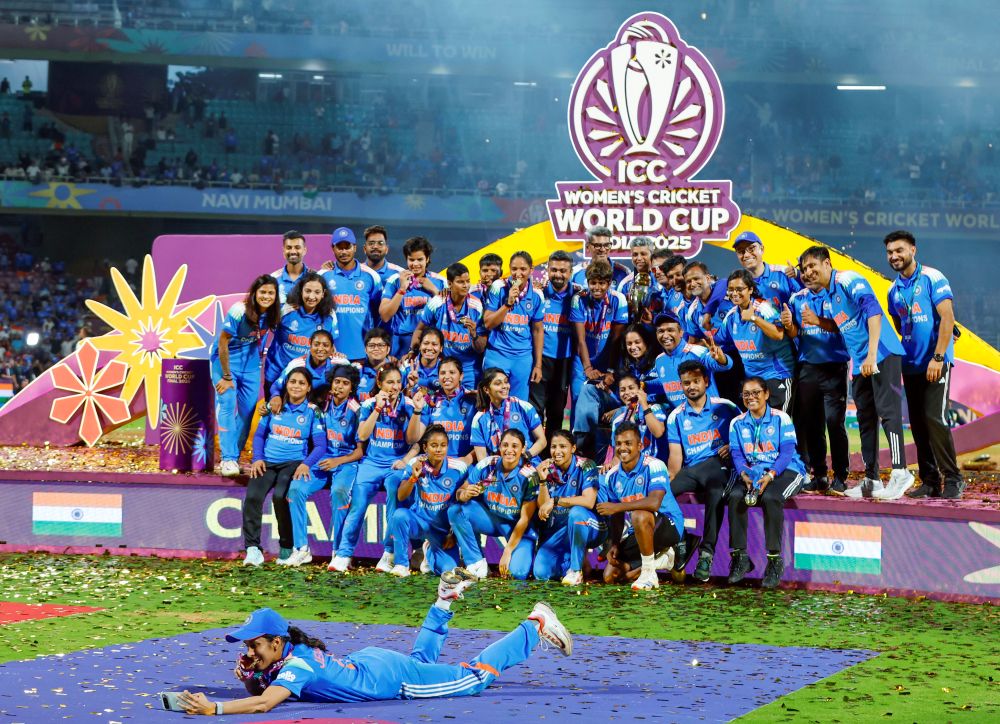
India didn’t just win the 2025 ICC Women’s World Cup they rewrote destiny with eyeliner still running from happy tears. For a nation that waited nearly half a century to see its women hold the golden cup, this wasn’t just cricket; it was catharsis. Ahmedabad became a festival, not a final. Fireworks lit up the sky, cellphones lit up timelines, and even the skeptics who once said “let them stick to academics” were suddenly googling player stats like lifelong fans.
India’s start to the World Cup was, frankly, a comedy of errors. Three losses in a row, social media meltdowns, and enough armchair coaching to fill a BCCI think tank. The critics came in full voice, and some of that criticism dipped into the kind of gender bias that smelled of mothballs and double standards. But this team didn’t need sympathy, they needed spark.
Enter Jemimah Rodrigues, the girl who smiles like she’s singing in a church choir but bats like she’s breaking into a bank. Her unbeaten 127 against Australia in that semi-final wasn’t just an innings; it was an intervention. When she refused to celebrate her century, you could almost hear her saying, “I’ll celebrate when the scoreboard does.” And when India chased down 339, she sank to her knees in tears, part exhaustion, part exorcism. As one fan tweeted, “Even the Death Star couldn’t stop Jemi Skywalker.”
If leadership had a face, it’d be Harmanpreet Kaur’s fierce eyes, full heart, and occasionally full-on emotional meltdown. But that’s the beauty of her captaincy: she leads with passion, not pretense. When India were wobbling mid-tournament, Harman didn’t hide behind clichés. She wept, she yelled, and then she won. Her decision to hand Shafali Verma the ball in the final was pure instinct, the kind that separates captains from calculators. And when it worked, her smirk said it all: “Told you, data boys”. Her post-match interview summed her up perfectly: “Sometimes I cry in the dressing room, but I also make sure others laugh before we walk out.” That’s leadership with equal parts steel and softness, the perfect blend for a team learning to love its scars.
Smriti Mandhana was built for the big stage and for billboards, yes but this time she brought grit with her gloss. Her 45 in the final may not sound like fireworks, but it was the fuse that lit India’s innings. As she and Shafali stitched a century stand, the swagger was unmistakable. She passed Mithali Raj’s record for most runs by an Indian in a single World Cup, proving that beauty and brutality can coexist especially when your cover drives have both. And when she walked the trophy toward the stands to hand it to Jhulan Goswami and Mithali Raj, it was more than symbolism. It was closure. The torch had officially changed hands and India’s women finally had both hands-on history.
Every champion side needs a constant, the one who quietly gets the job done while the stars soak up the spotlight. For India, that was Deepti Sharma, the “professor” of the dressing room. Her World Cup numbers read like a math textbook with attitude: 22 wickets, 215 runs, and a first-ever double of 200+ runs and 20+ wickets in a single edition. And that final, a 58-run knock followed by a five-wicket haul. Talk about five-star service. Harsha Bhogle called it “a story of redemption”; the fans just called her Deepti the Destroyer.
The most moving scenes came after the match. Harmanpreet and Smriti took the trophy around the ground, walking it straight to the pioneers; Jhulan Goswami in tears, Mithali Raj beaming, Anjum Chopra shouting “Finally! Finally! Finally!” from the commentary box. Jemimah posted, “This trophy belongs to them as much as it does to us.” And for once, the internet agreed on something. Dinesh Karthik called it “India’s 1983 moment From Mumbai to Manipur, girls held bats taller than themselves and parents finally said, “Why not her?” The BCCI’s ₹51 crore reward was the cherry on top of a victory already rich in meaning.
In 2025, India women cricket team turned whispers into war cries, criticism into conviction, and talent into triumph. As the confetti settled and the champions hugged their heroes, a new truth emerged, women’s cricket in India no longer needs validation, it needs vision. Because the future isn’t female or male anymore, it’s fearless.
And from Nov 2 2025, when India dreams of cricketing glory, the women in blue won’t be following in footsteps, they’ll be leaving them.
Archan Mehta is a writer dedicated to telling compelling stories about athletes, teams, and the world of cricket