

Our Bureau
Berlin/ New Delhi
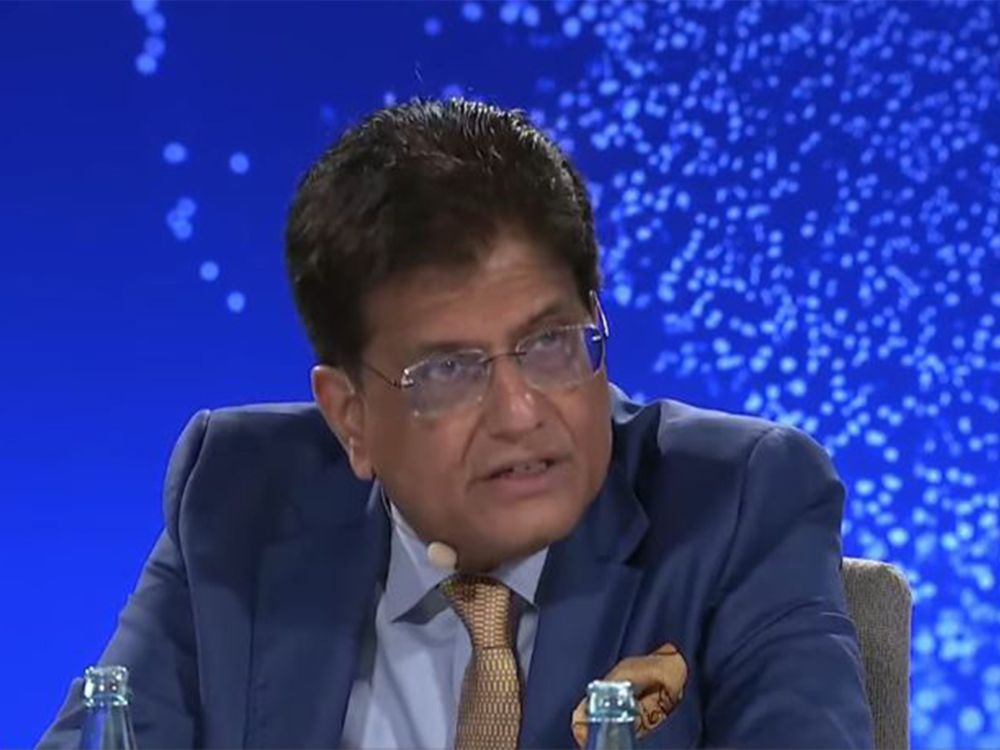
Union Commerce and Industry Minister Piyush Goyal on Friday said that India will not sign any trade deal in a “hurry” as New Delhi views trade agreements as an opportunity to build deeper trust and partnerships.
He said India is exploring new markets and looking at “stronger demand impetus” within the country.
Speaking at the Berlin Global Dialogue on Friday, the Minister emphasised that India views trade agreements as an opportunity to build deeper trust and partnerships.
“India never thinks decisions in a rush or on the pressure of the moment, and we’ve accepted that there are tariffs on us, we’re looking at how to overcome that. We’re looking at newer markets. We are looking at a stronger demand impetus within the Indian economy,” the Minister said during a panel discussion, referring to the tariffs imposed by the US.
Talking about the bilateral trade deal (BTA) between India and the US, the Minister stated that talks are going on, but India is not in a hurry to finalise the BTA under any pressure.
“We are talking to the US, but we don’t do deals in a hurry,” he said, adding that India doesn’t do deals with deadlines or with a “gun on our head.”
Earlier, in an interaction with DD, Goyal highlighted that India and the US are engaged in talks, with teams working together, and that the Commerce Secretary met US counterparts to push talks toward a fair and equitable trade deal.
Talking about the intent behind the trade deals, he added, “Trade deals are for a longer duration. Trade deals are not only about tariffs; it’s not only about access to goods or services; it’s also about trust, it’s also about relationships. It’s a demonstration to businesses that you can work between both countries and trust businesses to prosper, businesses to be protected, businesses to get opportunities and a fair deal.”
Speaking about the advantages due to the active workforce, Goyal said, “We have a demographic dividend, our average age is only 28 and years, which you won’t find in many other parts of the world except of course Africa. Now that young person now connected with the internet, and we have a billion internet users, very aspirational. That aspiration is driving him to work harder, is driving him to adopt new technologies, new languages, new countries. I think one must also recognise India’s economy, while it may seem it’s only a USD 4 trillion economy, on a purchasing power parity is already at USD 15 trillion.”
India is also actively pursuing FTAs with the EU, New Zealand, and other countries, while having already signed agreements with the UAE, Australia, and the UK.
Meanwhile, an Indian government official in New Delhi said on Friday that India and the US are “very near” to finalising the first tranche of the ambitious Bilateral Trade Agreement (BTA).
The official affirmed that both sides are converging on most of the issues and negotiators of both the countries are sorting out “language of the agreement”.
There are not many differences for the countries to reach a resolution, the official claimed.
Talks are progressing well on the agreement and no new issues are acting as hurdle in the negotiations, he further said, adding that both parties are hopeful of the deadline.
On Thursday, negotiators of both countries had a virtual discussion. So far, five rounds of talks have been completed since March for the first phase of the bilateral trade agreement, initially decided to be inked by the “fall of 2025.”
The bilateral trade agreement, formally proposed in February following directives from leaders of both countries, aims to more than double trade volumes from the current USD 191 billion to USD 500 billion by 2030.
Commerce and Industry Minister Piyush Goyal was in the United States last month, leading high-level trade negotiations as both nations work toward concluding a comprehensive bilateral trade agreement. Goyal was accompanied by a delegation of senior ministry officials including Special Secretary and India’s Chief Negotiator Rajesh Agrawal.
In mid-September, a team of United States officials led by Assistant US Trade Representative for South and Central Asia, Brendan Lynch, had “positive and forward-looking” discussions with the officials from India’s Department of Commerce and it was decided to intensify efforts to achieve early conclusion of a mutually beneficial Trade Agreement.
Over the past few months, India and the US have been negotiating for an interim trade deal. There were reservations from the Indian side on the US demand for opening up the agricultural and dairy sectors. Agriculture and dairy are critical for India as these two sectors provide livelihood opportunities to a large section of people.
Initially, US President Donald Trump announced 25 per cent tariffs on Indian goods that came into effect on August 1, even as there were hopes of an interim India-US trade deal that would have otherwise helped avoid elevated tariffs. A few days later, he imposed another 25 per cent tariff, taking the total to 50 per cent, citing India’s continued imports of Russian oil.
The 50% tariffs came into effect on August 27.
US President Donald Trump had imposed reciprocal tariffs on dozens of countries with which the US has a trade deficit.