

Our Bureau
Mumbai / New Delhi
India’s financial markets ended lower for a second straight session on Thursday after the United States imposed fresh tariffs on Indian imports. While investor sentiment has clearly taken a hit, government officials and economists stressed that the impact of these trade barriers will be largely short-lived, cushioned by reforms, diversification, and robust domestic demand.
The BSE Sensex dropped 705.97 points, or 0.87 per cent, to close at 80,080.57, while the Nifty 50 slipped 211.15 points, or 0.85 per cent, to 24,500.90. Export-heavy sectors like IT, chemicals, and textiles bore the brunt of selling, with broader indices such as Nifty Midcap 100 and Nifty Smallcap 100 also sliding more than one per cent.
Analysts attributed the fall to renewed trade tensions with the US. “Tariffs happened, truce did not,” said banking and market expert Ajay Bagga, noting that conflicting signals from Washington had unsettled investors. “Democrats in the US are calling Trump’s sanctions on India a self-goal.”
Short-Term Pain
Amid the market volatility, the Commerce Ministry moved to reassure industry. A senior official acknowledged that higher tariffs—raised to as much as 50 per cent—would hurt Indian exporters in sectors such as textiles, chemicals, and machinery. However, he emphasized that the damage would be temporary.
“It is understood that 50 per cent tariffs are going to impact trade in the short run, but it will not be a very long-term loss,” the official told ANI. Exporters, he admitted, may face liquidity constraints due to slowing orders and delayed payments. But the government is preparing targeted relief, including an accelerated rollout of the Export Promotion Mission (EPM) to cushion the blow.
Officials also view the situation as an opportunity to diversify exports. “Every little challenge is a wake-up call,” the official said. “Industry and governments must now broaden export markets and product bases.”
Market Impact
The immediate impact of the tariff hike has been a dip in confidence. Nifty has now corrected by over 650 points in just five sessions, slipping below its key moving averages. Sudeep Shah of SBI Securities warned that both short- and medium-term momentum remain under pressure.
Yet experts note that structural policy measures will limit long-term damage. “The government’s infrastructure push and rising domestic consumption should offset some export weakness,” said Dipti Deshpande, Principal Economist at Crisil. “Rural demand, in particular, could provide resilience.”
The Commerce Ministry is also encouraging exporters to leverage e-commerce platforms and strengthen B2B connections through diplomatic missions abroad. While no new round of bilateral trade talks with the US is on the table for now, officials stressed that negotiations have not been abandoned.
Latest data on the Index of Industrial Production (IIP) reinforced this narrative of resilience. Industrial output grew 3.5 per cent in July 2025, up from 1.5 per cent in June. Manufacturing, led by sectors like basic metals and electrical equipment, grew by 5.4 per cent, offsetting a decline in mining.
Infrastructure and construction goods showed the strongest growth at 11.9 per cent, driven by government capital expenditure. “This frontloading of infrastructure spending shows that the domestic economy is not entirely dependent on external demand,” Deshpande said.
Limited Impact on GDP
Both government and private economists agree that while exporters will face short-term disruption, the impact on India’s overall GDP will remain minimal. Trade with the US accounts for an important share of India’s exports, but the economy is increasingly driven by domestic consumption and investment.
“Some sectors will face pain if tariffs persist, but India’s growth story remains intact,” Deshpande noted. “The bigger picture is that domestic demand and public investment are strong buffers.”
In the near term, markets may continue to reflect anxiety over the trade standoff. Exporters in textiles, chemicals, IT, and machinery will face margin pressures and potential order losses. But the government is betting on policy support, diversification, and resilient consumption to limit long-term fallout.
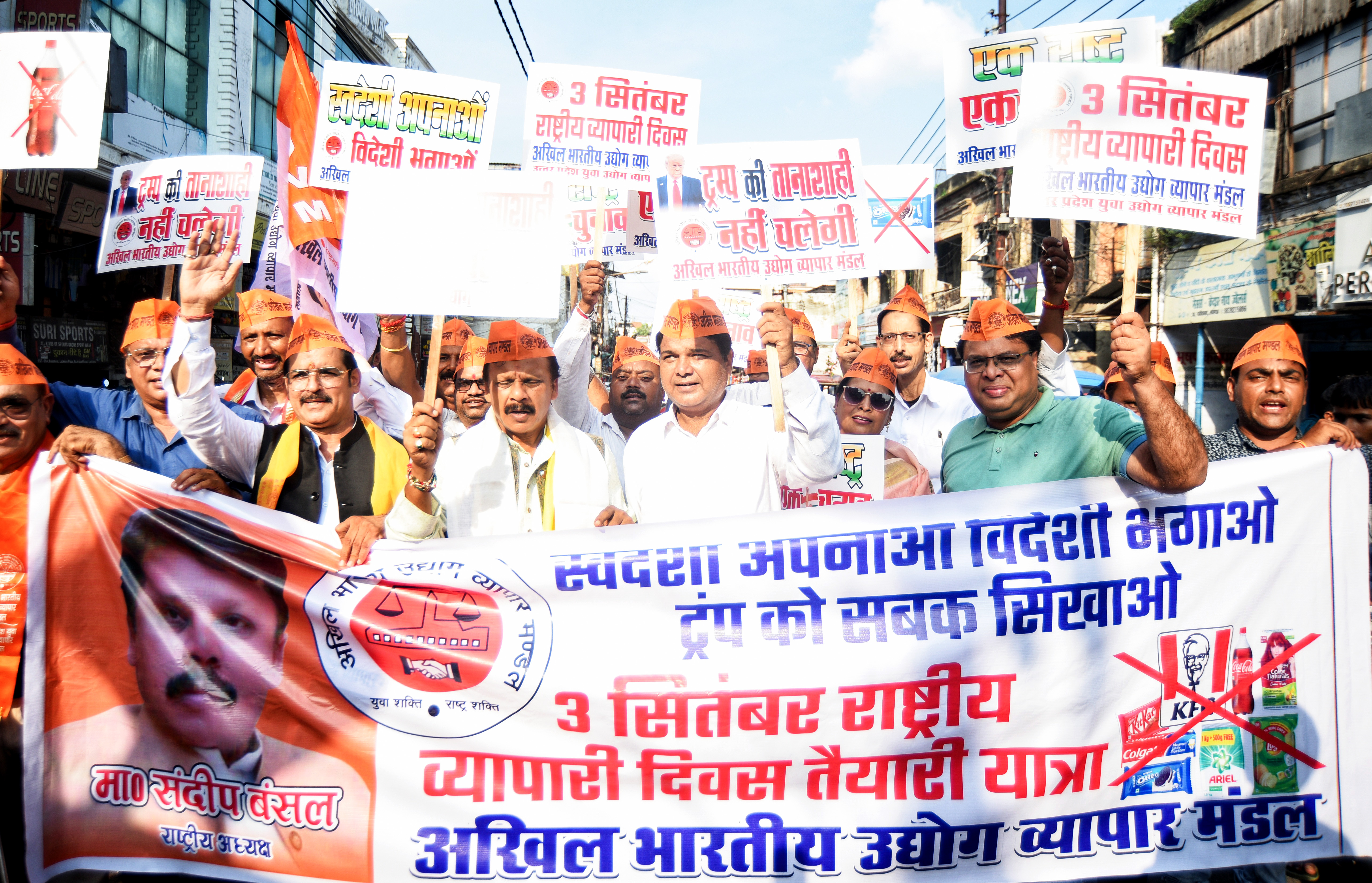
As the Commerce Ministry official summed up: “This is not 2019, when global trade wars slowed everyone down. Today, India’s fundamentals are stronger, and the economy is better positioned to absorb shocks. These tariffs are a challenge—but only in the short run.”Members of the Akhil Bharatiya Udyog Vyapar Mandal take out an awareness rally promoting the adoption of Swadeshi products in Lucknow on Wednesday in protest against the tariff imposed on India by U.S. President Donald Trump (ANI photo)