

Our Bureau
New Delhi
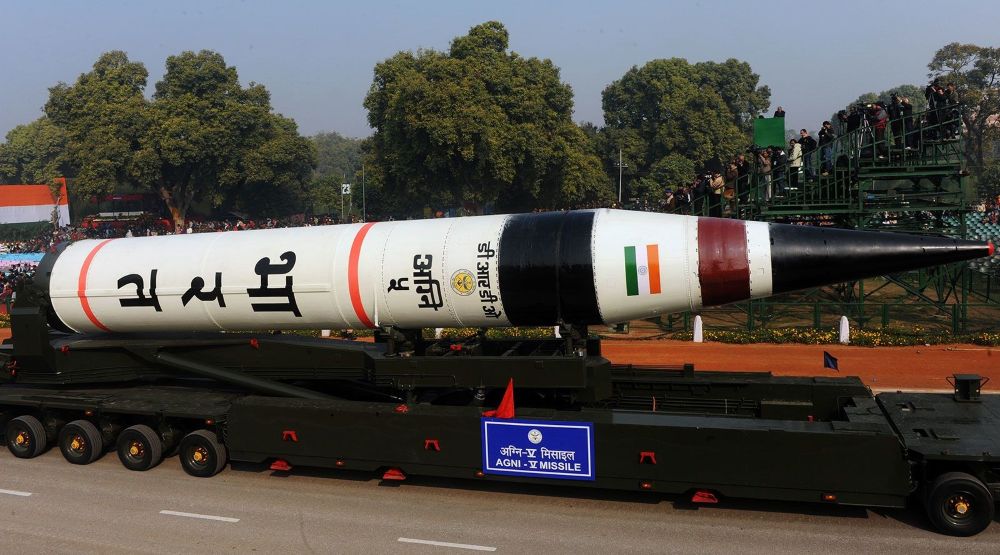
India recently announced it had successfully test-fired its nuclear-capable Agni-V missile from a test range in Odisha, marking a significant stride in its long-range missile programme. The test comes just days before Prime Minister Narendra Modi departs for Beijing to attend the Shanghai Cooperation Organisation (SCO) summit, underscoring its strategic timing.
Agni-V—meaning “fire” in Sanskrit—is among the fastest ballistic missiles in the world, capable of striking targets more than 5,000km away at hypersonic speeds of nearly 30,000km/h. The 17.5-metre-long, 50-tonne missile can deliver payloads of over 1,000kg, either conventional or nuclear, placing much of Asia, including China’s far north, within reach. This launch was the missile’s 10th test since 2012 and its first in nearly 18 months.
While Pakistan recently announced the formation of a new Army Rocket Force Command (ARFC), defence experts said the Agni-V test is less about South Asia and more about signalling strength to China. “Agni-V is designed for deterrence against China, not Pakistan,” said Manpreet Sethi of the Centre for Air Power Studies, noting that India’s long-range systems are dictated by its northern security concerns.
The strategic context is multilayered. India and Pakistan fought a four-day conflict in May, during which India acknowledged losing fighter jets but claimed success with its supersonic BrahMos cruise missiles. In response, Islamabad showcased its Fatah-4 cruise missile and strengthened its missile command. Yet, analysts maintain that India’s push for longer-range systems reflects ambitions beyond the subcontinent. “The primary mission is to hold Chinese economic centres on the east coast at risk,” said Christopher Clary of the University at Albany.
India is also developing the Agni-VI, expected to exceed 10,000km in range with multiple independently targetable reentry vehicles (MIRVs), a capability already demonstrated in Agni-V. Combined with India’s growing fleet of nuclear-powered submarines, these advances highlight a broader move toward global nuclear deterrence.
By contrast, Pakistan’s longest-range missile, the Shaheen-III, can reach just 2,750km, while its Ababeel—South Asia’s first MIRV-capable missile—remains regionally constrained. Western powers, however, view the two neighbours differently: Islamabad’s missile expansion has drawn U.S. warnings, while India’s tests are tacitly accepted as part of Washington’s Asia-Pacific balancing strategy.
As Modi prepares for his first trip to China since 2018, the Agni-V launch underscores India’s delicate balancing act—pursuing detente with Beijing amidst U.S. tariff pressure, while simultaneously strengthening the strategic arsenal aimed squarely at its northern neighbour.