

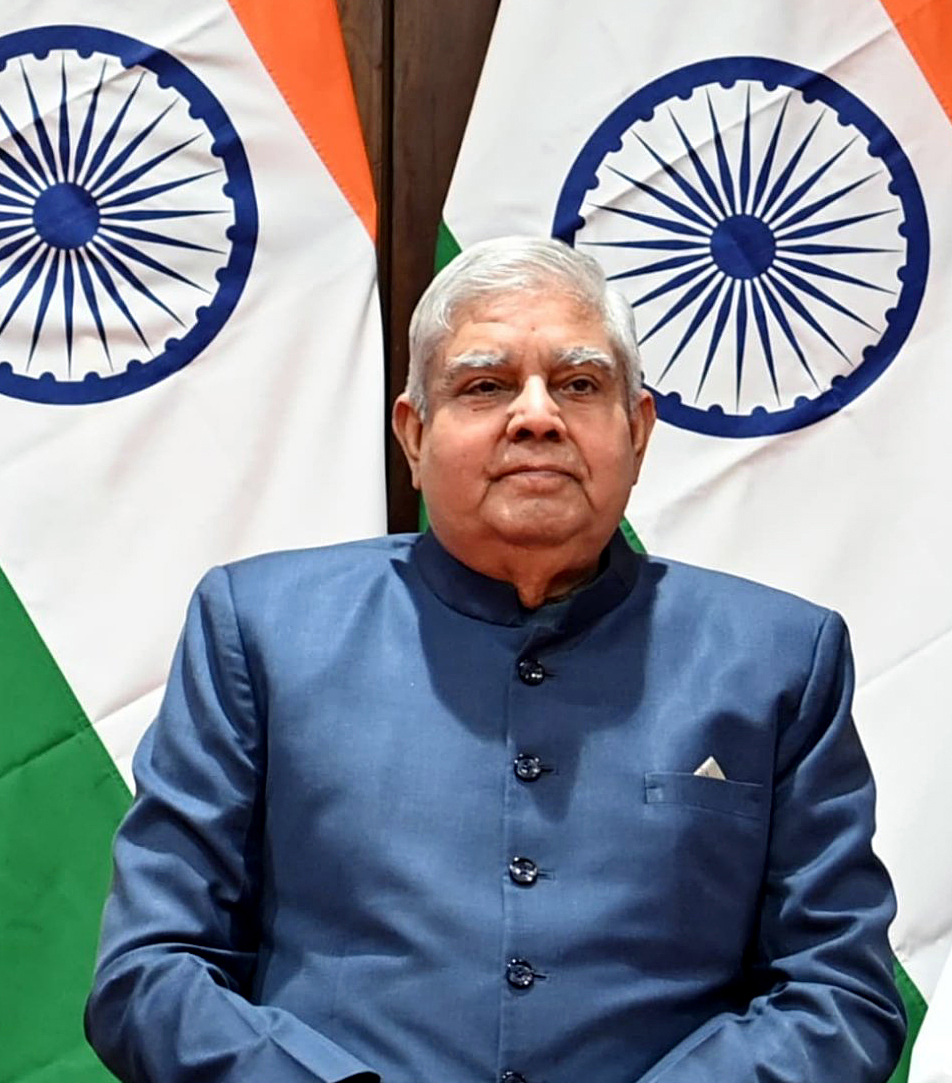
The sudden resignation of Vice President Jagdeep Dhankhar has triggered a political firestorm, with opposition leaders questioning the official narrative and accusing the ruling BJP of undermining constitutional processes
Our Bureau
New Delhi
The political corridors of Delhi are abuzz with speculation following the abrupt resignation of Vice President Jagdeep Dhankhar, who stepped down from his constitutional post last Monday evening citing health concerns. While his official letter to President Droupadi Murmu referenced “medical advice” and a desire to “prioritise health,” opposition parties allege that the real reasons lie deeper — and are being deliberately obscured.
The Congress, Aam Aadmi Party (AAP), Jharkhand Mukti Morcha (JMM), and Shiv Sena (UBT) have all demanded clarity, questioning both the timing and circumstances of Dhankhar’s exit. Some have gone as far as to suggest internal turmoil within the BJP or friction within Parliament as possible triggers.
“The sudden and mysterious manner in which the Vice President resigned leaves many questions unanswered,” said Congress leader Randeep Surjewala. “The BJP has a track record of weakening constitutional offices and processes. We demand that Prime Minister Modi come forward and explain the reasons to the people and to Parliament.”
In his letter, Dhankhar stated: “To prioritise health care and abide by medical advice, I hereby resign as the Vice President of India, effective immediately, in accordance with Article 67(a) of the Constitution.” Yet many opposition leaders are skeptical. AAP Delhi President Saurabh Bhardwaj called the resignation “unusual” and hinted at behind-the-scenes developments.
Bhardwaj also pointed to unresolved internal discussions within the BJP regarding party leadership, suggesting that Dhankhar’s resignation might be linked to broader political realignments. “There have been talks about changes in the party president’s post for months, and this resignation adds to the uncertainty,” he said.
Sources close to Parliament suggest that Dhankhar’s relationship with some senior BJP leaders had become strained in recent weeks. Congress MP Jairam Ramesh recounted events on the day of Dhankhar’s resignation, alleging that he was not informed in person about the absence of key BJP leaders from a critical Business Advisory Committee (BAC) meeting, which may have led to his decision to step down.
In a post on X, Ramesh wrote: “Yesterday, Shri Jagdeep Dhankhar chaired the Business Advisory Committee of the Rajya Sabha at 12:30 PM. It was attended by most members, including Leader of the House JP Nadda and Minister of Parliamentary Affairs Kiren Rijiju. The BAC reconvened at 4:30 PM, but both Nadda and Rijiju were absent and did not inform him directly. This may have been the final straw.”
Adding a new layer to the controversy, it has emerged that opposition parties had recently submitted a notice seeking Dhankhar’s removal as Vice President, citing partisan conduct in the Rajya Sabha. As Chairman of the Upper House, Dhankhar was accused of suppressing opposition voices and exhibiting favoritism towards the ruling NDA coalition.
Supriya Shrinate of the Congress noted, “The picture is not as clear as it is shown. There are layers to this resignation that will only become visible in the coming days. It is our responsibility to seek answers and ensure transparency in constitutional offices.”
Jagdeep Dhankhar’s tenure as Vice President was marked by firm control over parliamentary proceedings and frequent clashes with opposition MPs. While BJP leaders hailed his leadership for upholding decorum in the Rajya Sabha, critics labeled him as overtly partisan. Prior to serving as Vice President, Dhankhar was the Governor of West Bengal, where he had multiple run-ins with the state government led by Mamata Banerjee.
Despite his strong alignment with the BJP, Dhankhar occasionally voiced concerns on issues like judicial accountability, farmers’ welfare, and excessive political arrogance, which endeared him to some and alienated others.
JMM MP Mahua Maji said the timing of the resignation—just days before the expected conclusion of the Monsoon Session—was “shocking” and that Dhankhar could have waited. “There should have been transparency. Everyone is speculating now,” she said.
Shiv Sena MP Priyanka Chaturvedi emphasized the unprecedented nature of the resignation. “This is the first time in history that over 50 MPs signed a no-confidence motion against the Vice President. The government owes us and the people an explanation,” she told ANI.
So far, the BJP has remained largely silent. No senior party member has publicly addressed the circumstances leading to Dhankhar’s resignation. Observers believe the party is working behind the scenes to manage the fallout and ensure a smooth transition.
As per constitutional provisions, an election will now be held to fill the vacant post. The Vice President is elected by an electoral college composed of members from both Houses of Parliament through a proportional representation system.
Until then, speculation will continue to swirl. Was Dhankhar’s exit truly about health, or was it a symptom of a deeper political rift within the ruling establishment? Until the silence from the government is broken, political circles are likely to remain rife with speculation and conjecture.