








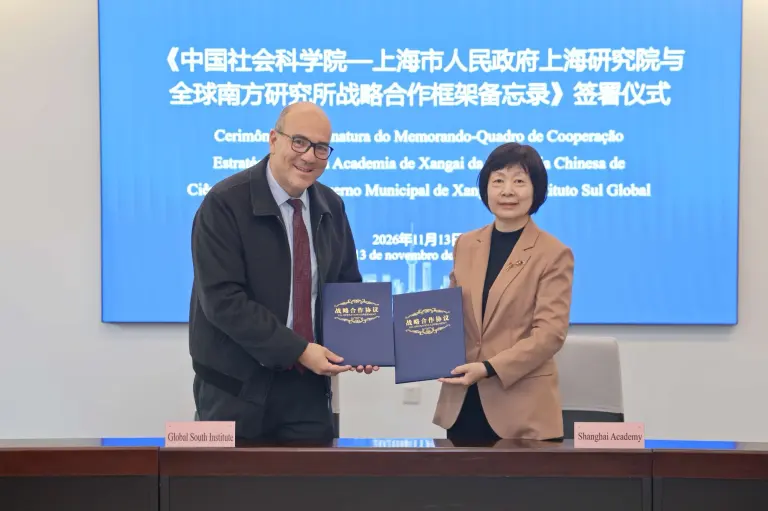
Partnership with think tank linked to the Chinese Academy of Social Sciences envisages joint research, international conferences and academic exchanges; agreement was signed by Leonardo Attuch and Wang Xiaoxia in Shanghai
The Global South Institute and the Shanghai Academy signed a cooperation agreement on Friday morning (13) in Shanghai, aimed at conducting joint research, organising international meetings and promoting exchanges between Brazilian and Chinese researchers. The document was signed by Leonardo Attuch, president of the Global South Institute, and Wang Xiaoxia, executive vice-president of the Shanghai Academy, one of China’s leading think tanks, affiliated with the Chinese Academy of Social Sciences (CASS).The partnership brings the newly established Brazilian institute closer to an institution that combines academic research with studies addressing the practical challenges of development and public administration. The Shanghai Academy operates at Shanghai University, on a campus with around 40,000 students, and counts Chinese modernisation, regional integration, the governance of large cities and the development of an open economy among its priorities.During the ceremony, Wang noted that although Brazil and China are geographically distant, they are partner countries whose peoples value friendship. The official recently visited Brazil, where she was received by a delegation from the Global South Institute. The signing continued this rapprochement and established an institutional foundation for developing joint activities.Attuch thanked the academy for its trust and said the agreement marked the beginning of a long-term friendship between the institutions. The expectation is to turn this relationship into a permanent agenda for intellectual and academic cooperation, with initiatives capable of expanding mutual understanding between Brazilians and Chinese.Research, meetings and academic trainingThe cooperation agreement establishes five areas of activity. The first involves conducting joint research, allowing the institutions to identify issues of common interest and bring researchers together around shared projects.The second provides for the joint organisation of international academic conferences and symposia, as well as participation in events organised by each of the parties. This area opens up opportunities for meetings between specialists, presentation of research and discussion of experiences from both countries.The agreement also provides for invitations to researchers to deliver lectures, in addition to the development of short- and long-term academic programmes. A fifth area allows for other academic activities considered appropriate, subject to agreement between the partners.The document thus creates a framework for sustained cooperation. The conditions for implementing each activity or programme will be discussed between the institutions and formalised in writing through supplementary agreements.An institution bringing research and public policy togetherFounded on June 5, 2015, the Shanghai Academy was established through an agreement between the Chinese Academy of Social Sciences and the Shanghai municipal government. According to its institutional presentation, it was conceived as a comprehensive think tank capable of combining CASS’s research capabilities with the practical experience of government agencies.This combination guides the production of knowledge aimed at addressing both academic questions and the challenges facing the country. The institution seeks to contribute to strategic debate and public policy formulation, with particular attention to Shanghai’s needs and China’s development process.Its four priority areas are Chinese modernisation; the integrated development of the Yangtze River Delta; social governance in megacities; and the development of an open economy. This agenda brings together economic, social, territorial and administrative issues that also offer opportunities for dialogue with the Brazilian reality.In addition to strategic research and the preparation of public policy recommendations, the Shanghai Academy works in talent development, the advancement of academic disciplines and international exchanges.Understanding development challengesThe rapprochement offers the Global South Institute an opportunity to establish dialogue with researchers who follow China’s economic and social transformations. At the same time, it creates a channel for presenting Brazilian studies, experiences and debates to Chinese counterparts.Topics such as planning, regional integration and the administration of large cities constitute potential areas for comparative research. Brazil and China have different trajectories but face challenges that can be examined through the exchange of knowledge, while respecting the particularities of each society.The cooperation could help identify common issues and develop studies that contribute to understanding both the achievements and the difficulties present in the development processes of the two countries. Specific projects will be jointly defined by the institutions.Building bridges between Brazil, China and the Global SouthFor the Global South Institute, the signing represents progress in its proposal to build a cooperation network involving research centres, universities and intellectuals from different countries, with a focus on South-South relations.The partnership is also connected to the history of engagement with China built by Brasil 247 and TV 247. With the institute, this relationship gains an additional dimension of research and academic exchange, opening up possibilities for knowledge produced to reach wider audiences.The agreement signed in Shanghai establishes the foundations for this new phase. Wang Xiaoxia’s recent visit to Brazil and Attuch’s presence in China reflect a willingness to strengthen ties that can now develop into shared projects.In thanking the Shanghai Academy for its trust, the president of the Global South Institute emphasised the long-term horizon of the relationship. The signing formalises this commitment and opens the way for a cooperation agenda based on friendship, the exchange of experiences and the joint production of knowledge.
Courtesy: Brasil 247