








Our Bureau
Bishkek
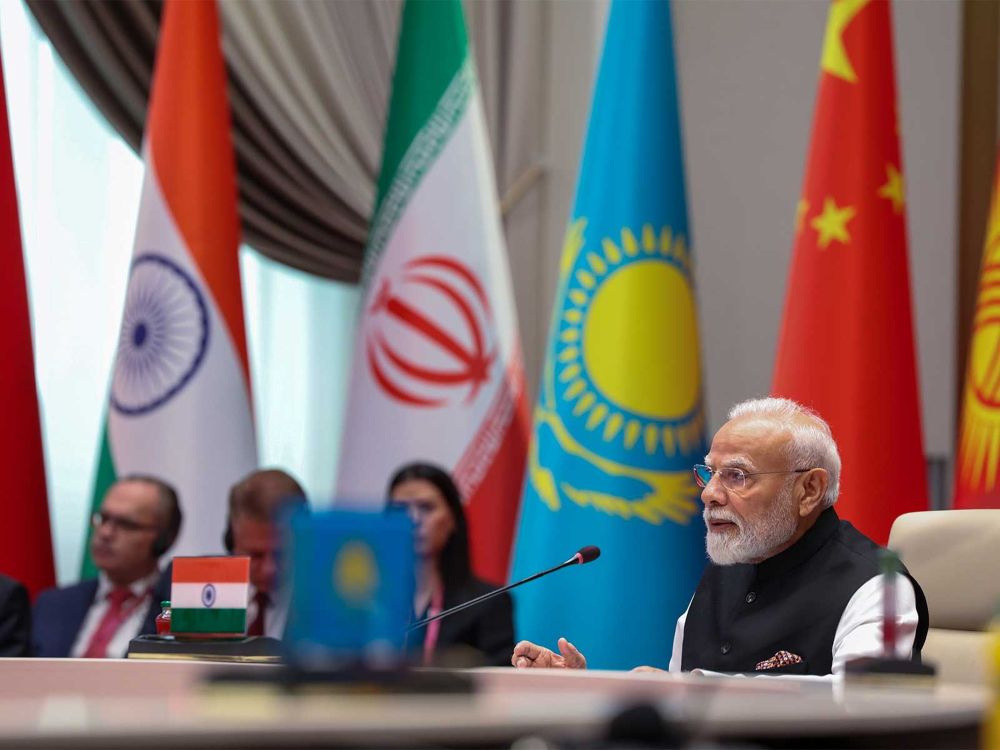
Addressing the 26th Shanghai Cooperation Organisation (SCO) Summit in Bishkek, Kyrgyzstan, Prime Minister Narendra Modi on Tuesday outlined 10 key measures to deepen regional cooperation, prioritising security, connectivity and economic opportunities, while pressing for a firm, collective response to terrorism.
Addressing the Summit of the organisation, which is marking its 25th anniversary, PM Modi urged member states to reinforce the SCO’s three core pillars of Security, Connectivity and Opportunity and to translate shared vision into concrete, measurable results.
The Prime Minister called for the complete dismantling of the terrorism ecosystem by striking at its financing networks, recruitment channels, radicalisation processes and safe havens.
He stressed the need for zero tolerance of any double standards in confronting the threat, further insisting that the organisation must send an unambiguous signal against state-supported terrorism, making clear that terrorism can never be treated as a strategic asset.
The Prime Minister advocated continued efforts to promote peace and stability in Afghanistan through sustained development assistance and humanitarian support for the Afghan people.
Conflicts, he said, should be resolved through dialogue and diplomacy rather than being allowed to escalate and disrupt global energy security, maritime trade and supply chains.
The Prime Minister also called for intensified regional action against drug trafficking, organised crime and other security challenges, underpinned by effective coordination and prompt use of existing SCO mechanisms.
On connectivity, PM Modi emphasised the need to build reliable and inclusive networks while fully respecting the sovereignty and territorial integrity of all countries, in accordance with the SCO Charter.
He urged the modernisation of trade and logistics links through simplified customs procedures, wider use of digital documentation and more efficient logistics systems.
People-to-people ties, he said, must be placed at the heart of SCO cooperation, with particular attention to youth, entrepreneurs and farmers so that the organisation’s work delivers tangible benefits for citizens.
Finally, the Prime Minister called for an expansion of youth, scientific, entrepreneurial and civilisational exchanges, pointing to initiatives such as the SCO Start-up Forum, Young Authors’ Conclave and Young Scientists’ Forum.
He also proposed the establishment of an SCO Civilizational Dialogue Forum, with its first session to be hosted by India.
The summit brings together member states to address major regional challenges, with Kyrgyzstan President Sadyr Japarov hosting the gathering as chairman alongside leaders including Chinese President Xi Jinping, Russian President Vladimir Putin, Pakistan Prime Minister Shehbaz Sharif, Iranian President Masoud Pezeshkian, Belarusian President Alexander Lukashenko, Kazakhstan President Kassym-Jomart Tokayev, Uzbek President Shavkat Mirziyoyev and Tajik President Emomali Rahmon.
Against this multilateral backdrop, Prime Minister Narendra Modi on Tuesday conveyed strong optimism that his high-level diplomatic engagements on the sidelines of the summit will deliver concrete advantages for India.
Reflecting on what he termed a fruitful visit of the Kyrgyz Republic, PM Modi extended his appreciation to President Sadyr Zhaparov alongside the local populace for their exceptional hospitality.
“Here are highlights from a productive visit to the Kyrgyz Republic. The various meetings on the sidelines of SCO Summit will lead to substantive benefits for India. At the same time, shared a roadmap for the time ahead as the SCO plans for the next 25 years. Also had a delightful interaction with people from the Kyrgyz Republic who are associated with India and paid homage to Mahatma Gandhi Ji in Bishkek. I thank the people, Government and President Zhaparov for their warmth and affection,” PM Modi shared on X.
The SCO grouping currently encompasses 10 full member nations, namely Belarus, India, Iran, Kazakhstan, China, Kyrgyzstan, Pakistan, Russia, Tajikistan and Uzbekistan, alongside two observer states and 15 dialogue partners.