








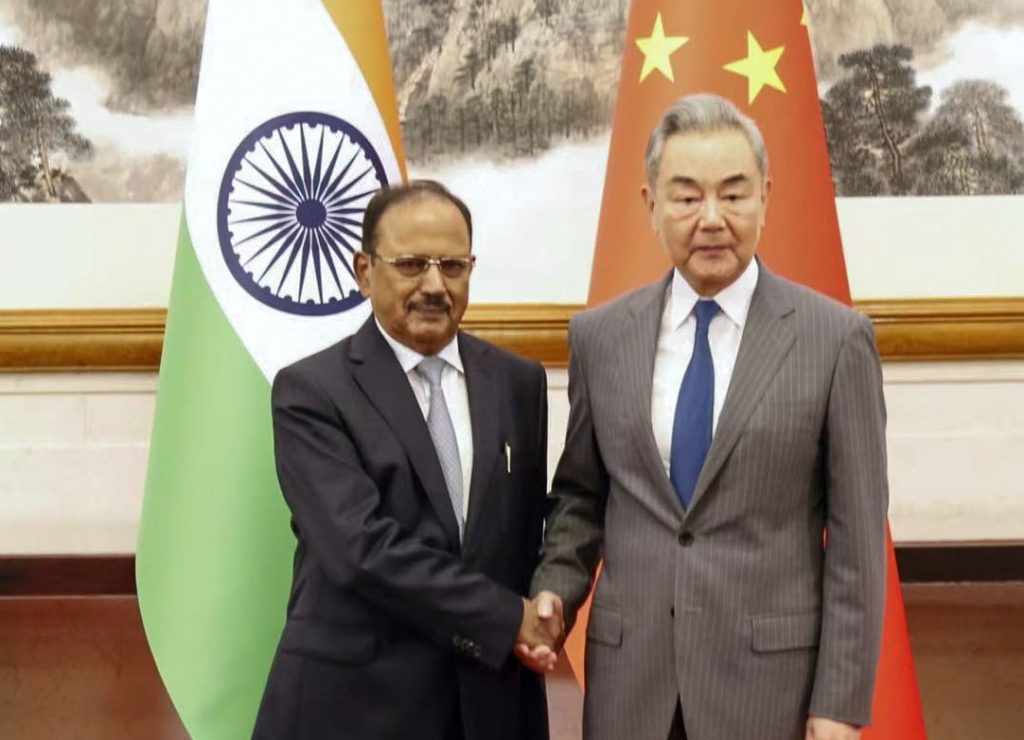
As India and China cautiously rebuild ties after the Ladakh crisis, the upcoming visit of Xi Jinping to New Delhi for the BRICS summit could mark an important test of whether their thaw can move from border management to a broader strategic reset
Ashish K Singh
India-China relations are entering a delicate but consequential phase. The 25th round of Special Representatives’ talks in Beijing, led by National Security Adviser Ajit Doval and Chinese Foreign Minister Wang Yi, has reinforced a message that would have seemed difficult to imagine a few years ago: New Delhi and Beijing are again trying to normalise a relationship damaged by the 2020 military confrontation along the Line of Actual Control.
But this is not reconciliation. It is strategic realism.
The two countries have agreed to continue working towards a political settlement of the boundary question, while expanding people-to-people exchanges, border trade and the Kailash Mansarovar Yatra. They have also agreed to hold the next round of boundary talks in India. Reuters reported that both sides reaffirmed their commitment to border peace and better communication mechanisms.
The border remains the central test.
India cannot build a durable relationship with China while treating the unresolved boundary as a secondary issue. The lesson of 2020 is precisely that economic engagement and political dialogue cannot compensate for military distrust. Peace and tranquillity along the border are therefore not merely confidence-building measures; they are the foundation on which every other aspect of the relationship must rest.
This is where Doval’s talks acquire significance. India is not asking China to abandon its territorial claims, nor is Beijing abandoning its positions. The immediate objective is more practical: prevent another confrontation, stabilise the frontier and create enough political space for the two sides to address their differences.
That distinction matters. The India-China relationship does not require the two countries to become friends. It requires them to become predictable rivals capable of managing competition.
The possible visit of Chinese President Xi Jinping to India for the BRICS summit in September could become the next major test. Xi’s visit, if confirmed, would be his first to India in seven years. Prime Minister Narendra Modi had invited Xi to the 2026 BRICS summit during their 2025 meeting in Tianjin, where both leaders stressed that differences should not become disputes.
The symbolism will be considerable. A Xi visit to New Delhi would demonstrate that the relationship has moved beyond the immediate post-Galwan freeze. More importantly, BRICS gives both leaders a setting in which bilateral tensions can be discussed alongside a larger conversation about the emerging multipolar order.
For India, this is particularly important at a time when its relationship with the United States is becoming more complicated.
Washington remains a critical strategic and economic partner, but the relationship is no longer free of friction. Trade negotiations, tariffs and disagreements over India’s economic and strategic choices have introduced new uncertainties. The US administration’s Section 301 measures in July imposed an additional 10 per cent duty on Indian imports linked to its forced-labour investigation.
India therefore has little interest in allowing its foreign policy to become dependent on any single major power.
China, too, has reasons to engage. Beijing faces a difficult international environment, including continuing strategic competition with Washington.
The economic relationship makes disengagement even less realistic. India’s official data show bilateral goods trade reached about $151.1 billion in FY2025-26, although the Indian deficit stood at more than $112 billion. The relationship is therefore economically significant but structurally unbalanced.
This is where the Pakistan factor enters the equation.
For India, improved relations with China could reduce one of Pakistan’s most important strategic advantages: the ability to exploit simultaneous pressure on India’s western and northern fronts. China will remain Pakistan’s close strategic partner, and there is no reason to expect Beijing-Islamabad ties to disappear. But a less confrontational China-India relationship can reduce the possibility of a two-front security crisis for India.
The coming months will therefore test whether the India-China thaw is tactical or genuinely structural.
India is not lowering its guard. It is trying to create stability without surrendering its interests. China is doing something similar.
For India, the larger calculation is clear. A strong relationship with the US is valuable. Strong ties with Russia remain important. But strategic autonomy becomes meaningful only when India can maintain working relationships with competing centres of power simultaneously.
The India-China thaw is therefore not a retreat from India’s global partnerships. It is an assertion of India’s independent strategic space.
And the border remains the price of admission.